
Ever hear a faint sound of running water when all the taps are off? Or maybe you opened your water bill and were shocked by how much it jumped? These aren’t just little household quirks; they could be the first signs of a slab leak—a sneaky leak in the water lines buried directly under your home’s concrete foundation. Trust me, this is one of those problems you don’t want to ignore.
What a Slab Leak Means for Your Home
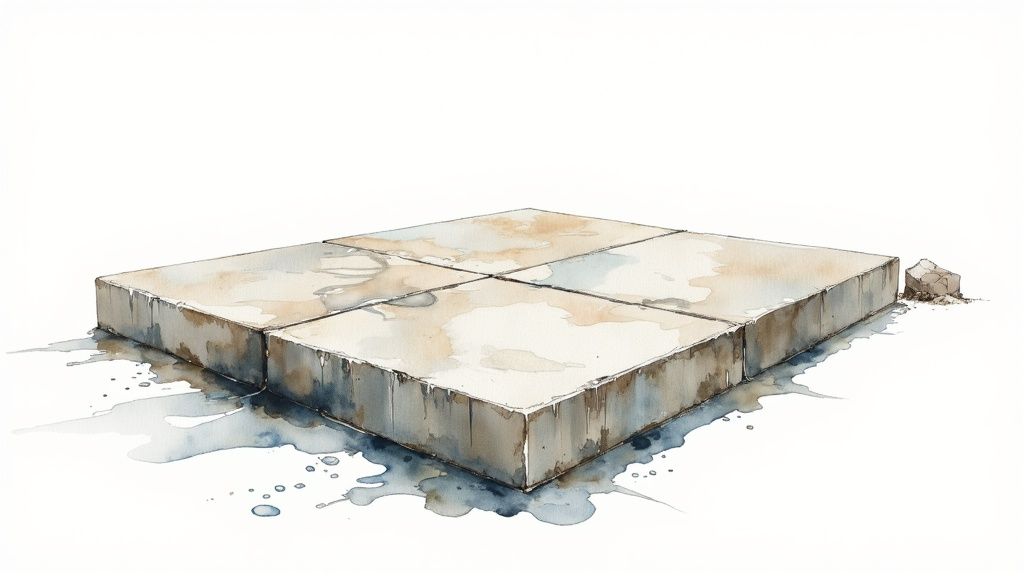
A slab leak isn’t your average drip under the sink. Its location is what makes it so uniquely destructive. Before your home’s foundation was ever poured, plumbers laid the pipes for hot and cold water. When one of those pipes starts to leak, water escapes into the soil right beneath your house. Out of sight, but definitely not out of mind.
Common Causes and Unseen Dangers
So, what causes these pipes to fail? It’s rarely one single thing. In older homes, the pipes themselves can simply wear out from decades of use, corroding from the inside. Sometimes, the water pressure is just too high, constantly straining the system until a weak spot gives way. Shifting soil, a very common issue in many areas, can also put immense pressure on pipes, causing them to bend, crimp, or crack over time.
The real trouble with a slab leak goes way beyond a high water bill. That constant, hidden moisture can wreak havoc on your property.
- Foundation Damage: As water saturates the soil under your home, it can cause the ground to expand or wash away. This can lead to serious cracks in your foundation, threatening your home’s entire structural integrity.
- Flooring Ruin: Moisture has a way of finding its way up. It can seep through the concrete, warping beautiful hardwood floors, causing tiles to come loose, or creating musty, damp patches on your carpet that never seem to dry.
- Hidden Mold Growth: The dark, damp environment under your floor is the perfect breeding ground for mold and mildew. This isn’t just an ugly stain; it can introduce serious health risks for your family.
Understanding these risks is why catching a slab leak early is so incredibly important. Spotting it soon can mean the difference between a manageable repair and a full-blown nightmare involving foundation contractors and major home restoration. To get a better handle on water issues in general, this comprehensive guide on general water leaks is a great resource.
The demand for leak detection services is on the rise, which tells you just how common this issue is. The global market for these services was valued at around $783 million in 2025 and is expected to grow as more homes with aging plumbing face these problems. Homeowners are rightly concerned about protecting their biggest investment.
Your best defense is being proactive. Following a good https://professional-plumbers-denver.com/blogs/plumbing-maintenance-checklist/ can help you notice small changes before they spiral out of control.
Spotting the Telltale Signs of a Slab Leak
A slab leak rarely bursts onto the scene with a sudden geyser in your living room. It’s much more subtle than that. The real art of slab leaks detection is learning to recognize the quiet, often-ignored clues your home sends out long before disaster strikes. Catching these early whispers can mean the difference between a straightforward repair and a catastrophic foundation problem.
One of the first things I tell homeowners to watch for is a sudden, unexplained jump in their water bill. If you haven’t been filling a swimming pool or watering a new lawn, but your bill shoots up by 20%, 30%, or more, that’s a massive red flag. That isn’t just a billing error; it’s often the first tangible proof that water is escaping somewhere you can’t see it—possibly right under your feet.
Listen to Your Home
Sometimes, the best detection tool you have is a good pair of ears. Try this tonight: wait until the house is completely quiet. The dishwasher is off, the washing machine is done, and no one is taking a shower. Now, listen. Do you hear a faint hissing or the sound of running water?
It’s easy to dismiss that sound as the ice maker or the house settling. But if it’s persistent, it could be the sound of pressurized water escaping a pipe buried in the concrete. I’ve been in countless homes where this phantom noise was the only clue something was wrong. It’s your plumbing system literally crying out for help.
Feel for Physical Clues
Your floors can tell you a lot, too. One of the most classic giveaways, especially when a hot water line is the culprit, is a random warm spot on the floor. If you’re walking barefoot and come across a section of tile, vinyl, or wood that feels noticeably warmer than the area around it, you might be standing right on top of the leak.
My Advice: Don’t just stumble upon it by accident. Be proactive. Take a walk along the known paths of your hot water lines—from the water heater to your kitchen, bathrooms, and laundry room. Any unexpected warmth underfoot is a strong signal that you need to investigate further, and quickly.
Dampness is another critical clue that’s impossible to ignore once you spot it. Be on the lookout for:
- Damp Carpets: Patches of carpet that feel soggy or just never seem to dry out completely.
- Warped Floors: Hardwood planks that are starting to cup, buckle, or separate at the seams.
- Loose Tiles: Floor tiles that have become wobbly or have crumbling grout around them.
These are all direct consequences of moisture wicking its way up through the concrete slab. You can see a more complete rundown by checking out our guide to common slab leak symptoms.
Slab leaks can be sneaky, so having a quick reference can make all the difference. Use this checklist to see if your home is showing any of the common signs.
Slab Leak Symptom Checklist
| Symptom Category | Specific Sign to Look For | What It Could Mean |
|---|---|---|
| Auditory | Faint sound of running or hissing water when all taps are off. | A pressurized pipe is actively leaking beneath the slab. |
| Physical (Floor) | An unusually warm spot on a tile, wood, or concrete floor. | A hot water line has a break or pinhole leak. |
| Physical (Floor) | Damp carpets, warped flooring, or loose tiles. | Water is seeping up through the foundation. |
| Structural | New cracks appearing in interior walls or the foundation itself. | Soil saturation is causing the foundation to shift. |
| Sensory (Smell) | A persistent musty or mildew-like odor with no clear source. | Mold and mildew are growing in the damp, dark space under your floor. |
| Billing | A sudden, significant, and unexplained increase in your water bill. | Water is being lost 24/7 through an undetected leak. |
Seeing even one of these signs doesn’t automatically mean you have a slab leak, but seeing two or more is a strong indication that you should take action.
Look for Structural and Sensory Signs
A long-term leak can do more than just make your floors wet. As water saturates the soil beneath your home, it can cause the ground to shift and heave, putting immense stress on your foundation. This stress often appears as new cracks in your drywall or along the exterior of your foundation. These aren’t just cosmetic blemishes; they’re evidence of a serious structural issue in the making.
Finally, trust your nose. That persistent, musty smell you can’t seem to air out? It’s not your imagination. That’s the unmistakable odor of mold and mildew, and it thrives in the dark, damp environment created by a constant leak. Paying attention to what you see, hear, feel, and smell is the absolute best first step you can take to protect your home.
DIY Inspection Tests You Can Do This Weekend
So, you suspect a slab leak but aren’t quite ready to call in a professional. Good news—there are a couple of solid tests you can run yourself to get a better handle on the situation. Think of this as your initial fact-finding mission. It helps you confirm there’s an active leak before you bring in the experts for more advanced slab leaks detection.
The Definitive Water Meter Test
The single best way for a homeowner to confirm a leak is by checking the water meter. It’s a surprisingly straightforward process that gives you a clear yes or no answer.
First things first: you have to make sure every single drop of water on your property is turned off. This is non-negotiable for an accurate test.
- Shut off every faucet, indoors and out.
- Double-check that the dishwasher and washing machine are completely off.
- Listen to your toilets. Make sure they aren’t running and have finished filling.
- Don’t forget to turn off any automatic sprinkler or drip irrigation systems.
With everything shut down, head out to your water meter. It’s usually housed in a concrete box near the street with a lid marked “Water.” You might need a screwdriver or a pair of pliers to help lift the heavy cover.
Inside, you’ll see the meter’s face. Look for a small, often red or black, triangle or star-shaped dial. This is the low-flow indicator. If that little dial is spinning, even just a tiny bit, you’ve got a leak somewhere. It’s picking up water movement that’s too subtle for the main sweep hand to register.
If the indicator is still, don’t pack it in just yet. Snap a quick photo of the meter’s reading or jot down the numbers. Now, wait. Give it at least 30 minutes, but an hour is even better. During this time, it’s critical that nobody uses any water. Go back, check the meter again. If those numbers have ticked up at all, you’ve confirmed it.
A Plumber’s Perspective: The water meter test is the gold standard for homeowners. While it won’t tell you where the leak is, it gives you undeniable proof that water is escaping somewhere. A moving meter when all your water is off is the smoking gun.
What to Look for on a Visual Walk-Around
While the meter test proves a leak exists, a careful walk around your property can offer some great clues about its general location.
Put on your boots and take a slow lap around your home’s foundation. What you’re searching for is anything that looks out of place. Do you see a patch of soil that’s always damp, or even muddy, when everything else is bone dry? Have you noticed a spot where the grass or weeds are suspiciously green and lush compared to the surrounding area? That could be a sign that a broken pipe is giving them a private, round-the-clock watering.
This is a great visual guide to the kinds of signs you should be looking for.
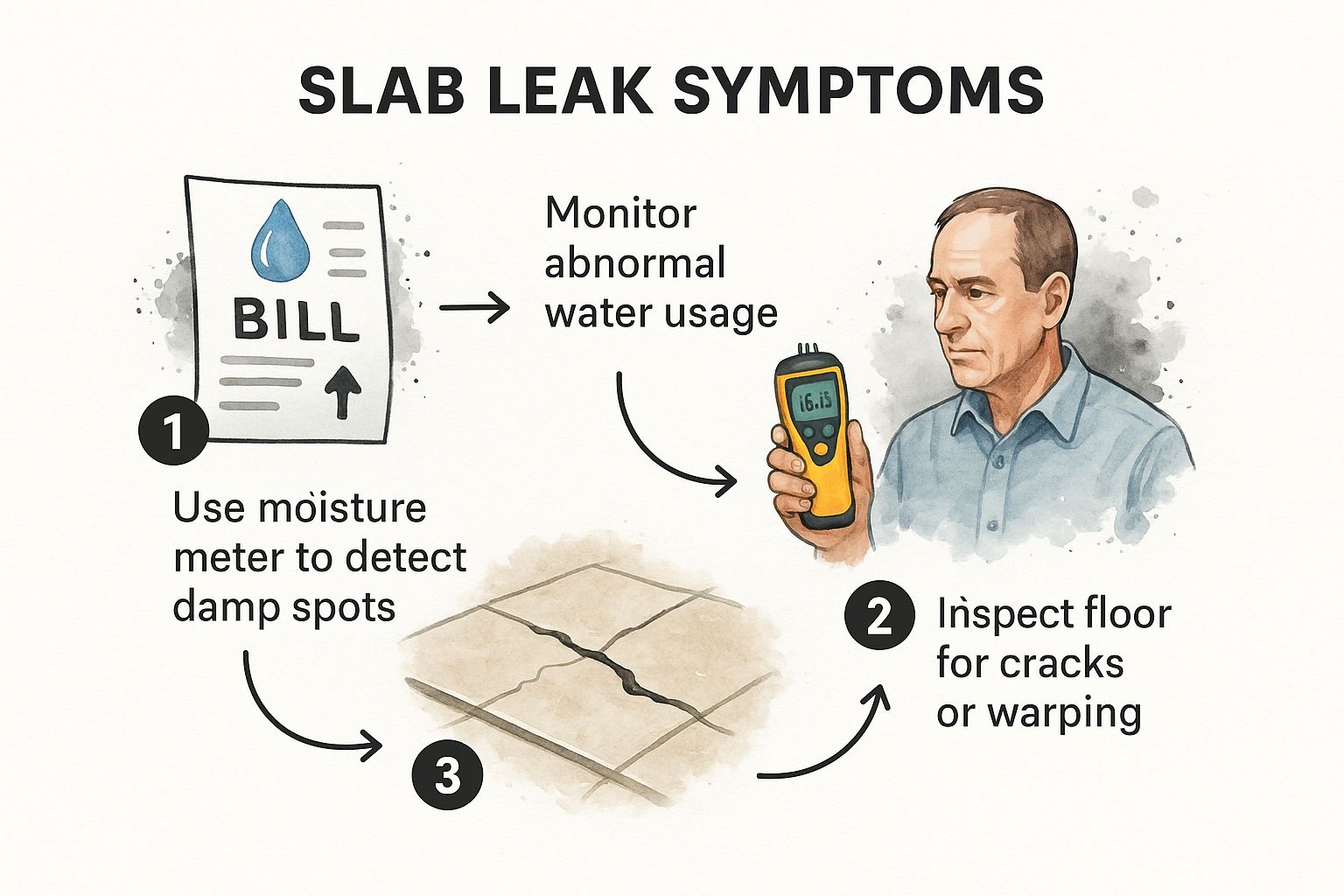
These DIY checks are incredibly useful for turning a gut feeling into hard evidence. Having this information in hand makes the decision to call a professional much clearer. Just remember, these tests are for confirmation; they aren’t designed to pinpoint the exact location under your foundation. That’s a job for specialized equipment.
How the Pros Find the Exact Spot of a Hidden Leak

So, your own tests suggest you’ve got a leak under the slab. Now what? This is the point where you really need to bring in a professional with the right gear. Trying to find a tiny pipe break under six inches of concrete isn’t a guessing game. It requires specialized equipment to avoid turning your living room into a demolition site.
We use non-invasive methods that let us “see” and “hear” through the concrete without having to pick up a jackhammer first. Think of it like a doctor using an X-ray or a stethoscope. This approach saves a massive amount of time, money, and stress.
Listening for Clues with Acoustic Gear
One of the go-to tools in our truck is an acoustic listening device. It’s essentially an incredibly sensitive, industrial-strength microphone built for one job: hearing water escape from a pipe.
When water is forced out of a pressurized pipe, it creates a unique sound—sometimes it’s a very faint hiss, other times it’s more of a “whoosh.” You’d never hear it on your own, but these acoustic amplifiers can pick up the subtle vibrations through the concrete.
A good technician will methodically sweep the floor, listening intently. As they get closer to the break, the sound gets louder. This lets us zero in on the leak, whether it’s in a hot or cold water line.
Expert Insight: The success of acoustic detection really comes down to the technician’s ear. An experienced pro can tell the difference between a leak and background noise from an appliance or even traffic outside. That experience is what ensures we’re marking the right spot.
Using Heat to See Hot Water Leaks
If we suspect the leak is in a hot water line, we have another trick up our sleeve: thermal imaging cameras. These cameras don’t see water, but they’re brilliant at detecting tiny differences in temperature across a surface.
A leaking hot water pipe warms the concrete and the flooring directly above it. When we scan the floor with a thermal camera, these warm spots show up as bright red or yellow plumes against the cooler blue and green of the surrounding floor. It gives us a clear visual map to the leak, often pinpointing it down to a few inches.
Following the Scent with Tracer Gas
For those really stubborn leaks—the tiny, hard-to-find ones—we can turn to tracer gas detection. It’s a precise and completely safe method.
Here’s how it works:
- First, we isolate the pipe we think is leaking and drain all the water out.
- Then, we pressurize the empty pipe with a harmless, non-toxic gas, usually a hydrogen/nitrogen blend.
- The gas is lighter than water and under pressure, so it will find even the smallest pinhole to escape through, rising up through the slab and flooring.
- We use a highly sensitive “gas sniffer” to scan the floor. The spot where we get the strongest reading is right above the leak.
Another tool we sometimes use is a specialized dye. The global market for leak detection dyes is valued at an estimated $902.5 million in 2025, which shows just how important these visual aids are in plumbing and other industries. We can add these eco-friendly dyes to the system, and where they appear confirms the leak’s location. To see just how widely these are used, check out this detailed report on leak detection dyes.
When to Hand It Over to a Professional
While the DIY tests we’ve covered are fantastic for confirming you have a problem, the most critical part of slab leak detection is knowing your own limits. Recognizing that moment to step back and call in a licensed plumber can be the difference between a manageable repair and a full-blown household catastrophe. The real goal isn’t just finding a leak—it’s protecting your home’s structural integrity and value.
Some signs are an immediate red flag, telling you it’s time to pick up the phone. For instance, if you’ve shut off the main water valve to your house and the water meter is still spinning, that’s a dead giveaway. It means the leak is somewhere between the meter and your home, very likely under the slab. This is no longer a DIY situation.
Likewise, if you’re seeing visible cracks forming in your foundation or significant, unexplained water damage appearing on your floors, your diagnostic work is done. These aren’t just subtle clues anymore; they are clear evidence that your home’s structure is already being compromised.
The High Stakes of a DIY Approach
Trying to pinpoint—or worse, repair—a slab leak on your own is a gamble, and the odds are not in your favor. Without professional equipment, finding the exact location of the leak is pure guesswork.
Imagine breaking up the wrong section of your foundation based on a hunch. You could easily turn what would have been a precise, targeted repair into a massive, expensive construction project.
The risks go beyond just making a bigger mess:
- Compromising Your Foundation: An amateur attempt at breaking concrete can weaken the entire slab, creating entirely new structural problems that are far more serious than the original leak.
- Creating More Plumbing Damage: It’s surprisingly easy to accidentally damage other pipes running nearby, turning one leak into several.
- Voiding Your Insurance Coverage: Many homeowner’s insurance policies have a fine-print clause requiring that major repairs be handled by licensed professionals. A DIY attempt could get your claim denied.
Key Takeaway: The moment your water meter test confirms a leak or you see physical damage like cracks and warping floors, your job as the homeowner investigator is over. It’s time to shift gears into the role of project manager and bring in an expert.
Trusting the Professional Process
Hiring a professional isn’t giving up; it’s making a smart, strategic decision to protect your biggest investment. These experts don’t just show up with a bigger wrench. They use advanced technology that has become a massive industry in its own right. The global water leak detection systems market was valued at $5.63 billion in 2025 and is projected to keep growing, all driven by the need to prevent this kind of costly damage.
A seasoned plumber will arrive with tools like acoustic listeners and thermal imaging cameras to find the leak with surgical precision, minimizing the damage to your home. This level of expertise is invaluable, and you can learn more about why hiring a professional plumber is so important for these kinds of complex jobs.
Understanding how these businesses operate, including how they generate leads for home service companies, can also give you insight into the industry. Ultimately, a pro’s experience ensures the problem is diagnosed correctly the first time and repaired with the least possible disruption to your home and your life.
Common Questions About Slab Leaks
When you’re dealing with a potential slab leak, your mind is probably racing with questions about what comes next. It’s a stressful situation, no doubt. But getting a handle on the costs, insurance details, and what the repair process actually looks like can make a world of difference.
Let’s walk through some of the most common questions I hear from homeowners.
How Much Does Professional Detection Cost?
This is usually the first thing people ask, and for good reason. Professional slab leak detection isn’t a simple visual check; it’s a highly skilled service that uses some pretty advanced tools.
You can typically expect the initial detection service to fall somewhere in the $150 to $400 range. This fee covers the plumber’s expertise and the use of their specialized equipment—like sensitive acoustic listeners or thermal imaging cameras—to find the precise source of the trouble. Keep in mind, this price is just for finding the leak, not for the repair itself.
Will My Homeowners Insurance Cover This?
Insurance and slab leaks can be a tricky combination. In my experience, most standard homeowners policies will step in to cover the secondary damage. This means they’ll help pay for things like tearing out and replacing waterlogged flooring, drywall, and cabinetry.
What they often do not cover is the cost of repairing the actual broken pipe. Insurers usually classify a worn-out or corroded pipe as a maintenance issue, which falls outside the scope of most policies.
My advice? Call your insurance agent the moment you suspect a slab leak. Take pictures of everything and keep a log of all communications. You need to know exactly what your policy says before you authorize any major work.
How Long Does the Detection Process Take?
The good news is that finding the leak is usually the quickest part of the whole ordeal. Once an experienced plumber is on-site with the right gear, they can often pinpoint the leak’s location within one to three hours.
Their tools take the guesswork out of the equation, which is a huge relief. This speed allows them to give you a clear, accurate estimate for repairs much faster, helping to stop further water damage in its tracks.
What Are My Repair Options?
After we’ve found the leak, we’ll talk through the best way to fix it. The right approach really depends on where the leak is, how bad it is, and the overall condition of your pipes.
Here are the typical paths we might consider:
- Spot Repair: This is the most direct fix. If you have a single, isolated leak and the rest of the pipe is in solid shape, we’ll open up a small, targeted area of the slab to patch that one spot.
- Pipe Rerouting: Sometimes, a pipe is in a really tough spot or is so corroded that a simple patch won’t last. In these cases, it’s often better to cap off the old line and run a new pipe through the attic or walls, bypassing the slab entirely. It’s a fantastic long-term solution.
- Repiping: If we find that your entire plumbing system is old, brittle, and likely to spring more leaks, the most responsible recommendation might be to replace all the pipes running under the foundation. It’s a bigger job, but it prevents you from having to do this all over again in a year or two.
Each of these options has different costs and involves a different level of disruption to your home, and we’ll go over all the pros and cons together.
If you’re in the Denver area and these questions are on your mind, Professional Plumber Denver can give you the clear answers and expert help you need. We specialize in precise slab leak detection and offer transparent repair options to safeguard your home. Don’t let the problem get worse—contact us 24/7 for a professional assessment.