
Think of an anode rod as the unsung hero of your water heater. It’s a simple metal rod with one crucial job: to act as a sacrificial bodyguard for your water heater’s tank. This single part is designed to slowly dissolve over time, deliberately taking the hit from corrosion so the expensive steel tank doesn’t have to.
The Hidden Guardian of Your Water Heater
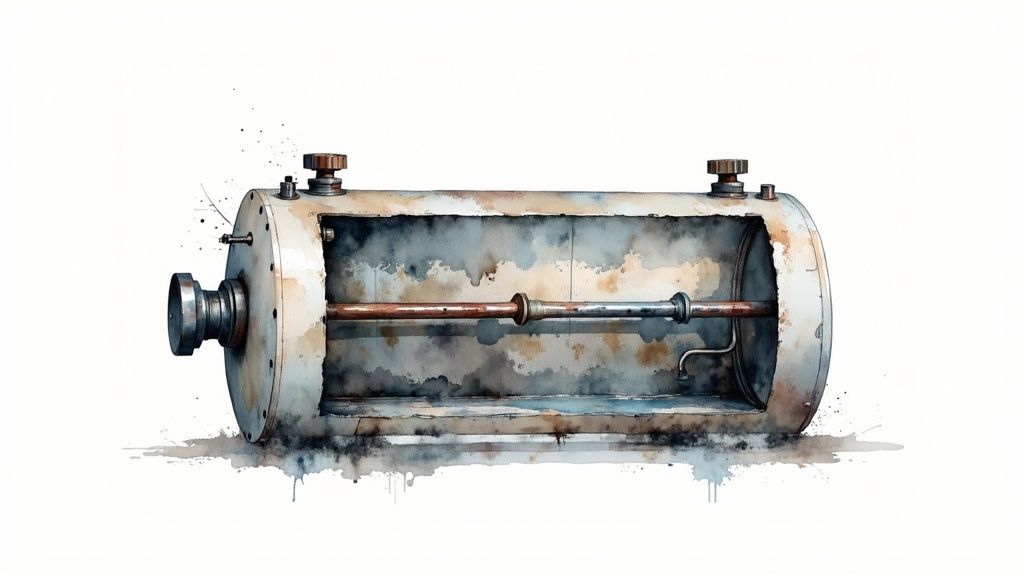
Deep inside your water heater, a silent battle against rust is constantly being waged. The water in your home contains minerals and elements that are naturally corrosive to steel. Day in and day out, these elements are trying to eat away at the inner walls of your tank.
Without a defense, your water heater’s life would be cut dramatically short, ending in a messy leak and a costly replacement. This is where the humble anode rod steps in.
It works like a decoy. The rod is built from a metal that is more chemically reactive than the steel of the tank. This clever bit of chemistry creates an electrochemical process where all the corrosive action is drawn to the rod, leaving the tank unharmed. It literally sacrifices itself to save the appliance.
What Is an Anode Rod and Why Does It Matter?
An anode rod is an essential part of any modern tank-style water heater. Its entire purpose is to prevent the steel tank from rusting out through a process known as galvanic corrosion. These rods are usually made from magnesium, aluminum, or a zinc-aluminum alloy. Because the rod is made of a more “attractive” metal for corrosion, it gets eaten away first.
Most standard water heaters have one, though some larger capacity tanks may be equipped with two. Its job is to be destroyed so that your much more expensive water heater survives. This simple piece of engineering is the main reason a water heater can last 10 years or more. For a deeper dive into how they work, you can find great information by understanding water heater anode rods on kingheating.com.
To help summarize its role, here’s a quick overview of what you need to know.
Anode Rod Quick Facts
| Key Aspect | Description |
|---|---|
| Primary Function | Acts as a sacrificial component to prevent the steel tank from rusting. |
| Core Science | Utilizes galvanic corrosion, where the more active metal (anode) corrodes first. |
| Common Materials | Magnesium, Aluminum, or a Zinc-Aluminum alloy. |
| Result of Failure | If the rod depletes, the tank itself begins to corrode, leading to leaks and failure. |
Ultimately, understanding the anode rod’s function is the first step toward smart home maintenance.
Key Takeaway: The anode rod is the single most important component for preventing internal rust and extending the functional life of your tank-style water heater. Neglecting it is the fastest way to a premature and expensive failure.
By recognizing its importance, you can be proactive about checking and replacing it. This small bit of maintenance is key to keeping your water heater running efficiently and reliably for years to come.
How a Simple Rod Prevents Your Tank from Rusting
It seems almost impossible, doesn’t it? The idea that one simple metal rod can stop a 40-gallon steel tank from turning into a rusty, leaking mess. But it’s true, and the science behind it—a process called galvanic corrosion—is what’s silently protecting your water heater every single day.
Think of it as a tiny, purpose-built battery running inside your water tank. Any battery needs two different metals (an anode and a cathode) and a liquid to connect them (an electrolyte). In your water heater, the anode rod is the anode, the steel tank is the cathode, and the water is the electrolyte that completes the circuit.
This setup kicks off an electrochemical reaction. The anode rod is made from a more “reactive” metal, like magnesium or aluminum, which means it doesn’t hold onto its electrons as tightly as the steel tank does. The water creates a pathway for a natural process where the more reactive metal sacrifices itself to protect the less reactive one.
The Science of Sacrificial Protection
At its core, this is all about nature taking the path of least resistance. It’s simply easier for corrosive elements in the water to “eat away” at the anode rod than it is to start attacking the tough steel of the tank. The rod willingly gives up its electrons, which flow through the water to the tank wall, effectively shielding it from harm.
Essentially, the rod acts as a decoy, drawing all the corrosive fire. It’s a constant, invisible battle that turns a complex scientific principle into a brilliant bit of home maintenance engineering. The rod corrodes so your tank doesn’t have to.
The Anode Rod’s Mission: The anode rod is designed to be the “sacrificial” component. Its entire purpose is to corrode and dissolve, drawing away the corrosive elements in the water that would otherwise attack and destroy the steel walls of your water heater tank.
This infographic really helps visualize how all these pieces come together to keep your tank safe.
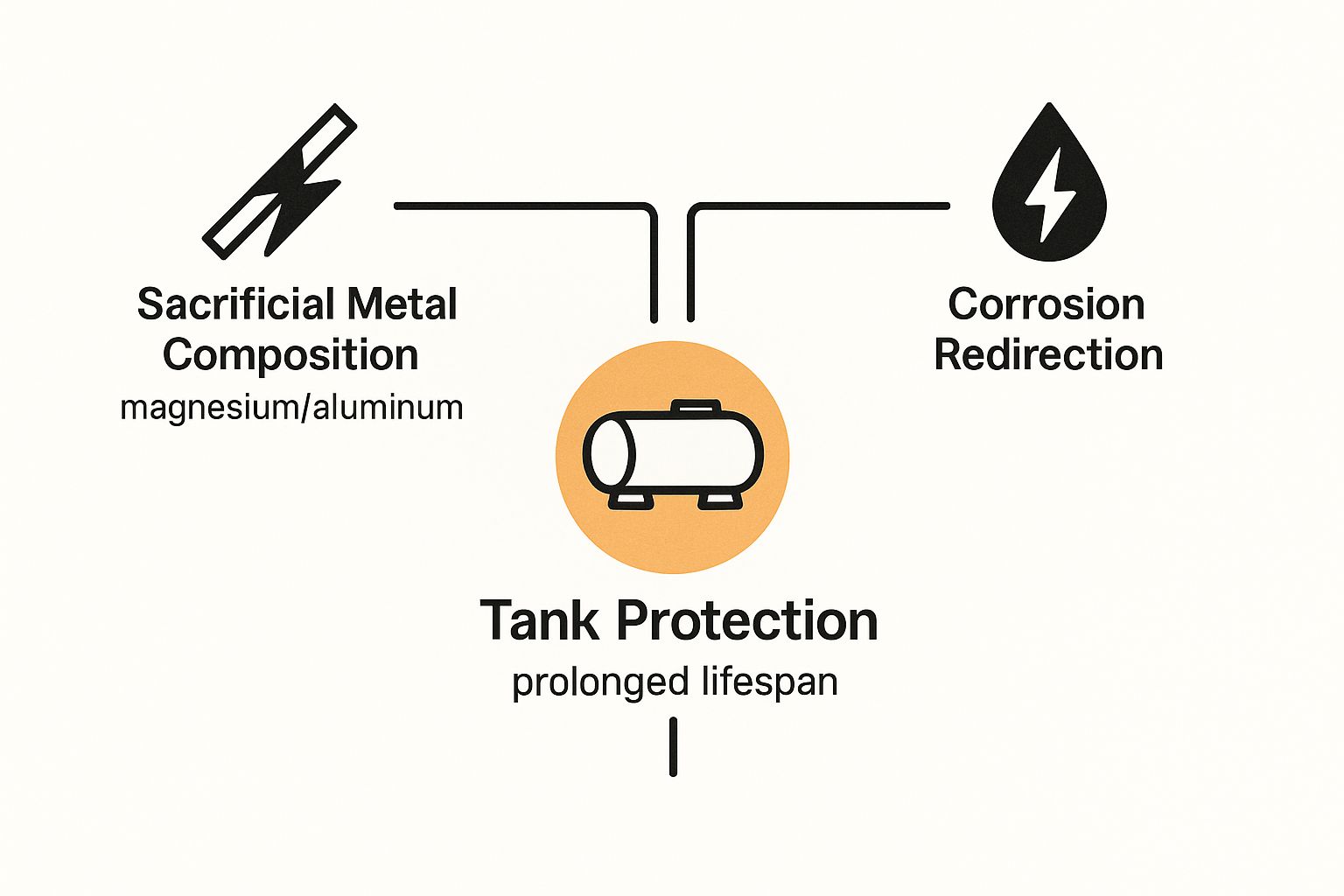
As you can see, the rod’s specific metal makeup is what allows it to redirect corrosion, leading to long-term protection for the tank. Take that sacrificial element out of the equation, and the tank itself becomes the next target.
How Different Factors Impact Corrosion Speed
How quickly your anode rod gets used up depends entirely on your water chemistry. Several key factors can either speed up or slow down this process, which directly impacts how often you’ll need to think about a replacement.
- Water Hardness: Water loaded with minerals (hard water) is more conductive. This extra conductivity speeds up the electrochemical reaction, meaning anode rods in homes with hard water often get eaten away much faster.
- Water Softeners: While they’re great for stopping mineral scale, water softeners can make water more aggressive. By swapping calcium and magnesium for sodium, they increase the water’s conductivity and can cause a standard anode rod to corrode at a surprisingly rapid pace.
- Acidity (pH Level): Water with a low pH is acidic, making it naturally more corrosive. The more acidic the water, the faster it will consume the anode rod.
For instance, a homeowner in a place with very hard water might find their anode rod is completely gone in just one or two years. Meanwhile, someone with balanced, softer water might get five years or more out of their rod. This is why there’s no “one-size-fits-all” replacement schedule. It all comes down to your home’s unique water conditions.
Choosing the Right Anode Rod for Your Home
Picking the right anode rod isn’t a one-size-fits-all deal. The kind of water you have—whether it’s hard, soft, or even a bit smelly—is the biggest factor in figuring out which rod will protect your tank best. Making the right call here is a huge part of getting the most life out of your water heater and heading off common problems before they even start.
Think of it like choosing tires for your car. You wouldn’t put summer tires on for a blizzard, and you shouldn’t use the wrong anode rod for your home’s unique water chemistry. When you get this part right, you ensure the rod sacrifices itself efficiently, keeping your tank safe.
The three main players in the anode rod game are magnesium, aluminum, and a zinc-aluminum alloy. Each one is engineered to shine in different water conditions. Let’s dig into which one makes the most sense for you.
Magnesium Rods: The Go-To for Softer Water
Magnesium anode rods are what you’ll find in most new water heaters right from the factory—they’re the industry standard for a reason. As the most reactive material of the bunch, they offer top-tier protection by corroding much more easily than your steel tank.
This high-energy sacrifice makes magnesium perfect for homes with naturally soft water or moderately hard water. In these environments, a magnesium rod provides the strongest defense against corrosion. If your water is pretty balanced, this is almost certainly your best bet.
But there’s a catch. That same high reactivity becomes a weakness in very hard water. The extra minerals in the water supercharge the corrosion process, and a magnesium rod can get eaten up in just a year or two—way faster than it should.
Aluminum Rods: The Champion for Hard Water
If your home has very hard water, an aluminum anode rod is your best friend. Aluminum is less reactive than magnesium, so it corrodes at a much slower, more controlled rate when faced with water loaded with minerals.
This steady, slower breakdown is exactly what you want in those tough water conditions. It may not have the same protective punch as magnesium, but its endurance in hard water makes it a far more practical and budget-friendly choice in the long run. It won’t dissolve prematurely, giving you reliable protection for years.
Key Insight: The choice between magnesium and aluminum is a simple trade-off. Magnesium provides more powerful protection but dissolves quickly in hard water. Aluminum offers less powerful but more durable protection, which is exactly what you need for those same hard water conditions.
Matching the rod to your water is a critical piece of any good water heater maintenance schedule, as it keeps you from having to do replacements way too often.
Zinc-Aluminum Rods: The Fix for That “Rotten Egg” Smell
Ever turn on the hot water and get hit with a nasty “rotten egg” smell? That’s a classic sign of sulfur-reducing bacteria, which love to set up camp inside a water heater tank. When these bacteria interact with a standard anode rod, they produce hydrogen sulfide gas—and that’s the source of the stink.
A zinc-aluminum alloy rod is the specific fix for this problem. These rods are mostly aluminum but have a critical addition of about 10% zinc. That zinc is the hero here; it actively neutralizes the bacteria and stops them from producing that foul-smelling gas.
If you’re tired of holding your nose every time you wash your hands, swapping your old rod for a zinc-aluminum one will often solve the problem completely. It’s a targeted solution that still provides excellent corrosion protection.
To make it even clearer, here’s a quick comparison of the three main types of anode rods.
Anode Rod Material Comparison
| Material Type | Best For | Pros | Cons |
|---|---|---|---|
| Magnesium | Soft to moderately hard water | Highest level of protection; very reactive. | Corrodes very quickly in hard water. |
| Aluminum | Very hard water | Lasts much longer in hard water; cost-effective. | Provides slightly less protective voltage. |
| Zinc-Aluminum | Homes with smelly hot water (sulfur) | Neutralizes odor-causing bacteria; eliminates rotten egg smell. | Not necessary if you don’t have a sulfur issue. |
Ultimately, knowing your water is the first step. Once you’ve identified whether it’s hard, soft, or smelly, you can confidently choose the anode rod that will give your water heater the longest, most efficient life possible.
What About Flexible Anode Rods?
Sometimes the problem isn’t your water—it’s your space. Many water heaters are tucked away in tight closets or basements with low ceilings, leaving you with no room to wiggle in a standard rigid 44-inch rod.
That’s where flexible anode rods save the day. They’re built from several shorter segments of magnesium or aluminum linked together with a flexible steel cable. This clever design lets you bend the rod as you feed it into the tank, making replacement possible even when you have zero overhead clearance. They give you the exact same protection, just with a lot more convenience for tricky installations.
Warning Signs Your Anode Rod Is Failing
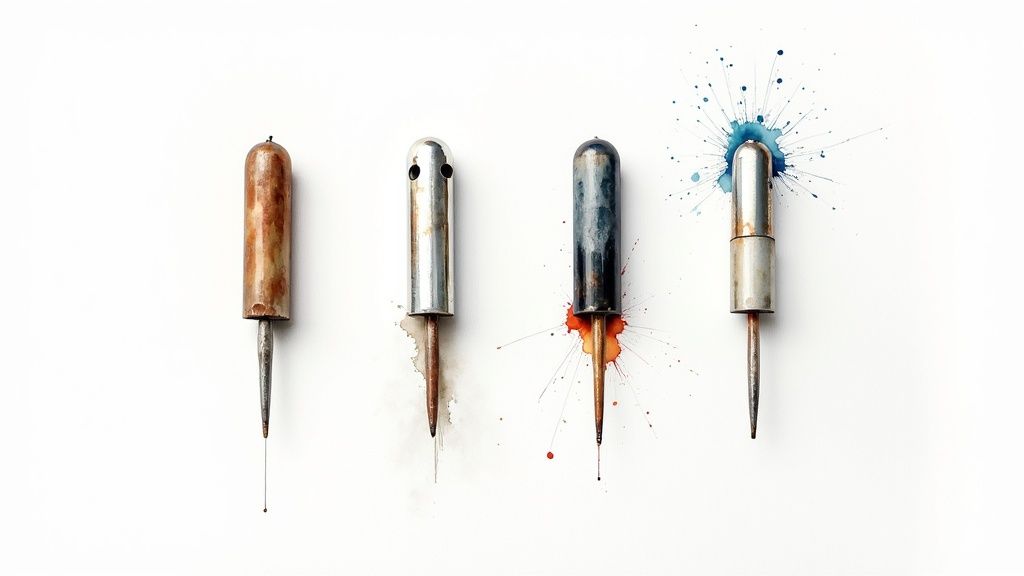
Your anode rod works completely out of sight, but it won’t fail silently. When it’s on its last legs, your water heater will often send out some pretty clear distress signals. Recognizing these clues is the key to catching a problem before it turns into a catastrophic tank failure.
Think of it this way: ignoring these signs is like ignoring the oil light in your car. It might seem small, but you’re risking a much bigger, more expensive problem down the road—like a flooded basement instead of a simple maintenance swap.
Let’s walk through the specific symptoms you need to look, listen, and even smell for.
Foul Odor From Your Hot Water
One of the most distinct—and unpleasant—signs of a failing anode rod is a “rotten egg” smell coming from your hot water. If it only happens with the hot water, you’ve likely found your culprit.
That sulfurous odor is hydrogen sulfide gas. It’s produced when certain bacteria in the water supply react with a magnesium or aluminum anode rod. As the rod wears down, the chemical reaction can get worse, making the smell more noticeable. If your hot water suddenly stinks, your anode rod is likely either shot or simply the wrong type for your local water chemistry.
Rusty or Discolored Hot Water
Are you seeing a brownish or orange tint when you turn on the hot tap? That’s a huge red flag. Discolored hot water is a classic symptom of a completely depleted anode rod.
When the rod is gone, the corrosive elements in your water have found a new target: the steel liner of the water heater tank itself. That rusty color is literally tiny particles of your tank flaking off and mixing into your water supply.
Critical Alert: Rusty water means your tank is actively corroding from the inside out. At this point, the damage might be irreversible. An immediate inspection is essential to see if the tank can be saved or if you’re looking at an emergency replacement.
Loud or Unusual Noises From the Tank
A water heater will make some noise, but you should never hear loud popping or banging sounds. If you do, it’s a serious cause for concern. These sounds are often caused by a thick layer of sediment that has built up at the bottom of the tank.
What is that sediment? It’s usually a mix of hard water mineral scale and the chalky, corroded remains of a disintegrated anode rod. When the burner or heating element kicks on, it superheats the water trapped underneath that sludge, causing it to boil violently and create those disruptive popping noises. It’s an audible sign that the anode rod is long gone.
These are also some of the telltale signs that your water heater needs repairs in general, but they very often point back to this one neglected part. Paying attention to these warnings can help you avoid a plumbing disaster. If you notice any of them, it’s time to get your water heater inspected.
A Homeowner’s Guide to Anode Rod Replacement
https://www.youtube.com/embed/4IKv0ZkpMzM
Alright, ready to get your hands dirty? Replacing an anode rod is one of those DIY projects that’s incredibly satisfying. It’ll save you a decent chunk of change and give you a real sense of accomplishment. While it does take a little muscle, the whole process is pretty straightforward once you know the steps. I’ll walk you through everything, from getting prepped to the final install.
First things first: safety is everything. You’re working with water, either electricity or gas, and a seriously heavy appliance. Always, always prioritize getting your work area safe before you even think about speed.
Essential Safety and Preparation Steps
Before you even touch a tool, you have to completely shut down and isolate your water heater. Don’t even think about taking a shortcut here—it’s not worth the risk.
- Kill the Power or Gas: If you have an electric heater, head to your breaker box and flip the correct circuit breaker to the OFF position. For a gas heater, find the control knob on the unit itself and turn it to OFF.
- Shut Off the Water: Look for the cold water pipe going into the tank. You’ll see a shut-off valve on that line. Turn it clockwise all the way until it stops. That’s it, the water supply is cut.
- Relieve the Pressure: Go to the nearest sink and turn on the hot water. You’ll get a trickle of water, and then it will stop. This simple step lets air into the plumbing, which relieves the pressure inside the tank. This is absolutely critical for draining it and getting the old rod out safely.
Once all the utilities are off and the pressure’s gone, you’re ready to grab your tools and get started.
Gathering the Right Tools for the Job
Having the right gear on hand is what separates a frustrating afternoon from a smooth, successful job. You don’t need a professional-grade workshop, but a few key items will make all the difference.
Here’s your must-have list:
- A Breaker Bar: For most anode rods, this is non-negotiable. They are often cranked in there incredibly tight, and a normal socket wrench just won’t give you the leverage you need. Your breaker bar will be your best friend.
- A 1 1/16-Inch Socket: This is the magic number for the hex head on most residential anode rods. It’s always a good idea to double-check your specific model, but this size is the go-to for the vast majority of heaters.
- A Garden Hose: You’ll need to hook this up to the drain valve to let out just enough water so the level is below the anode rod’s opening.
- Teflon Tape (Plumber’s Tape): This is essential for creating a perfect, watertight seal when you screw in the new rod.
With your tools laid out, it’s time to find that old rod and get it out of there.
Locating and Removing the Old Anode Rod
Most of the time, the anode rod is right on top of the water heater, sometimes hidden under a little plastic cap. It might be its own separate hex-headed plug, or it could be built into the hot water outlet nipple as a combination unit.
Once you’ve found it, the real work begins. Pop your 1 1/16-inch socket onto the breaker bar and get a solid grip on the hex head. Brace the tank (or have a friend help) and give it a strong, steady pull counter-clockwise to break that seal. Don’t be surprised if it takes a serious amount of force, especially if the rod has been sitting in there for years.
Pro Tip for Stuck Rods: If that thing just won’t budge, have a helper hold the tank steady so it doesn’t twist with your wrench. Sometimes, a quick, sharp jerk on the breaker bar works better than a slow, steady pull. Just be careful you don’t wrench on the tank’s connections and cause a leak.
After you break it loose, you can unscrew the old rod and pull it out. Prepare yourself for a bit of a shock—if it did its job well, it will look absolutely mangled, pitted, and way thinner than the new one. If you pull out nothing but a thin wire hanging from the plug, you got to it just in the nick of time. Performing this check is a cornerstone of any good hot water heater maintenance plan and the single best thing you can do to prevent a tank failure.
And what if you have a low ceiling? No problem. If there isn’t enough overhead clearance to pull the old rod out or put a new one in, a flexible anode rod is the perfect solution. They are designed in segments connected by a wire, allowing you to bend and feed it into the tank one section at a time. It’s a clever design that makes installation possible even in the tightest closets or basements.
How Sacrificial Anodes Protect Ships and Pipelines

That humble anode rod inside your water heater isn’t just a random part. It’s actually a miniature version of the same technology that keeps massive, multi-billion-dollar structures from turning into rust buckets. This brilliant engineering concept, called cathodic protection, is the world’s go-to defense against the destructive power of saltwater and even corrosive soil.
When you see how it works on an epic scale, you get a whole new appreciation for the clever science humming away in your own basement. It’s the same basic idea, whether it’s protecting a 40-gallon tank or a 900-foot-long naval carrier.
The story of using sacrificial anodes on a grand scale starts at sea. A steel ship floating in saltwater is basically a textbook recipe for galvanic corrosion. You have the steel hull, the conductive saltwater (the electrolyte), and other metals all forming one giant, self-destructing battery.
Industrial-Scale Sacrificial Protection
So, how do you stop a ship from eating itself? Engineers bolt large blocks of a more reactive metal, usually zinc or aluminum, directly onto the hull. These blocks are essentially giant anode rods. They are designed to corrode first, sacrificing themselves to keep the ship’s vast steel surface from rusting away. Without them, a ship’s hull would be dangerously weakened in just a few years.
This exact same method is a lifeline for other critical infrastructure:
- Offshore Oil Rigs: These platforms stand in corrosive seawater 24/7. To keep them from crumbling, huge sacrificial anodes are welded to their underwater support legs.
- Submarines: The Navy has been using this trick for a long time. Submarines were fitted with thousands of sacrificial zinc anodes to fight off intense saltwater corrosion. As you can learn in this water heater anode experiment on gwgillplumbingandheating.com, these anodes were swapped out during regular maintenance to keep the hull safe.
- Underground Pipelines: Miles of metal pipes carrying oil, gas, and water are buried in soil, which is surprisingly good at conducting electricity and causing rust. To stop this, anodes are buried right alongside the pipeline and wired to it, drawing the corrosive attack away from the pipe and preventing catastrophic leaks.
The Universal Principle: Whether it’s a giant ship or a home water heater, the rule is the same. The sacrificial anode must be electrically connected to the metal it’s protecting and immersed in a shared electrolyte (like water or soil) to work.
The anode rod in your home relies on this identical, time-tested principle. It’s a testament to simple, effective engineering that stands guard against the very same forces threatening the world’s biggest and most expensive structures, making sure your own investment stays protected.
Answering Your Top Questions About Anode Rods
Once you get the gist of what an anode rod does, the practical questions usually start popping up. I’ve found that most homeowners run into the same few uncertainties, especially when it comes to replacement schedules and specific water types. Let’s walk through the most common ones so you have clear answers you can actually use.
How Often Should I Really Be Replacing My Anode Rod?
The general rule of thumb you’ll hear is every 3 to 5 years. But honestly, that’s just a baseline. The real lifespan of your anode rod comes down to one thing: your water quality.
- Homes with Hard Water or a Water Softener: If you have hard water or use a salt-based softener, the water is much more aggressive. In this case, your anode rod is working overtime and will get eaten away much faster. Plan on checking it every 2 years.
- Homes with Naturally Soft Water: If you’re lucky enough to have naturally soft water, your rod will have a much easier life and could easily last beyond the 5-year mark.
Here’s my advice: check it for the first time around year three. Seeing how much it has worn down will tell you everything you need to know about your water’s corrosivity, allowing you to create a replacement schedule that’s right for your home.
Key Insight: Don’t wait for signs like rusty water to appear. By the time you see them, the corrosion has already started chewing away at your tank. Proactive checks are the only way to truly protect your investment.
Do Tankless Water Heaters Have Anode Rods?
Nope! Tankless water heaters don’t have anode rods because they don’t need them. An anode rod’s entire job is to protect a large steel tank where dozens of gallons of water sit 24/7. Since tankless models heat water as it passes through, there’s no stored water and therefore no risk of the slow-burn corrosion that plagues tank-style heaters.
What’s the Big Deal If I Don’t Replace It?
Forgetting about your anode rod is, without a doubt, the single fastest way to kill your water heater. As soon as that sacrificial rod is gone, the galvanic corrosion has to find its next meal, and that’s going to be the steel liner of your tank. Before you know it, you’ll have rust, leaks, and eventually, a full-blown tank failure—a messy and expensive problem that was completely preventable.
Think about it this way: spending $30-$50 on a new anode rod every few years can save you from a $1,500+ bill for a brand new water heater, not to mention the potential cost of water damage. It’s easily one of the smartest and most cost-effective maintenance tasks you can do.
Keeping your water heater running smoothly sometimes means calling in a pro. For reliable service and expert advice you can trust, Professional Plumbers Denver has the skill to handle everything from anode rod swaps to emergency plumbing situations. If you’re around Denver, feel free to reach out to us for help.