
When you’re thinking about putting in a new drain, it’s usually for one of two reasons: you have to, or you want to. It’s a lot more involved than a simple fix-it job—it’s a serious upgrade to your home’s plumbing that can solve years of headaches or make a dream renovation possible.
Why and When You Might Need a New Drain
So, what pushes a homeowner to take on a project like this? Often, the house makes the decision for you. You might be dealing with old, corroded pipes that are just done. Maybe you’ve got constant clogs that no amount of drain cleaner will solve, or you’re smelling that faint, unpleasant sewer gas. These aren’t just minor annoyances; they’re red flags that your system is failing from the inside out.
On the flip side, sometimes a new drain is the first, exciting step in a home project you’ve been planning for years. That basement bathroom you’ve been dreaming of? Or maybe moving the laundry room upstairs so you don’t have to haul baskets up and down flights of stairs? None of that can happen without new plumbing to carry the wastewater away.
Common Scenarios We See All the Time
I’ve been in countless Denver homes, and these are the most frequent reasons a new drain installation comes up:
- Finishing a Basement: If you’re adding a bathroom, a wet bar, or even a simple utility sink down there, you’ll need new drain lines. This almost always involves cutting into the concrete slab to lay the pipes correctly.
- Building a Home Addition: Any new space with plumbing—be it a kitchen, bathroom, or laundry area—has to have its own drainage. We’ll need to tie this new line into your home’s main sewer line.
- Fighting Constant Clogs & Backups: Are you on a first-name basis with your plumber because of slow drains? This could be a sign of something more serious, like tree roots crushing the pipe, old lines corroding from within, or a pipe that was installed without the proper slope years ago. A new drain is often the only permanent fix.
- Replacing Outdated Pipes: If your home still has old cast iron or clay pipes, you’re living on borrowed time. Swapping them out for modern, durable PVC or ABS pipes is a smart move to head off a major failure down the road.
Think of a new drain installation as an investment in your home’s health and value. It fixes the problems you have now and prevents bigger, messier ones later, making sure your plumbing can handle your family’s needs for years.
This isn’t just a local trend; it’s a critical part of construction and renovation worldwide. The global market for drain pipes was around USD 8.5 billion and is expected to climb to USD 12.6 billion by 2033, driven by new construction and the urgent need to upgrade aging infrastructure. You can get more details on this growth from Verified Market Reports.
Ultimately, installing a new drain gives you a fresh start. You get a system designed for exactly what you need, built to today’s standards. If your problems seem bigger than just one drain, it helps to know what’s going on with the main line. We put together a guide specifically on understanding sewer line issues and repairs in Denver that can shed some light on the subject.
Planning Your Drain Project for Success

A successful new drain installation is almost always decided long before you cut the first piece of pipe. Honestly, solid planning is what separates a smooth, professional job from a project that spirals into a costly, frustrating headache. This is your pre-construction playbook—let’s get the details right from the start.
Think of yourself as a water traffic controller. Your job is to map out the most efficient, foolproof path for wastewater to get out of your house and into the main system. This isn’t just about connecting two points; it’s a game of physics and, more importantly, following the strict building codes that keep your home safe.
Mapping for Perfect Drainage Flow
The single most critical detail in any drain line is the slope. It’s all about gravity. For a drain to do its job, the pipe needs a consistent, gentle downward angle.
The gold standard here is a minimum of 1/4 inch of fall for every foot of horizontal pipe. Get this wrong, and you’re setting yourself up for constant clogs. That precise grade is what keeps water and solids moving along together, just as they should.
Proper venting is the other piece of the puzzle you can’t ignore. A vent pipe is like a snorkel for your plumbing system. It lets air in behind the flowing water, which prevents a vacuum from forming. Without that vent, the water in your P-traps would get siphoned out, opening a direct line for foul—and hazardous—sewer gas to seep into your home.
One Call You Absolutely Must Make
Before you even think about digging or cutting, you have a legal and safety duty to call 811. It’s a free service. They’ll contact all the local utility companies to come out and mark their underground lines. Hitting a gas or power line can be a catastrophic mistake, and this one simple call prevents it.
Navigating Denver’s Permitting Process
Here in Denver, any new plumbing work, including installing a new drain, requires a permit. This isn’t just bureaucratic busywork. It’s a crucial system of checks and balances designed to make sure the work is done safely and meets current building codes.
Getting your permit is a key step, and the city will want to see that you’ve done your homework. A well-prepared application makes the whole process smoother.
Denver Drain Permit Essential Checklist
Below is a table outlining the essential items you’ll need to gather to successfully secure your plumbing permit in Denver. Having these ready will show the permitting office you’re serious and prepared.
| Checklist Item | What It Is & Why It Matters | Status |
|---|---|---|
| Detailed Drawing/Plan | A clear diagram of the new drain. It should show pipe layout, sizes, materials, and how it connects to your existing plumbing. This proves you have a workable plan. | |
| Completed Application Form | The official plumbing permit application from the Denver Community Planning and Development office. Fill it out completely and accurately. | |
| Permit Fee Payment | Fees are based on your project’s scope. This payment covers the cost of the city’s review and inspection process. | |
| Material & Cost Estimate | A list of materials and an estimated project cost. This helps determine the permit fee and shows you’ve thought through the logistics. |
Once you’ve checked these boxes, you’re in a great position to get your permit approved without unnecessary delays, allowing you to move forward with your project.
When you’re putting together your budget, it’s incredibly helpful to know what materials will cost. Online tools like a construction material cost predictor can give you a solid baseline for pipes, fittings, glue, and everything else you’ll need.
This kind of careful planning is part of a bigger trend. The entire market for drainage systems is growing—from USD 2.25 billion to an estimated USD 2.35 billion—as cities like Denver continue to grow and modernize. By planning your project correctly, you’re not just fixing a problem; you’re ensuring your home’s plumbing is up to modern standards, which adds real, lasting value.
Choosing the Right Drain Pipes and Materials
Walking into the plumbing aisle can be overwhelming, but choosing the right materials for your new drain doesn’t have to be a guessing game. What you pick here—the pipes, the fittings, the glue—will determine how well your system works for years to come. It’s less about just buying parts and more about building a system that’s right for your home.
For nearly every residential drain project you’ll tackle in the Denver area, the choice boils down to two main players: PVC (polyvinyl chloride) and ABS (acrylonitrile butadiene styrene). You’ve seen them before. PVC is the classic white pipe, while ABS is black.
The real difference isn’t the color; it’s how you put them together. PVC requires a two-step process: you apply a purple primer to clean and soften the pipe, then follow it up with cement. With ABS, you just use a special one-step solvent cement. That makes ABS connections a bit faster, but both are rock-solid when done right.
While Denver plumbing codes generally allow both, it’s always smart to double-check what’s preferred for your specific situation. A quick call to the local building department can save you a major headache.
More Than Just Pipes
A drain line is a system of parts. You can’t just connect pipes end-to-end. You’ll need couplers to join straight runs, elbows to make turns, and fittings like wyes or tees to branch off in other directions.
The goal here is a perfectly sealed, leak-proof system. That’s why your technique with the primer and cement is so important. Think of it like assembling a custom-fit puzzle for your home’s unique layout, where every piece has to be perfect.
You might also run into cast iron pipes, especially if you’re working on an older home. It’s tough as nails and incredibly quiet—you’ll never hear water rushing through it. But it’s also a beast to work with. It’s heavy, tough to cut, and needs special tools. For most modern projects, homeowners stick with PVC or ABS because they just make the job easier.
A Pro’s Tip From the Field: Always, and I mean always, check the expiration date on your solvent cement. If it’s old and thick, it won’t create a proper chemical weld. Your joints will fail. Spending a few extra bucks on a fresh can is the cheapest insurance you can buy against a future leak.
This level of detail matters for everything. Take something as simple as a floor drain. You wouldn’t think there’s much to it, but the global market for just bathroom floor drains was valued at around USD 1.5 billion and is projected to climb to USD 2.55 billion by 2033. That growth reflects a huge variety of specialized options, from simple gravity models to spring-loaded ones. You can get a sense of the options in this detailed market report.
Making the Final Call: PVC vs. ABS vs. Cast Iron
So, what’s the right choice for your project? Let’s break down the common options to make it simple. Here’s a quick comparison to help you decide what to load into your cart.
Drain Pipe Comparison: PVC vs. ABS vs. Cast Iron
A comparative look at common drain pipe materials to help you choose the best option for your home.
| Material | Best Use Cases | Cost & Durability | Key Considerations |
|---|---|---|---|
| PVC | Main drain lines, vents, and general residential plumbing. Excellent for underground burial. | Inexpensive and very durable. Resists chemical corrosion and is widely available. | Requires a two-step joining process (primer and cement). Can become brittle in extreme cold. |
| ABS | Similar to PVC for drains and vents. Often preferred for its one-step joining process. | Cost is comparable to PVC. Also very durable but can be damaged by UV light if exposed. | Joining is faster (no primer), but some codes may favor PVC for certain applications. |
| Cast Iron | Main sewer stacks in multi-story homes to reduce noise. Tying into existing cast iron lines. | More expensive and requires more labor. Extremely durable and fire-resistant. | Very heavy and difficult to work with. Requires specialized snap cutters and shielded couplings. |
For most homeowners in Denver handling a new drain installation, it’s hard to go wrong with PVC. It hits the sweet spot of being affordable, durable, and readily available. The two-step joining process is easy for a beginner to get right, giving you the confidence that your connections are strong and built to last.
Executing the Installation Like a Pro
Alright, you’ve done the legwork. Your plans are approved, your materials are staged, and now it’s time for the real work to begin. This is where all that planning pays off, turning a collection of pipes and fittings into a reliable drainage system that will serve your home for years to come. The focus now shifts to the hands-on part: the new drain installation.
A truly professional installation goes beyond just gluing pipes together. It’s about building a system that works with gravity, not against it. It’s about keeping nasty sewer gases out of your living space and building something that can handle the unique challenges of Colorado’s soil and climate.
Mastering the Art of the Slope
If there’s one thing you absolutely have to get right, it’s the slope—what we in the trade call “pitch” or “fall.” This is non-negotiable. For just about every residential drain line, the gold standard is a minimum drop of 1/4 inch for every foot of horizontal pipe.
That specific angle is the sweet spot. It lets gravity pull water along at the perfect speed to carry solids with it. Go too steep, and the liquids will race ahead, leaving solids behind to create a nasty blockage. Too flat, and nothing moves well at all, leading to constant slow drains and clogs. Keep a good level—a torpedo for tight spots or a 4-foot level for longer runs—handy at all times. You should be checking your pitch constantly as you install each section.
Getting the trench graded correctly from the start is half the battle. This is the foundation for the entire drain line.
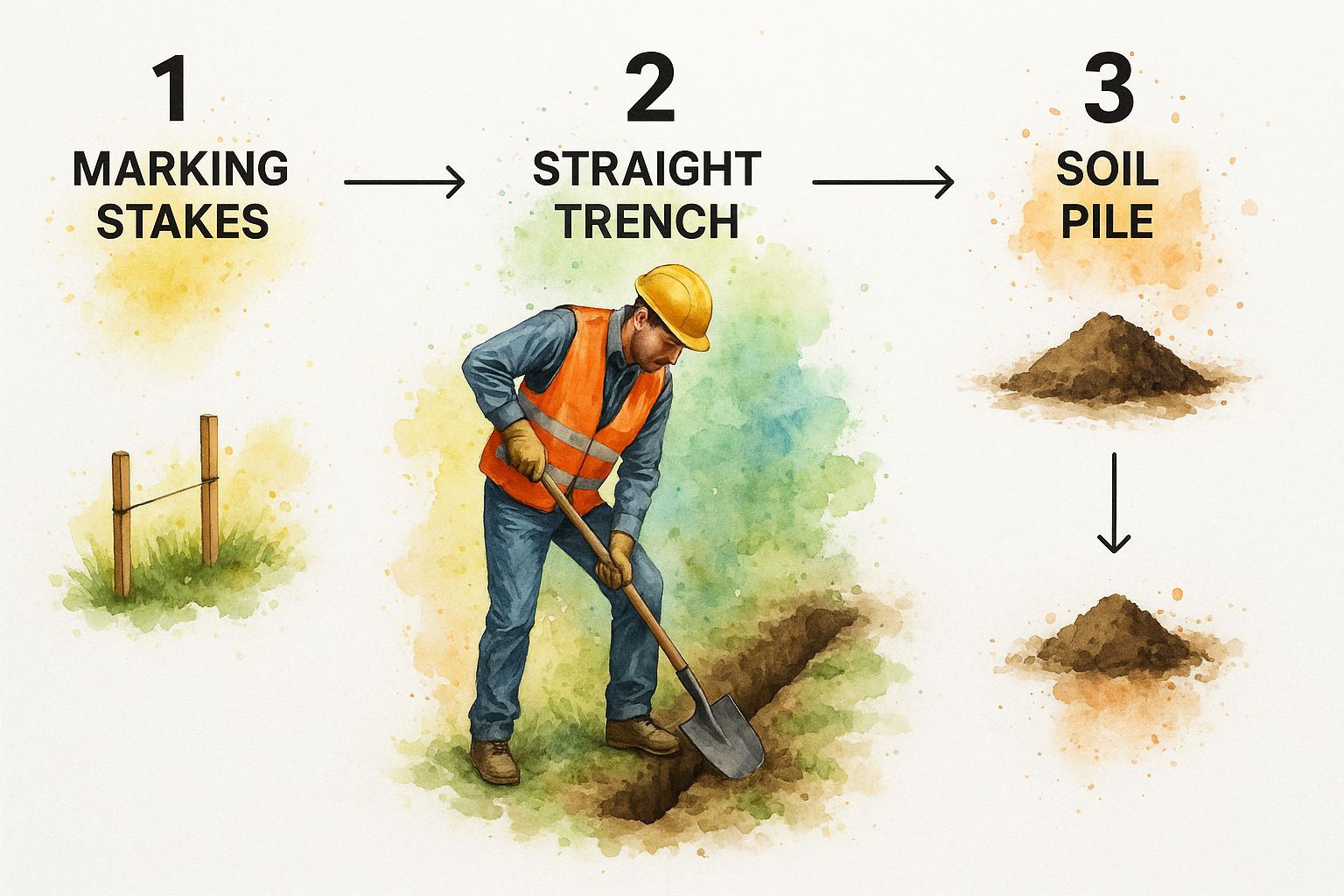
As you can see, a straight, evenly graded trench is the first step toward a system that works properly and passes inspection without any headaches.
Making Secure Connections and Preventing Gas Intrusion
Every joint in the system is a potential weak spot, so getting the connections right is critical. Whether you’re working with PVC or ABS pipes, the technique is the same:
- Start with clean, square cuts on your pipe.
- Apply the right solvent cement (and don’t forget the primer for PVC).
- When you join them, push the pipe into the fitting with a firm, quarter-turn twist. This ensures the cement spreads evenly and creates a strong chemical weld.
Just as crucial is the P-trap—that U-shaped bend you see under every sink and floor drain. Its simple job is to hold a small plug of water that acts as a physical barrier, blocking sewer gas from creeping up the pipe and into your house. Every single fixture needs its own P-trap.
The P-trap can’t do its job alone, though. It needs a vent. A vent pipe allows air to enter the drain system behind the flowing water. Without it, a vacuum would form, siphoning the water right out of the trap and leaving you with gurgling drains and foul odors.
A Quick Tip on Protection: When burying pipes, especially here in Colorado where our soil loves to shift, you need to bed them properly. After digging your trench, lay down a 2-3 inch layer of pea gravel or sand. This cushions the pipe, protects it from sharp rocks, and helps groundwater drain away, preventing damage from the freeze-thaw cycles that can heave the soil.
Navigating Common Obstacles
I’ve never seen an installation that was a perfectly straight shot. You’re going to run into things—floor joists, concrete footings, maybe even another utility line. The trick is to work around them without messing up your slope. This might mean carefully drilling through a joist (always follow building codes for hole size and placement!) or using a combination of fittings to “jog” the pipe around the obstacle.
While you’re deep in this project, if you’ve been dealing with stubborn clogs elsewhere in the house, now might be the perfect time to tackle them. Our guide on how to unclog a stubborn drain pipe has some field-tested advice. And if your project involves tying into a more complex system with larger components, understanding the fundamentals is invaluable. For instance, knowing how to install polyethylene tanks can give you a better grasp of the proper techniques for supports and fittings that apply to many large-scale drainage components.
When to Hire a Professional Plumber
There’s a great sense of accomplishment that comes with a successful DIY project. But I’ve been in this business long enough to know that the smartest tool in any homeowner’s kit is knowing when to call for backup. A new drain installation can go from a weekend project to a homeowner’s nightmare in a heartbeat.
Recognizing when a job is over your head isn’t about giving up. It’s about protecting your home and your wallet from a costly mistake.
For instance, if your plan involves connecting your new drain directly to the city’s main sewer line, that’s an immediate stop sign for any DIYer. This isn’t just a simple connection; it demands absolute precision and has to meet strict city codes. One wrong move here can cause major backups for you and even your neighbors.
The same goes for any project that involves cutting through your concrete slab or foundation. This goes way beyond making a mess. You’re dealing with the structural integrity of your home and need heavy-duty, specialized equipment. Without serious training, it’s a massive risk.
Key Moments to Call a Pro
Think of these as your non-negotiable “call a plumber” moments. If you run into any of these, it’s time to bring in an expert:
- You’re Dealing with Old Cast Iron Pipes: This stuff is incredibly heavy, brittle, and a real pain to work with. Trying to cut it without the right snap cutters often leads to the pipe cracking, which can cause a much bigger, more expensive problem.
- The Venting Looks Complicated: Proper venting is crucial. If your new drain needs to be vented through a complex web of existing pipes, a pro is your best bet to avoid sewer gas leaks and drains that gurgle and siphon.
- You Need to Touch the Main Line: I can’t stress this enough. Any work on your main sewer or septic line is a job for a licensed professional. It’s a world of code compliance and serious consequences if done wrong.
- You’re Unsure About Local Codes: Denver has very specific plumbing codes for everything from pipe slope to the types of fittings you can use. A licensed plumber knows these rules inside and out, guaranteeing your work will pass inspection the first time.
A professional plumber doesn’t just bring a truck full of tools. They bring liability insurance that protects you and your home. They also guarantee their work, saving you the headache and cost of failed inspections.
The value a pro brings often goes beyond the immediate task. While you’re focused on the new drain, an experienced plumber can spot other potential issues with your system. For example, regular maintenance is key, and understanding the benefits of professional drain cleaning services in Denver can help you build a long-term plan for a healthy plumbing system.
When you decide to hire someone, do your homework. Look for licensed and insured plumbers with a solid reputation in the Denver area. Always ask for a detailed, itemized quote before work starts to ensure there are no surprises.
Common Questions About Drain Installation
Even the most carefully planned drain installation can leave you with a few nagging questions. That’s perfectly normal. To help you feel completely confident before you (or a pro) get started, I’ve put together the answers to the questions we hear most often from Denver homeowners.
Let’s get the big one out of the way first: cost. What’s this actually going to set you back? Naturally, every project is unique. A straightforward basement sink drain, for example, will likely cost a homeowner between $800 and $1,500 when hired out to a professional.
However, if you’re talking about a bigger job—like a full bathroom addition that involves cutting into a concrete slab and running a significant length of pipe—you could easily be looking at a $3,000 to $7,000+ bill. The final price tag really boils down to the length of the pipe, how complicated it is to connect to your existing drain system, and any local permit fees.
Getting the Details Right
Another question that comes up all the time is about the proper slope for the drain pipe. This is one of those details you absolutely have to get right. For residential drains, the universal standard is a minimum slope of 1/4 inch of fall for every foot of horizontal run.
That specific angle is the magic number. It uses gravity to move both water and solid waste along perfectly. If the pipe is too steep, the water can rush past the solids, leaving them behind. Too flat? You’re just asking for constant clogs down the road.
This brings us to another critical element: venting.
Is a vent pipe really necessary for a new drain? Yes, 100%. Every single plumbing code requires a vent pipe, and for good reason. It lets air into the system, which is crucial for preventing a vacuum from forming as water flows out. Without it, the water in your P-trap gets siphoned away, and that water barrier is the only thing stopping nasty sewer gas from seeping into your home.
Understanding the Broader Industry
Occasionally, homeowners get curious about how the plumbing business itself works. If you’re interested in how experts connect with customers, learning about digital marketing strategies for plumbers offers a fascinating peek behind the curtain. It shows how skilled tradespeople promote services like drain installation and find the clients who need them. Knowing a bit about this helps you understand the business side of the pros you might hire, making it easier to find a reputable expert for your own project.
When you need a new drain installation done right the first time, turn to the local experts who understand Denver’s unique plumbing challenges. Contact Professional Plumbers Denver today for a detailed consultation and a free, no-obligation quote. Let us ensure your project is a complete success. Visit us at https://professional-plumbers-denver.com to get started.