
To keep your drain field in good shape, you first have to appreciate what it actually does. It’s more than just a patch of grass in your yard; it’s the final, crucial filtration stage of your entire septic system. This unsung hero is what safely returns treated wastewater to the environment. A little care here goes a long way in preventing catastrophic failures and protecting your property value.
What Every Homeowner Needs to Know About Their Drain Field
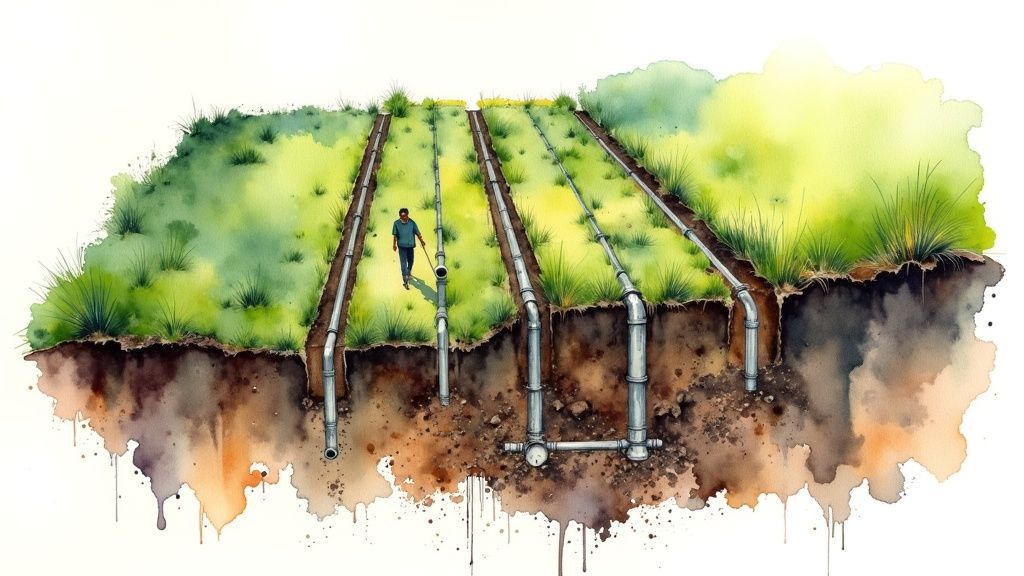
Before we get into the nitty-gritty of maintenance, let’s get on the same page about what a drain field (sometimes called a leach field) really is. I like to think of it as the lungs of your septic system.
Here’s how it works: after your septic tank does the heavy lifting of separating solid waste from liquid, that wastewater (called effluent) flows out into a network of perforated pipes. These pipes are buried under your lawn in special trenches filled with gravel.
But it’s not just about getting rid of water. It’s a brilliant, natural treatment process. The soil and gravel work together as a giant biological filter. Good bacteria living in the soil get to work, breaking down any nasty pathogens and viruses left in the effluent. This purifies the water before it can safely rejoin the groundwater. The whole system hinges on one thing: the soil’s ability to absorb and filter that water.
Healthy vs. Failing: Know the Signs
Knowing the difference between a drain field that’s working perfectly and one that’s on the brink of failure is half the battle. A healthy system is totally invisible. You shouldn’t see or smell a thing—just a normal lawn.
A failing system, on the other hand, will start sending out clear distress signals. It’s telling you it’s overwhelmed and can’t process wastewater anymore. Catching these signs early can mean the difference between a simple, manageable fix and a complete drain field replacement, which is a massive and expensive job. This is where a holistic approach comes in, because regular plumbing maintenance inside your home directly impacts the health of your septic system outside.
To help you spot the difference, here’s a quick checklist comparing a healthy drain field with a failing one.
Drain Field Health At a Glance
| Indicator | Healthy System Sign (What you want to see) | Failing System Sign (What to watch out for) |
|---|---|---|
| Ground Condition | Dry, firm soil over the field area. | Spongy, wet spots, or standing water (puddles). |
| Vegetation | Normal grass growth, similar to the rest of the yard. | Unusually lush, green grass in strips over the lines. |
| Odor | No unusual smells. | A distinct “sewage” or rotten egg smell outdoors. |
| Plumbing | Toilets flush and drains run quickly and smoothly. | Slow drains, gurgling sounds, or sewage backing up. |
Keep this table handy. If you start noticing any of the signs in the “Failing System” column, it’s time to investigate further.
Why Drain Field Care Is a Global Concern
This isn’t just a Denver-area issue; it’s a worldwide responsibility. In fact, as of 2022, nearly 1.9 billion people across the globe depend on septic systems. That number has more than doubled since the year 2000. If you’re new to this, getting a handle on understanding septic tanks provides a great foundation. This global reliance really highlights the environmental duty every septic owner has to prevent groundwater contamination through proper care.
The Bottom Line: Your drain field is basically a living wastewater treatment plant buried in your yard. Its ability to “breathe” and filter is directly tied to the health of the soil around it. Anything you do that compacts the soil or floods the area with too much water is putting the entire system at risk.
Daily Habits That Protect Your Septic System

If you ask me, the real secret to a long-lasting drain field isn’t some expensive, one-off fix. It’s all about the little things you do inside your home every single day. These small habits are your best defense against a septic emergency that could cost you thousands.
Protecting your drain field starts with being conscious of what’s going down your drains—and I don’t just mean the toilet. Your kitchen sink, your showers, and even your washing machine all play a huge role. Every substance, every drop of water, affects the delicate balance of bacteria in your tank and the soil in your drain field.
Manage Your Water Usage Wisely
I’ve seen it time and time again: one of the biggest culprits behind drain field failure is hydraulic overload. It’s a technical term, but it just means you’re sending too much water into the system at once. The soil in your drain field can only handle so much water at a time. Overwhelm it, and you’ll get a soggy, saturated mess where untreated wastewater can bubble up to the surface or, even worse, back up into your house.
Think of it like watering a potted plant. If you pour a little water in, it soaks in perfectly. But dump a whole bucket on it? You just get mud.
Laundry is a classic example. Instead of saving all your loads for a marathon laundry day on Saturday, try spreading them out. Doing just one load a day gives your drain field plenty of time to absorb and process the wastewater from the wash without getting swamped.
Here are a few other practical ways to manage your water:
- Install high-efficiency fixtures. Modern toilets, showerheads, and faucets can significantly cut down on your water use without you even noticing.
- Fix leaks right away. That running toilet or dripping faucet might seem minor, but it can waste hundreds of gallons, silently flooding your drain field.
- Skip the garbage disposal. I know they’re convenient, but food waste adds a ton of solids and grease to your tank, meaning you’ll need to pump it more often and risk clogs.
Be Selective About What You Flush
Your toilet is not a trash can. This is probably the single most important rule of septic ownership. Flushing anything besides human waste and septic-safe toilet paper is asking for trouble. Things like wet wipes (even the “flushable” ones!), feminine hygiene products, and paper towels simply don’t break down. They will clog your pipes and your tank.
Key Takeaway: If it’s not human waste or toilet paper, it doesn’t belong in the toilet. Period. Following this one rule can save you from a major system blockage and a very unpleasant plumbing bill.
Chemicals are just as bad, if not worse. Harsh drain cleaners, potent antibacterial soaps, and excessive bleach will kill the good bacteria your septic system needs to break down solids. Without that army of microorganisms working for you, solids build up, escape into the drain field, and clog the soil pores for good.
The stakes are higher than you might think. Research shows that drain field failures are responsible for up to 60% of all septic system malfunctions in North America, and these very issues are often the cause. The good news? Diligent care, including smart water use and regular pumping, can slash that failure rate by a massive 80%. You can learn more about how proper maintenance keeps systems healthy by checking out resources like this article from BioMicrobics.com.
Managing the Land Above Your Drain Field
What you do on the surface of your yard can make or break the septic system working hard just a few feet underneath. I can’t stress this enough: that patch of land over your drain field needs to be treated like a protected zone.
The single biggest mistake I see homeowners around Denver make is treating this area just like any other part of their lawn. The soil here has a crucial job—it needs to stay light and airy so wastewater can filter through and evaporate. When you put heavy weight on it, you compact the soil and basically suffocate the entire system.
Keep Heavy Objects Off the Field
This one is an absolute rule, with no exceptions. The pressure from anything heavy will crush the perforated pipes and compact the surrounding soil. Once that happens, the damage is often irreversible. Think of it like stepping on a dry sponge; a crushed sponge just can’t absorb water anymore.
Make sure you keep these things off your drain field at all costs:
- Vehicles of any kind. No cars, trucks, RVs, or even heavy riding lawnmowers.
- Permanent structures. This includes sheds, gazebos, sports courts, or even playground equipment.
- Temporary heavy items, like an above-ground swimming pool or a big pile of dirt from another project.
Even smaller projects can cause big problems. If you’re planning on upgrading your outdoor living space with new patio and deck installations, you absolutely must know where your drain field is first. Always have a professional map it out to make sure you don’t accidentally build right on top of it.
Choose Your Landscaping Wisely
What you plant matters. A lot. The goal is to find plants that help soak up moisture without sending roots down to break your pipes.
Your safest bet is plants with shallow, fibrous root systems. Honestly, good old-fashioned grass is usually the best choice. It does the job without causing trouble.
Trees and large shrubs, however, are a huge problem. Their roots are naturally wired to seek out the steady supply of water and nutrients inside your leach lines. Once those roots get in, they’ll clog, crack, and eventually destroy the pipes. This isn’t a simple fix; it often means a complete system replacement.
Expert Tip: Already have a big tree near your drain field? It’s time to call in a septic pro. In some cases, installing a root barrier might work, but don’t be surprised if the safest long-term solution is to remove the tree altogether.
Control Excess Water Runoff
Your drain field is built to handle the wastewater from your home—and only that. It’s not designed to take on all the rainwater from your roof or the runoff from your driveway.
When outside water floods the area, the soil gets completely saturated. It becomes a waterlogged swamp that can’t absorb a single drop of effluent from your tank. This is one of the most common causes of premature drain field failure I see.
Take a walk around your property and check that all your gutter downspouts and sump pump discharges are pointed well away from the drain field. Sometimes, creating a gentle slope or a shallow ditch (called a swale) is all it takes to divert that surface water and give your system the breathing room it desperately needs.
When to Call a Septic Professional

While your daily habits and careful lawn care are your first line of defense, effective drain field maintenance isn’t a solo job. It’s a partnership. Think of a septic professional not as an emergency contact, but as a trusted advisor who helps you prevent those disasters from ever happening.
Knowing when to make that call is crucial. Sure, sewage backups and nasty odors are obvious red flags, but smart homeowners call us in long before things get that bad. A professional inspection goes far beyond what you can see from your back porch.
What a Professional Inspection Really Looks Like
When we come out to a property here in the Denver area, we’re not just glancing around. We’re looking at the entire system as a whole.
Inside the septic tank, we’ll check the scum and sludge layers to see if it’s time for pumping. We also inspect the tank’s baffles—those crucial walls that keep solids from escaping into your drain field—to make sure they’re intact and haven’t started to crumble.
For the drain field itself, we start with a visual check for tell-tale signs of stress, like soggy ground or patches of unusually green grass. But the real work happens below the surface. We use soil probes to check for saturation, giving us a clear picture of how well the soil is actually absorbing wastewater.
Pumping Is Your Best Insurance Policy
If there’s one piece of advice I give every septic owner, it’s this: regular septic tank pumping is the single most important investment you can make in your drain field’s longevity. It’s not just another chore; it’s the primary defense for the most expensive part of your system.
Over time, solid waste builds up in the tank. If you don’t have it pumped out every 3 to 5 years, those solids will eventually flow out and clog the pores in your drain field’s soil. Once that happens, the damage is often irreversible.
A scheduled pumping service every few years is a minor expense compared to the five-figure cost of replacing an entire drain field. It’s the best insurance policy against catastrophic failure.
Advanced Diagnostics for Tricky Problems
Sometimes, a standard inspection doesn’t tell the whole story. If we suspect a stubborn blockage, a crushed pipe, or root intrusion, that’s when we break out the advanced tools. A sewer camera inspection is one of our go-to solutions.
We feed a small, high-resolution camera down the lines, giving us a live video feed from inside your pipes. This lets us see the exact location and nature of the problem without any guesswork or disruptive digging. While not part of a routine check-up, it’s an essential step for troubleshooting complex issues.
The growing demand for these kinds of expert services is no surprise. The global septic maintenance industry, valued at around USD 0.66 billion in 2024, is only expected to grow as more people understand its importance. You can read more about what’s driving these market trends in this comprehensive report.
Even with the most diligent care, sometimes your drain field will act up. It happens. You might notice your drains are running slow, hear a gurgling sound from the toilet, or catch a whiff of something unpleasant in the yard. These are all signs your drain field is trying to tell you something’s wrong. Don’t panic, but don’t ignore it either.
The trick is to figure out what’s really going on. Is that wet spot over the drain field just from a minor clog, or are you looking at a more serious system failure? Knowing how to read the signs helps you react the right way, which can save you a world of headaches and a lot of cash down the road.
Diagnosing the Problem
First things first, you need to play detective and connect the symptom to the cause. Different signs point to different problems, and understanding what you’re seeing is crucial for effective drain field maintenance.
Here are a few classic scenarios I see all the time with Denver-area systems:
- Slow Drains & Gurgling Sounds: This is usually the first whisper of trouble. If it’s just one sink, it might be a simple clog in your home’s plumbing. But if it’s happening with multiple drains and toilets, that’s a big clue that your septic tank is full or the drain field is starting to have a hard time absorbing wastewater.
- Foul Odors Near the Drain Field: That unmistakable “rotten egg” or sewage smell is a dead giveaway that untreated wastewater is pooling at or near the ground’s surface. Your drain field isn’t doing its job of filtering the effluent.
- Soggy Ground or Puddles: When the ground over your drain field feels spongy or has standing water—especially when the rest of your lawn is dry—the soil is completely saturated. This points to a severely clogged or failing field and needs to be addressed immediately.
If you suspect the issue might be rooted inside your home’s plumbing, understanding the benefits of professional drain cleaning services can shed light on how internal pipes can impact your entire septic system.
DIY vs. Calling a Professional
Once you have a good idea of what’s happening, you have to decide: can I fix this myself, or is it time to call in the pros?
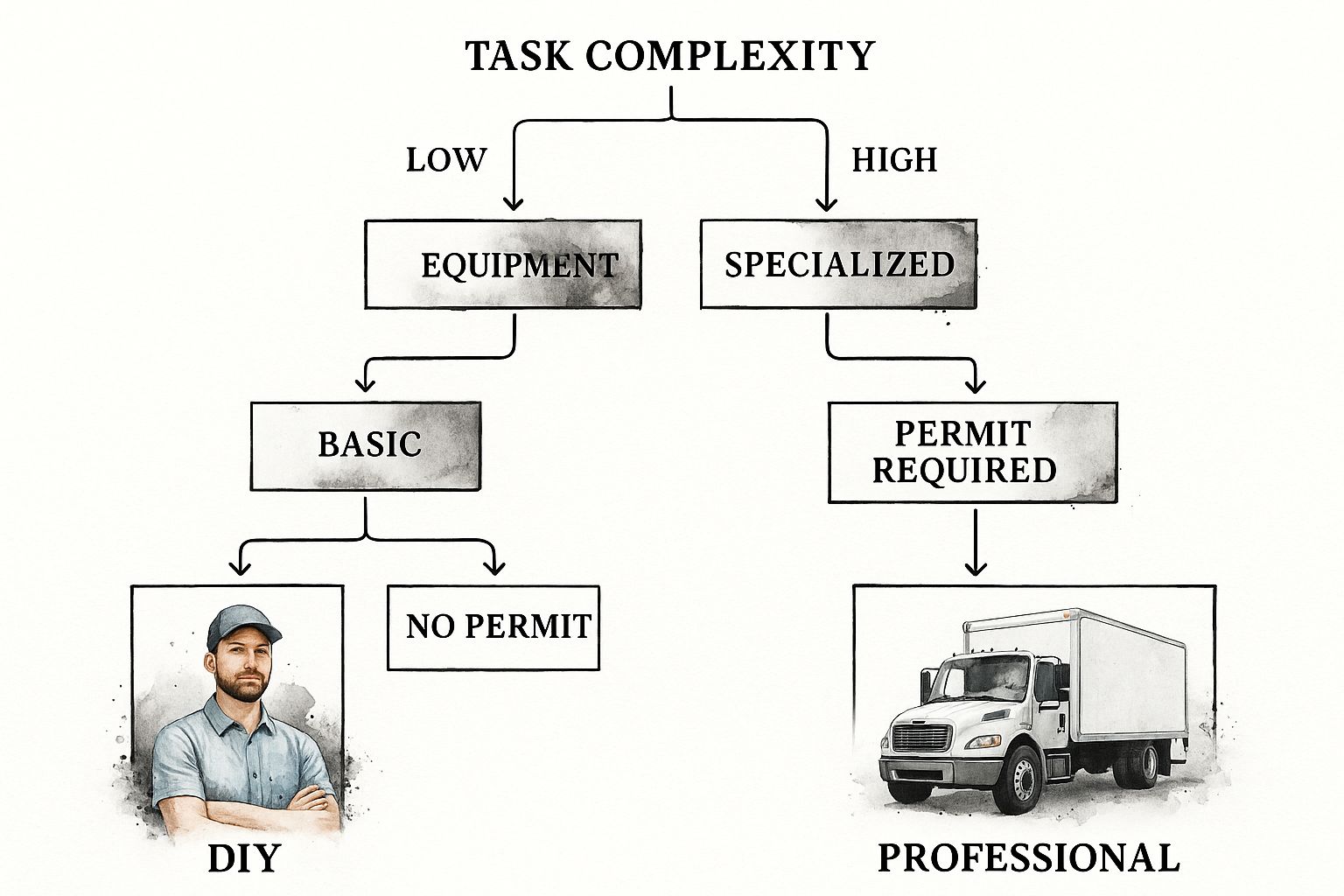
As you can see, some minor upkeep is perfectly fine for a homeowner to tackle. But when you get into tasks that require special tools or permits, it’s best to leave it to someone with experience.
Key Takeaway: A single slow drain might be a simple DIY fix. But widespread symptoms like soggy ground, foul odors, or sewage backing up into the house are red flags. That’s when you need to pick up the phone and get a professional evaluation right away.
For example, let’s say your drain field area is flooded after a heavy Colorado downpour. You might think about using a portable water pump to get rid of the standing water so you can see what’s going on. Just remember, this is a temporary band-aid to help dry things out—it won’t solve the underlying septic problem that’s preventing proper drainage in the first place.
Common Questions About Drain Field Maintenance
Even after you’ve got the basics down, a few questions always seem to pop up. When it comes to something as crucial as your drain field maintenance, you want clear, straightforward answers. I’ve heard just about every question in the book from homeowners across Denver, so let’s tackle some of the most common ones.
The first thing nearly everyone asks is how often they really need to pump their septic tank. The standard answer you’ll hear is every 3 to 5 years, but honestly, that’s just a ballpark figure. It really comes down to your specific situation—the size of your tank, how many people are in your home, and your family’s water habits. A couple living alone might go longer, while a family of five will need pumping much more frequently.
Are Septic-Safe Products Truly Safe?
Another big one is about those “septic-safe” products, especially for clearing drains. My advice? Be skeptical. While some might be less aggressive than pouring straight bleach down the drain, many still contain chemicals that can throw the essential bacteria in your tank completely out of whack.
Honestly, it’s best to skip chemical drain cleaners entirely. Your first line of defense should be preventing clogs with drain screens. If you do get a blockage, try a plumbing snake before reaching for a bottle of anything. A slow drain is often your system’s way of telling you there’s a bigger problem that chemicals won’t solve.
Expert Insight: I always tell people the best thing you can do for your septic system is to simply be mindful. The less you throw at it—fewer chemicals, less water, and zero non-flushable items—the longer and more reliably it will serve your home.
Spotting the Very First Sign of Trouble
What’s the absolute earliest red flag that your drain field is struggling? It’s probably not what you think. Forget dramatic sewage backups or smelly puddles in the yard. The first sign is usually much more subtle.
Pay attention to the little things. Is your toilet flushing with a little less gusto than it used to? Do you hear a soft gurgling sound from the drains right after you shower or do laundry? These small audio cues are your system’s early warning whispers. Catching these signs and acting on them can save you from a major headache down the road.
The Role of Broader Home Maintenance
Finally, people often ask if the rest of their home’s plumbing really affects the septic system. The answer is a huge “yes.” That tiny, dripping faucet you’ve been meaning to fix can send hundreds of extra gallons of water into your drain field over time, pushing it toward saturation.
This is why a holistic approach is so important. When you see your septic system as part of your entire home’s plumbing, you start to connect the dots. Understanding why your Denver home needs a plumbing maintenance plan helps you build a protective bubble around your entire property, ensuring everything works in harmony for years to come.
Are you facing a plumbing issue or need a reliable team to keep your system in top shape? The experts at Professional Plumber Denver are here to help with all your plumbing and drain cleaning needs in the Denver Metro area. Don’t wait for an emergency—contact us today at https://professional-plumbers-denver.com.