
Tucked away inside your water heater is a simple metal rod that most homeowners don't even know exists. Yet, this unassuming part is arguably the most critical component for ensuring your water heater lives a long, leak-free life. It’s called an anode rod, and its job is to sacrifice itself for the greater good of your hot water system.
It's a strange concept, right? A part that's designed to be destroyed. But that's exactly its genius. The anode rod is engineered to corrode and dissolve over time so that the steel walls of your water heater tank don't have to.
The Unsung Hero Inside Your Water Heater
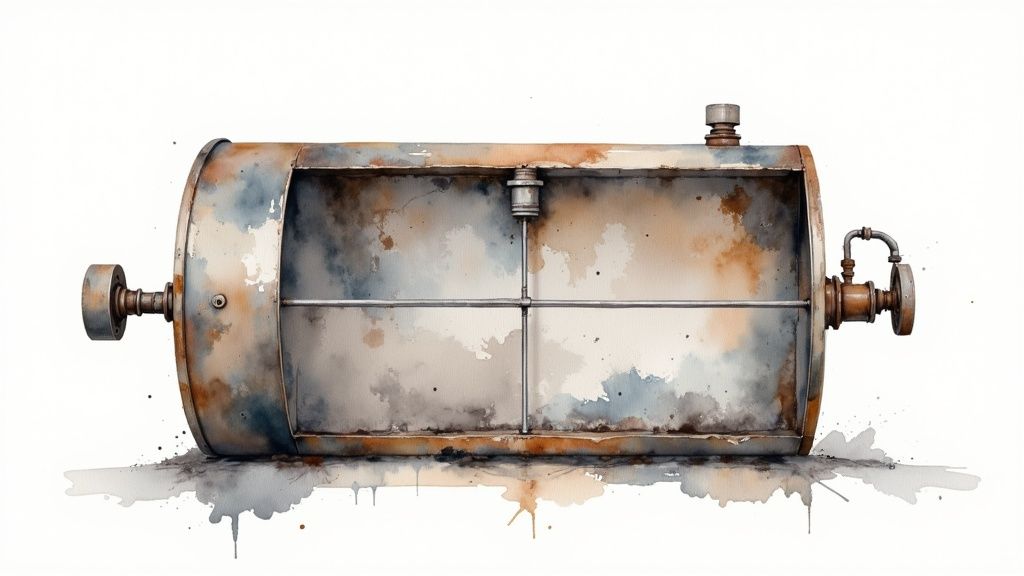
Think of your water heater tank as a steel ship navigating a corrosive sea—that's the water inside. The anode rod acts like a dedicated bodyguard, stepping in front of the ship to take all the hits. It intentionally draws the corrosive elements in the water to itself, leaving the valuable steel tank unharmed.
This clever bit of science is called cathodic protection, or galvanic corrosion. In simple terms, when you put two different metals in water, the more reactive, or "noble," metal will corrode first. Anode rods are made from metals like magnesium or aluminum, which are far more reactive than the steel of the tank. This difference in potential makes the rod an irresistible target for corrosion.
Key Takeaway: The anode rod sacrifices itself so your water heater tank doesn't have to. It's the single most important component for preventing internal rust and tank failure.
To give you a clearer picture, here's a quick summary of what this little hero does.
Anode Rod Quick Facts
| Attribute | Description |
|---|---|
| Primary Function | Acts as a sacrificial element to prevent the steel tank from rusting. |
| Scientific Principle | Utilizes galvanic corrosion (cathodic protection) to attract corrosive elements. |
| Common Materials | Typically made of magnesium, aluminum, or a zinc-aluminum alloy. |
| Lifespan | 2-5 years, depending on water quality and usage. |
| Purpose | Dramatically extends the water heater's service life and prevents premature failure. |
This sacrificial process is the backbone of modern water heater design, a technology that has been preventing catastrophic tank failures since the mid-20th century.
Why This Sacrificial Role Matters
What happens if that bodyguard goes missing? Without a working anode rod, the corrosive process attacks the next best thing: the thick steel walls of the tank itself. Rust begins to form from the inside out, silently eating away at the metal until a leak springs, often leading to a flooded basement and an emergency replacement.
In fact, most manufacturers' warranties become void if the anode rod isn't maintained. An unprotected tank that should last a decade might fail in just a few years. For a deeper dive into the materials and market for these critical parts, you can check out some recent industry analysis.
So, let's break down its job into a few core functions:
- It fights rust: This is its number one priority. It intercepts corrosion before it can touch the tank.
- It extends the heater's life: With a healthy anode rod, a water heater can easily last 10-15 years.
- It's a maintenance item: Because it's designed to be consumed, it must be checked every few years and replaced when depleted.
It helps to think of it like the brake pads on your car. They are meant to wear down with use to ensure the more critical (and expensive) parts of the braking system remain safe and functional. The anode rod works the same way, taking the wear and tear to protect your entire water heater. It’s a small, inexpensive part doing a massive job, truly the unsung hero of your home’s hot water.
How an Anode Rod Actually Works
So, how does a simple metal rod stop a huge steel tank from turning into a rusty mess? The whole trick relies on a fascinating natural process called galvanic corrosion. Honestly, it's easiest to think of it as a tiny, very slow-moving battery operating inside your water heater.
Whenever you have two different metals sitting in water (which acts as an electrolyte), a fascinating tug-of-war begins. Nature always has a winner and a loser. The more chemically reactive metal—the "less noble" one—becomes the anode and willingly sacrifices itself by corroding. The other, less reactive metal becomes the cathode, and it gets to stay protected.
This isn't an accident; it's by design. Your anode rod is intentionally made from a more reactive metal, like magnesium or aluminum, than the tank's steel lining. This setup essentially makes the rod a big, juicy target for all the corrosive gunk in your water.
By design, the anode rod is the weakest link in the system. It attracts all the corrosive action, effectively telling the rust-causing elements, "Corrode me, not the expensive steel tank!"
This sacrificial process is happening 24/7. A very small electrical current flows from the anode rod, through the water, to the steel tank. This current is what slowly eats away at the rod, causing its ions to dissolve into the water until there's nothing left.
The Science, Without the Lab Coat
Here's a simpler way to picture it. Your steel tank is a valuable castle, and the corrosive elements in the water are an invading army trying to tear down the walls. The anode rod? That's a brave group of soldiers who charge out of the castle to fight the invaders head-on.
They fight and fall, sacrificing themselves so the castle walls remain standing. As long as you have soldiers (the anode rod) on the field, your castle (the tank) is perfectly safe.
But once those soldiers are gone, the castle walls are defenseless. That's precisely what happens when your anode rod is used up. With no other target, the corrosive forces immediately start attacking the steel tank itself, leading to rust, sediment buildup, and eventually, a catastrophic leak. A typical anode rod lasts about 3 to 5 years, but this can be much shorter if your local water is particularly aggressive or hard.
Why Your Local Water Chemistry is a Big Deal
The speed at which your anode rod disappears is directly tied to the chemistry of your tap water.
- Soft Water: If you have a water softener, your water is often higher in sodium. This actually speeds up the galvanic process, causing the anode rod to corrode and dissolve much faster than it normally would.
- Hard Water: Hard water is full of minerals like calcium and magnesium. Sometimes, these minerals can build up a "scale" on the rod. While this can sometimes slow down the corrosion, it creates its own problems, like a thick layer of sediment at the bottom of your tank that kills its efficiency.
Getting a handle on this relationship is crucial. If you know your water type, you can make a much better guess as to when your anode rod needs a check-up. It's the difference between being a proactive homeowner and one who's reacting to a basement full of water. This simple piece of knowledge is your first line of defense against a messy and expensive water heater failure.
Choosing The Right Anode Rod For Your Home
Picking the right anode rod isn't a one-size-fits-all situation. The best choice for your water heater comes down to the specific chemistry of the water running through your pipes. Get this right, and you're giving your tank the best possible protection against rust and extending its life. It's really about matching the rod's material to what your water throws at it.
The image below breaks down the three main players in the anode rod game: magnesium, aluminum, and zinc-aluminum. Each one is designed for a different job.
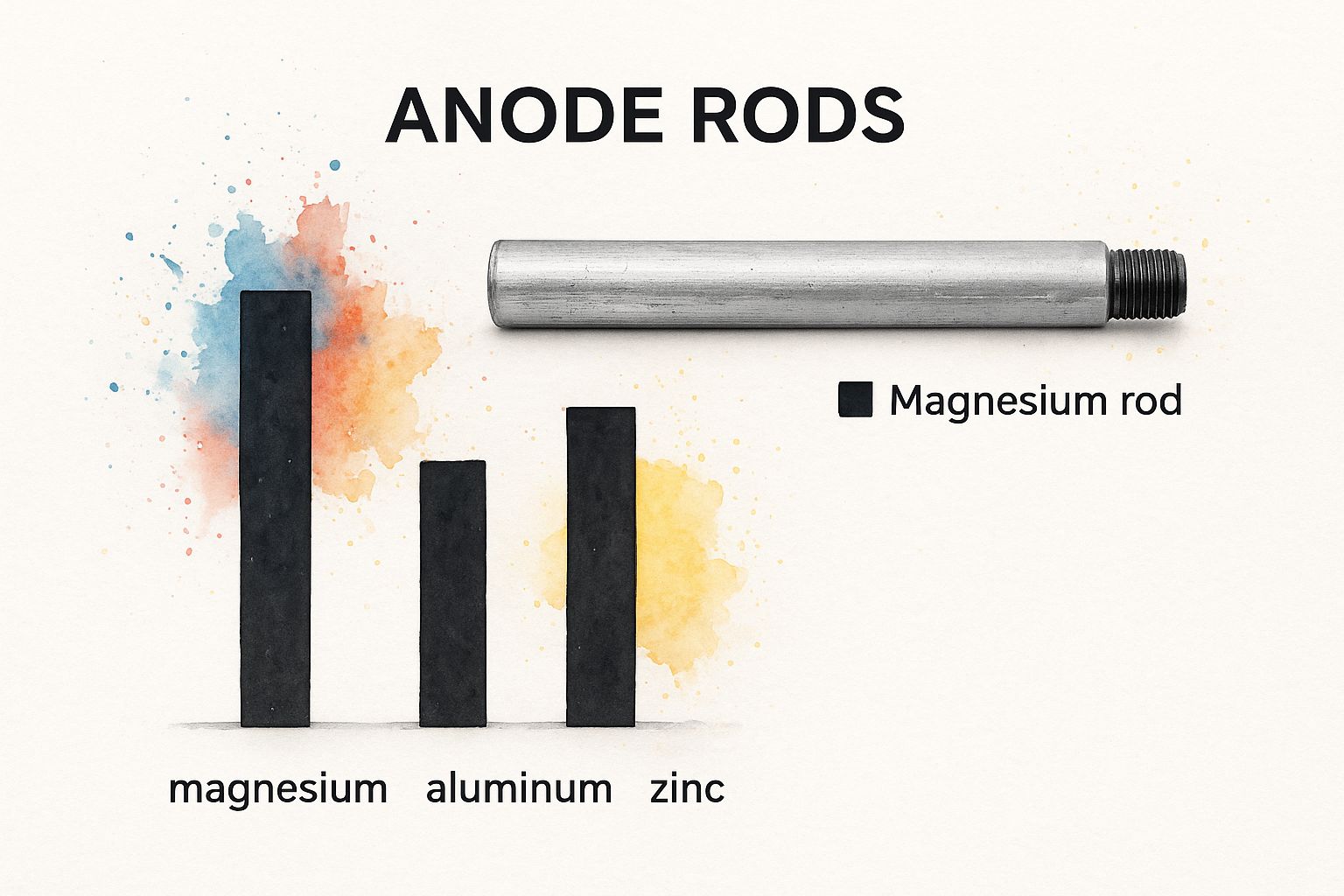
As you can see, each material has a specific purpose and solves a different kind of water problem. Let's dig into which one is right for you.
Magnesium: The Industry Standard
For most homes, a magnesium anode rod is the go-to, and for good reason. It’s what most water heaters come with from the factory. Magnesium is the most active metal on the galvanic scale, meaning it sacrifices itself more eagerly than other materials, offering the highest level of protection for your tank. If your home has soft or moderately hard water, this is almost always your best bet.
The only time its high reactivity becomes a problem is in very hard water. In that environment, a magnesium rod can sometimes create a surprising amount of sediment as it reacts with all the extra minerals, which can actually hurt your heater's efficiency.
Aluminum: The Hard Water Solution
If you know you have hard water, an aluminum anode rod is a fantastic choice. While it's still very good at preventing corrosion, aluminum is a bit less reactive than magnesium. This means it dissolves more slowly and won't create the same heavy, chunky sediment buildup that can clog up a heater in hard water areas.
Expert Tip: Aluminum rods are a durable, long-lasting option. We specifically recommend them for households where hard water minerals cause magnesium rods to get eaten up way too fast.
If you find yourself constantly flushing sediment from your tank or notice your magnesium rods are toast after just a couple of years, making the switch to aluminum is a smart, practical move.
Zinc-Aluminum: The Odor Killer
Ever turn on the hot water and get hit with that unmistakable "rotten egg" smell? That stinky situation is usually caused by sulfur-reducing bacteria, which love to set up camp in water heaters—especially in homes with well water. These little critters react with standard anode rods and produce hydrogen sulfide gas, which is what you're smelling.
A zinc-aluminum anode rod is the perfect fix. It's essentially an aluminum rod with about 10% zinc added to the mix. The zinc is the magic ingredient here; it poisons the bacteria, stopping the chemical reaction that creates that awful smell. If smelly water is your problem, this is your solution.
To help you decide, here’s a straightforward comparison of how the three types of anode rods stack up for different water situations.
Magnesium vs. Aluminum vs. Zinc-Aluminum Anode Rods
This table breaks down the key differences to help you choose the best anode rod based on your water type and needs.
| Material Type | Best For | Pros | Cons |
|---|---|---|---|
| Magnesium | Homes with soft water | Provides the highest level of tank protection. | Can corrode too quickly in hard water and create sediment. |
| Aluminum | Homes with hard water | Durable, long-lasting, and reduces sediment buildup. | Offers slightly less protection than magnesium. |
| Zinc-Aluminum | Homes with smelly water | Effectively eliminates "rotten egg" odors. | Only necessary if you have a specific odor problem. |
By taking a moment to understand your water quality, you can confidently pick the anode rod that will serve your home best. Making the right choice leads to better protection, fewer headaches, and a much longer life for your water heater.
Key Signs Your Anode Rod Needs Replacement
Your anode rod works silently in the background, sacrificing itself piece by piece, day after day. It's designed to corrode so your tank doesn't have to. The tricky part is, it doesn't just "break" one day—it slowly disappears. This is why you have to know the warning signs that your rod is used up and the corrosive elements in your water have started attacking the steel tank itself.
Catching these symptoms early is your best defense against a premature and costly tank failure. Ignoring them is like driving with your oil light on; you might get away with it for a little while, but a much bigger, more expensive problem is just around the corner. Thankfully, your water heater usually gives you a few clues that it’s time for a new anode rod.
Foul-Smelling Hot Water
The most common and unmistakable sign is that rotten egg smell coming only from your hot water taps. If the cold water smells fine, you can be almost certain the problem is brewing inside your water heater. That nasty odor is caused by hydrogen sulfide gas, which is produced when certain bacteria in the water supply react with a magnesium or aluminum anode rod.
This is a frequent headache for homes with well water, but it can pop up in city water systems, too. If you've started holding your nose every time you turn on the hot water, it's a clear signal that your anode rod needs attention. Often, the fix is as simple as swapping the old rod for a zinc-aluminum alloy version, which is specifically made to combat these odor-causing bacteria.
Key Insight: A foul odor from your hot water is your water heater talking to you. It's saying the anode rod is either failing or reacting badly with your water chemistry, and it’s time for an inspection.
Noises and Discolored Water
Your ears and eyes can also tip you off to a failing anode rod. Pay attention to any new sounds coming from the heater or changes in the water itself.
- Popping or Banging Sounds: Once an anode rod is gone, sediment and mineral scale build up much faster at the bottom of the tank. When the burner or heating element kicks on, it superheats the water trapped underneath this gunk, causing it to boil and create steam pockets that pop, rumble, or bang.
- Rusty or Discolored Water: This one is a major red flag. If your hot water comes out brown, orange, or has a rusty tint, the anode rod is almost certainly gone. The water is now eating away at the steel tank. By the time you see this, the damage might already be done.
While these symptoms often point to a spent anode rod, they can sometimes signal bigger trouble. It’s wise to understand the early signs it's time to replace your water heater to know if a simple rod swap will do the trick or if a complete failure is on the horizon.
The Best Sign Is No Sign at All
Honestly, the best way to handle your anode rod is to be proactive. Don't wait for smelly water or strange noises to tell you there's a problem.
The smartest approach is to simply check the rod every 2 to 3 years, regardless of whether you suspect an issue. This lets you see its actual condition instead of just reacting to a problem. A quick visual inspection will tell you everything you need to know.
Set a reminder on your calendar. When you pull the rod out and see it's about 75% corroded or looks like a wire coathanger, it's time for a new one. This simple, preventative step keeps your tank protected at all times, stretching its service life and saving you the headache of an emergency replacement.
How to Inspect and Replace Your Anode Rod
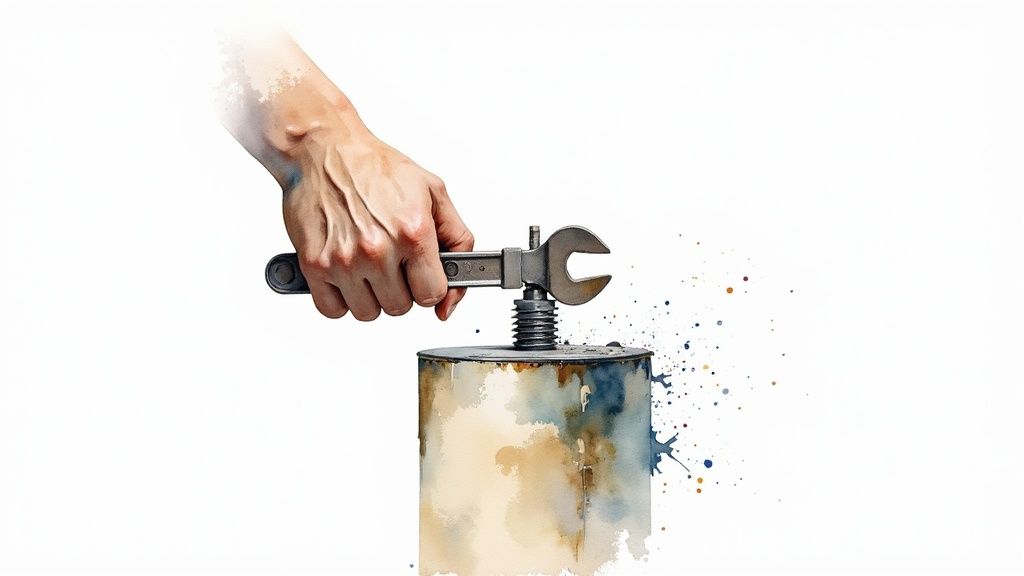
Alright, are you ready to get your hands dirty with a little water heater maintenance? Don't worry, this isn't as intimidating as it sounds. Checking and swapping out your anode rod is one of those simple DIY jobs that can save you from a catastrophic (and expensive) tank failure down the line.
Let's walk through this step-by-step. I'll cover everything from prepping your workspace to deciding if your old rod is truly done for.
Safety First: Don't Skip These Steps
Before you even lay a wrench on your water heater, we need to talk about safety. A few minutes of prep work here is non-negotiable—it’s what keeps this a simple project instead of a trip to the ER or a call to a restoration company.
-
Kill the Power: Head over to your circuit breaker box and flip the switch for your water heater to the OFF position. For a gas heater, you'll want to turn the gas control knob to "PILOT" or all the way to "OFF".
-
Turn Off the Water: Find the cold water inlet valve, which is usually a handle on the pipe going into the top of your tank. Turn the handle clockwise all the way until it stops. This cuts off the water supply.
-
Relieve Tank Pressure: Now, just go to any sink or tub in your house and turn on a hot water faucet. You'll hear some gurgling as the pressure inside the tank bleeds off. This simple step prevents you from getting a surprise geyser when you pull the rod out.
The Nitty-Gritty: Inspection and Replacement
Once you've handled the safety prep, you're good to go. The anode rod's hex head is almost always on the very top of the water heater, though some models hide it under a little plastic cap.
Tool Tip: You'll need a 1 1/16-inch socket and, trust me on this, a breaker bar. Anode rods are cranked down incredibly tight at the factory, and you’ll need the extra leverage of a long breaker bar to get that initial "pop" and break it loose.
Fit the socket over the hex head and use your breaker bar to turn it counter-clockwise. It's going to take some real muscle. If your water heater is tucked into a closet with low overhead clearance, don't panic. You can buy a flexible, chain-like anode rod that bends as you feed it into the tank.
With the old rod out, give it a good look. Here’s what you’re watching for:
- Heavy Pitting: Is the rod covered in deep craters and gouges?
- Serious Thinning: Has it corroded away to less than half its original thickness?
- Exposed Core Wire: Can you see the skinny steel wire running down the center?
If you answered "yes" to any of these, it's time for a replacement. A completely spent rod often looks like a thin, crusty wire—it has given its all and has nothing left to protect your tank.
Installing the new rod is the easy part. Wrap the threads with plumber's tape (the white Teflon kind) about three or four times, going in a clockwise direction. This helps create a perfect, leak-proof seal. Screw the new rod in by hand, then finish it off with your wrench, giving it about a half-turn to get it nice and snug.
When to Wave the White Flag and Call a Pro
While this is a fantastic DIY task, there are definitely times when calling a professional plumber is the smart play. If the rod is so corroded that it snaps off at the head when you try to remove it, or if it simply won't budge no matter what, stop right there. Continuing to force it can cause more damage.
Likewise, if you just don't feel comfortable with any part of this process, there's no shame in calling for backup. A pro can get this done quickly and correctly. A small service fee is always a better investment than accidentally causing a major leak. For a broader look at keeping your system in top shape, check out our comprehensive guide on hot water heater maintenance.
Anode Rods in the Wider World
It might surprise you, but that simple anode rod tucked away inside your water heater is a small-scale version of a technology that protects some of the most expensive and vital infrastructure on the planet. The very same scientific principle, known as cathodic protection, that keeps your water tank from turning into a rusty mess is also used to safeguard massive industrial assets from decay.
Think about the colossal steel structures constantly battling corrosive environments like saltwater or damp soil. Without this kind of protection, these assets would rust away in just a few years, leading to disastrous failures and eye-watering financial losses.
From Your Basement to Global Infrastructure
Sacrificial anodes are the unsung heroes working 24/7 in all sorts of heavy industries. Their job is exactly the same as the one in your home, just on an epic scale.
- Offshore Oil Rigs: These multi-billion dollar platforms are under constant assault from corrosive seawater. To combat this, enormous sacrificial anodes, sometimes weighing hundreds of pounds each, are welded directly onto the steel support legs to stop them from rusting out.
- Underground Pipelines: Thousands of miles of steel pipelines carry critical resources like oil, gas, and water across entire continents. Anodes are buried right alongside these pipes and connected to them, essentially pulling the corrosive attack away from the pipeline and onto themselves.
- Ships and Submarines: The hulls of any vessel spending time in the water are a prime target for rust. You'll find blocks of zinc or aluminum attached to the hull below the waterline, where they slowly dissolve to protect the ship’s structural integrity.
This widespread use in heavy industry really drives home just how valuable cathodic protection is. The global market for a specific type of durable anode—high silicon cast iron (HSCI)—was valued at roughly $1.2 billion in 2022 alone. And that number is only expected to climb as industries continue to rely on this proven method to protect their investments.
It's pretty amazing when you connect the dots between the rod in your basement and a massive anode bolted to an oil rig. It’s a powerful reminder of how a simple, elegant scientific solution can be scaled up to prevent enormous problems.
This technology isn't just for heavy industry; it's a universal principle that protects a whole range of systems. To see how anode rods fit into different heating systems, including modern heat pump water heater technologies, you just have to remember their one core function: protection. The same principle applies whether it's a 40-gallon tank in a home or a massive commercial boiler.
At the end of the day, the anode rod in your water heater isn't just some random component. It’s a piece of time-tested industrial technology that directly benefits you and your home. Keeping it in good shape is one of the most important things you can do to maximize your water heater's lifespan and make sure you get reliable hot water for years to come.
Anode Rod FAQs: Your Questions Answered
Even after getting the basics down, you probably still have some practical questions buzzing around. That's completely normal. Let's tackle some of the most common ones I hear from homeowners, so you can feel confident about keeping your water heater in top shape.
How Long Does a New Anode Rod Last?
You can generally expect a new anode rod to last about 3 to 5 years, but that’s just a ballpark figure. The real answer depends almost entirely on your water.
If you have soft water, which tends to be more corrosive, you might find your rod is depleted in as little as 2 or 3 years. On the flip side, if your local water is less aggressive, you might get a bit more life out of it. The only way to know for sure is to pull it out for a quick visual inspection every couple of years. It’s a little effort that takes all the guesswork out of the equation.
Can My Water Heater Work Without an Anode Rod?
Technically, yes, your water heater will still heat water without an anode rod. But doing so is an exceptionally bad idea. Without that rod, you're leaving your expensive steel tank completely defenseless against rust.
Think of it like firing a bodyguard. The tank, which should have lasted a decade or more, is now a sitting duck for corrosion. Running a heater without an anode rod is also a surefire way to void your manufacturer’s warranty.
What Happens When the Anode Rod Is Completely Gone?
Once that sacrificial rod has dissolved entirely, the corrosive process doesn't just stop. It immediately looks for a new metal to attack, and the next thing on the menu is the steel lining of your water heater tank.
This is where the real trouble begins. Rust starts to form inside, leading to sediment buildup at the bottom and, inevitably, a tank leak. A small, preventable maintenance task can quickly escalate into a catastrophic leak, causing major water damage and forcing you into an emergency replacement.
Is a Powered Anode Rod a Good Investment?
Powered anode rods are a newer technology that offers a different approach. Instead of sacrificing itself, it uses a tiny, continuous electrical current to disrupt the corrosion process. They cost more upfront, no doubt, but they’re designed to be a permanent fix—you install one, and you’re done.
For homeowners in areas with notoriously aggressive water or for anyone who simply wants a "set it and forget it" solution, a powered anode rod can be a fantastic long-term investment. It completely eliminates the need for those future inspections and replacements.
If you’re dealing with any of these issues or would just rather have a pro handle the job, Professional Plumber Denver is ready to help. Our team has the right tools and expertise to inspect and replace your anode rod correctly, giving you peace of mind that your water heater is protected. Visit us at https://professional-plumbers-denver.com to book an appointment.