
Dealing with a main sewer line problem is one of those homeowner nightmares nobody wants to face. But getting a handle on what's happening is the first real step toward fixing it. Your home's main sewer line is the single most important pipe in your entire plumbing system. It's the final exit route, responsible for carrying all wastewater from your house out to the city sewer or your septic tank.
When that critical pipe is damaged beyond a simple fix, a main sewer line replacement is often the only long-term solution to prevent nasty backups and serious property damage.
Your Guide to Main Sewer Line Replacement
A great way to picture your plumbing is to think of it like a tree. All the smaller pipes from your sinks, toilets, and showers are like branches. They all connect to one big trunk that runs underground out of your house—that’s the main sewer line. When that trunk gets cracked, crushed by shifting soil, or choked out by tree roots, the whole system grinds to a halt.
A full replacement is much more than a quick patch job. It’s a major project that swaps out that old, failing pipeline for a new one, guaranteeing your home’s wastewater has a clear, reliable path for years to come. This isn't a simple DIY weekend project; it requires a professional diagnosis, careful planning, and expert execution to get your plumbing back in working order with as little disruption as possible.
Understanding the Core Problem
So, what causes a main line to fail so catastrophically? Often, it's just a matter of age and materials. Older homes, particularly those with original clay or cast-iron pipes, are ticking time bombs. Decades of use cause these materials to corrode, crack under pressure from the soil above, or fall victim to thirsty tree roots.
A few of the most common culprits we see are:
- Pipe Belly: This happens when a section of the pipe sags, creating a low spot. Waste and water pool in this "belly" instead of flowing downhill, leading to constant clogs.
- Complete Collapse: The pipe is literally crushed flat, usually from age, heavy soil, or something heavy being driven over it. This creates a total blockage.
- Severe Root Intrusion: Tree roots are incredibly powerful. They can sneak into tiny joints in the pipe, and once inside, they expand and create a thick web that catches everything, eventually breaking the pipe wide open.
A main sewer line is out of sight but should never be out of mind. Proactive inspection and recognizing early warning signs can be the difference between a manageable repair and an emergency replacement.
Knowing what to look for is half the battle. Including a plumbing check in your yearly house maintenance checklist can help you catch problems early and budget for potential big-ticket repairs down the road.
Quick Guide to Sewer Line Symptoms
To help you connect the dots between what you’re seeing around the house and a potential main line issue, here's a quick reference table. It can help you figure out just how serious the problem might be.
| Symptom | What It Could Mean | Urgency Level |
|---|---|---|
| Multiple Drains Backing Up | The blockage isn't in a single drain; it's downstream in the main line. | High |
| Gurgling Sounds from Toilets | Air is getting trapped and forced back up, a classic sign of a main line clog. | Medium |
| Unpleasant Odors in the Yard | Raw sewage is likely leaking from a cracked or broken underground pipe. | High |
| Soggy or Lush Patches of Grass | A hidden underground leak is fertilizing one spot in your lawn. | Medium to High |
If you spot any of these signs, especially more than one at the same time, it’s a strong signal that the problem lies with your main sewer line and it’s time to call in a professional for a camera inspection.
Recognizing the Warning Signs of a Failing Sewer Line
Your home's plumbing system rarely fails without warning. It usually sends out distress signals—subtle whispers at first—that can escalate into a messy, expensive shout if you don't listen. Learning to spot these early clues is the key to catching a major sewer line problem before it turns into a full-blown catastrophe.

Think of it this way: a single clogged sink is like a neighborhood traffic jam. It's annoying, but it's contained. But when you have multiple drains backing up at once, that’s a sign the main highway out of town is completely blocked. This is the classic signal that your main sewer line is in deep trouble.
For instance, if flushing an upstairs toilet makes water bubble up in your first-floor shower, that's a huge red flag. The wastewater has nowhere to go, so it’s forced back up through the lowest point it can find. This is one of the clearest signs that a main sewer line replacement could be in your future.
Listen to What Your Drains Are Telling You
Sometimes, the clues aren't visual; they're audible. Do you hear strange gurgling sounds coming from your drains or toilets after a flush? That's not just a weird quirk—it's your plumbing trying to tell you something is wrong.
Those gurgles happen when a partial clog in the main line traps air. As water struggles to get past the obstruction, it shoves that trapped air back up the pipes, creating that unmistakable sound. It’s the plumbing equivalent of a congested cough, and it means the system can't breathe properly.
A gurgling toilet isn't just a quirky noise; it's an early alert system. It indicates a pressure imbalance in your main sewer line, often caused by a developing blockage from roots, debris, or a sagging pipe section.
Paying attention to these sounds gives you a chance to act before a partial clog becomes a complete one. For a more detailed breakdown, our guide on the signs you need a sewer line replacement in Denver offers more local insights.
Follow the Clues Outside Your Home
The evidence of a failing sewer line isn't always inside your house. Sometimes, the most telling signs are right there in your yard. A broken or leaking sewer pipe will almost always leave its mark on your landscape.
Keep an eye out for these outdoor indicators:
- Soggy Spots or Extra-Green Grass: Is one patch of your lawn suspiciously lush and green, even in dry weather? It might be getting some unwanted "fertilizer" from a cracked sewer line leaking wastewater directly into the soil.
- Foul Odors in the Yard: You know the smell of sewage. If you catch whiffs of it in your yard, it’s a strong sign that wastewater is escaping the pipe before it ever reaches the city main.
- Foundation Cracks: A chronic leak can saturate the ground around your foundation. Over time, this can cause the soil to shift, leading to cracks in your foundation slab, driveway, or patio.
- Sudden Pest Problems: A break in the sewer line is an open invitation for rodents. If you notice a sudden increase in pests, they might be using your compromised sewer pipe as a highway into your home.
Another common, but hidden, problem is a "bellied" pipe. This is when a section of the line sags due to soil movement, creating a low spot where waste and paper collect. You can snake it all you want, but the blockage will keep coming back. The only permanent fix for a belly in the line is a targeted repair or a full main sewer line replacement. Catching these signs early is your best defense against a much bigger headache down the road.
What Does a Main Sewer Line Replacement Actually Cost?
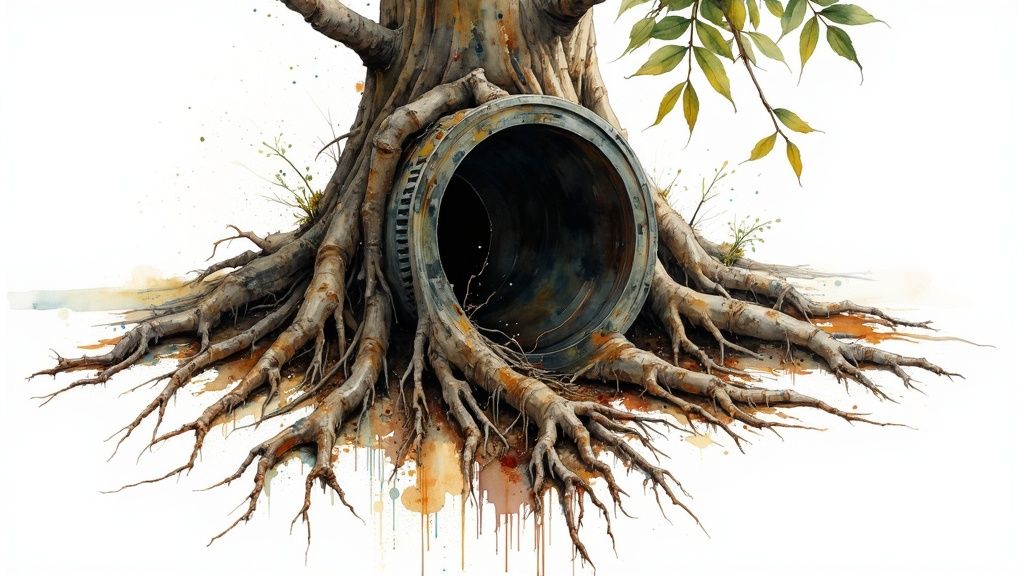
Trying to pin down the cost of a main sewer line replacement can feel like chasing a moving target. You hear one number from a neighbor and get a completely different quote for your own home. The truth is, there’s no one-size-fits-all price tag.
Think of it less like buying an appliance and more like a custom construction project. The final bill is a direct result of your property’s unique challenges. A simple job in an open, grassy yard is one thing; a complex replacement that has to navigate under your prized rose garden and concrete patio is a whole different ballgame.
Let’s pull back the curtain on what really goes into a professional estimate. By understanding the key variables, you can make a confident, well-informed decision for your home.
Key Factors That Drive the Final Cost
When a professional plumber gives you a quote, they’re not just pulling a number out of thin air. They’re assessing several critical factors that add up to the final cost.
Here are the main things that will move the needle on your estimate:
- Pipe Length and Depth: This one’s pretty straightforward. The more pipe you need to replace, the higher the cost for both materials and labor. A 100-foot line will naturally cost more than a 40-foot one, and deeper pipes require more extensive digging.
- Accessibility of the Line: Where is the pipe, really? If it’s under an open lawn, access is easy. But if it’s buried beneath your driveway, a century-old oak tree, or a custom-built deck, the job instantly gets more complicated. Demolition and restoration work add significant expense.
- Choice of Pipe Material: Most modern replacements use durable, cost-effective PVC or ABS pipes. If your home has older materials like heavy cast iron or brittle clay, the labor to remove and dispose of it properly will be factored into the price.
Don't forget about the "hidden" costs. The final bill isn't just for the new pipe. It also has to cover city permits, extensive landscaping repairs, and potentially even concrete work, all of which can add thousands to the bottom line.
This is a major home repair, and it reflects a nationwide issue. The global sewer service market hit around $15 billion annually in the mid-2020s. Why? Because much of our country's infrastructure is getting old and needs serious work to keep our homes and communities safe.
Traditional Trenching Versus Trenchless Methods
The single biggest factor that impacts both the cost and the mess is the method used for the replacement. Your two main options are old-school trenching (digging up the old pipe) and modern trenchless technologies. Each comes with a very different price tag and level of disruption.
To get a feel for what this might cost in our area, you can dig deeper into our guide on the average cost of sewer line replacement.
Comparing Replacement Method Costs and Impacts
To really see the difference, it helps to compare the two approaches side-by-side. The table below breaks down not just the upfront price but also the indirect costs and timelines that can make or break your budget and your sanity.
| Feature | Traditional Trenching | Trenchless Methods (Bursting or Lining) |
|---|---|---|
| Initial Cost | Tends to be lower for the plumbing work itself. | Higher upfront cost due to specialized equipment and materials. |
| Property Disruption | High. A large, destructive trench is dug across your yard, tearing up lawns, gardens, and driveways. | Minimal. Only small entry and exit points are needed, leaving your yard mostly untouched. |
| Restoration Costs | Significant. You'll need to budget to re-sod the lawn, rebuild patios, and repave driveways. | Low to None. Because your landscaping and hardscaping are preserved, you save thousands. |
| Project Timeline | Longer. The entire process of digging, replacing, and restoring can take several days or even a week. | Much faster. The job is often finished in just one or two days. |
| Best For | Completely collapsed lines or properties with lots of open space where digging won't cause major damage. | Properties with mature landscaping, driveways, or other structures located over the sewer line. |
So, what’s the bottom line? While trenchless methods can seem more expensive on paper, they often end up being the smarter financial choice. Once you add up the massive savings from not having to rebuild your yard, the value becomes crystal clear.
What Happens During a Main Sewer Line Replacement?
Knowing what to expect when you replace a main sewer line can really take the anxiety out of the equation. It's a big job, no doubt, but it follows a clear, predictable path. Once you understand the steps involved, you can prepare your home, ask informed questions, and feel confident as the pros get your plumbing system back in order.
Think of it like a major but necessary surgery for your house. Just as a surgeon needs an MRI to see exactly what's wrong before making an incision, a plumber needs to see inside your pipes. The whole process is designed to be thorough—no guesswork, just a permanent fix.
Phase 1: Diagnosis and Planning
It all starts with a video camera inspection. This is non-negotiable. A technician will thread a high-resolution camera on a flexible line down into your sewer system, giving everyone a live, real-time view of what’s happening underground.
This camera feed is the only way to get undeniable proof of the problem. Your plumber can show you precisely where tree roots have broken through, find the exact spot where a pipe has collapsed, or identify a severe "belly" (a dip in the line) that’s causing chronic backups. It confirms that a full main sewer line replacement is the right call, not just another temporary patch.
Once the diagnosis is clear, the planning phase kicks in. This typically involves:
- Getting Quotes: You should receive a detailed, written estimate that breaks down the scope of work, the replacement method (traditional trenching or a trenchless option), materials, and the total cost.
- Securing Permits: Most towns and cities require permits for this kind of major plumbing work. A reputable contractor will handle this entire process for you, ensuring everything is up to local code.
- Locating Utility Lines: Before a single shovel hits the dirt, a service is called to mark the location of all underground utilities—gas, electric, water, and cable lines. This is a critical safety step that prevents dangerous and expensive accidents.
The camera inspection isn't just for the plumber; it's for your peace of mind. It provides clear visual evidence of the damage, so you know you're investing in the correct solution for the actual problem.
With a solid plan in place, the physical work can begin. This is when your property becomes an active work zone, but thankfully, it's usually for a short time.
The image below shows the basic stages of a traditional replacement, from the initial inspection to the final installation.
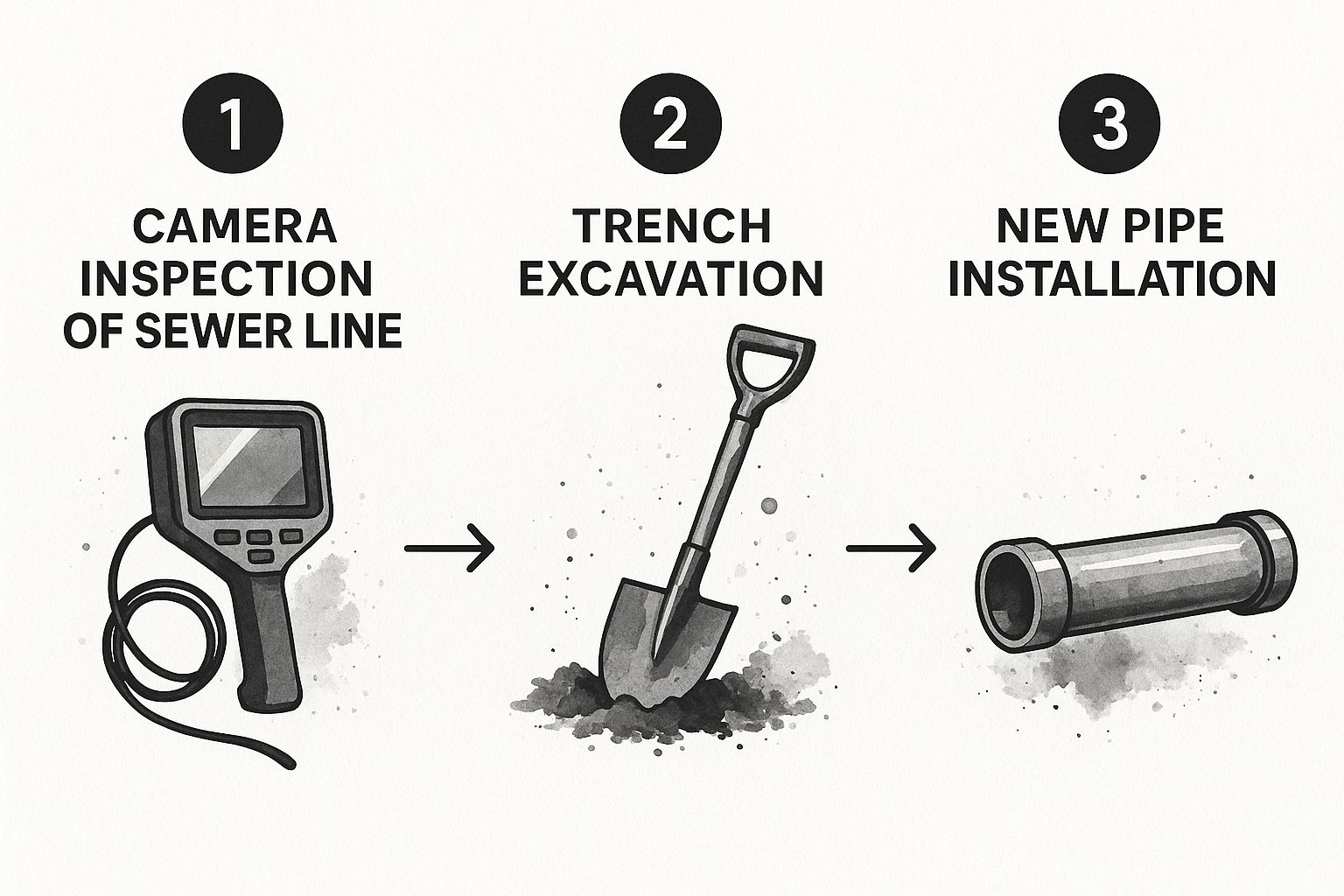
As you can see, each step builds on the last, creating a methodical workflow that brings your home’s essential plumbing back to life.
Phase 2: The Hands-On Replacement Work
This is where the real action happens and is the most intensive part of the project. If you've opted for a traditional replacement, a backhoe will carefully dig a trench following the path of the old pipe. If you're going with a trenchless method, the crew will only need to dig small entry and exit pits, which saves most of your landscaping.
Next, the crew gets to work removing the old, damaged pipe sections. It’s important to get that failing material out of the ground for good.
Once the path is clear, they lay the new pipe. Today, professional plumbers almost always use tough PVC or ABS pipes. These modern materials are fantastic because their smooth interior surfaces resist clogs and they're incredibly resistant to root intrusion and corrosion.
Proper installation here is everything. The new pipe has to be laid at a very specific and consistent slope—usually a quarter-inch drop for every foot of pipe. This precise angle, called the "fall," is what allows gravity to do its job, pulling waste and water away from your house effortlessly.
Phase 3: Final Testing and Putting It All Back Together
Just because the new line is in the ground doesn't mean the job is done. Before the trench is filled, the crew performs critical tests to make sure the new installation is perfect. This often involves a pressure test, where they fill the pipe with water or air to confirm there are absolutely no leaks at the joints.
A city inspector will also visit the site to give the work a final approval. This is your protection as a homeowner—it confirms the job was done right and meets all local codes for materials, depth, and slope.
After the inspection passes with flying colors, the restoration process begins.
- The trench is carefully backfilled, usually in layers, and compacted to prevent the ground from settling or sinking later on.
- The crew then grades the soil to match the rest of your yard as closely as possible.
- If any sidewalks, patios, or other hardscaping had to be removed, they will be repaired or replaced as outlined in your contract.
With the final cleanup complete, your home’s plumbing system is officially back in business. You’re left with a brand-new main sewer line, built from modern materials and ready to give you decades of trouble-free service.
Choosing Between Trenching and Trenchless Replacement

When it's time for a main sewer line replacement, the first big question is always the same: are we going to have to dig up the yard? The answer boils down to choosing between traditional trenching and modern trenchless methods. This decision is a big one, affecting everything from the project's cost and timeline to the state of your landscaping when it's all over.
Think of it like this: traditional trenching is the open-heart surgery of plumbing. It’s direct and gets the job done, but it definitely leaves a major scar on your property. On the flip side, trenchless methods are more like laparoscopic surgery—they fix the problem from the inside with minimal disruption.
Getting a handle on what each approach involves is the first step to making a smart decision for your home.
The Traditional Trenching Method
This one is pretty straightforward. A backhoe carves out a long, open trench that follows the path of your old sewer line. This gives the crew direct access to physically remove the damaged pipe and lay a brand-new one.
For years, this was the only way to do it, and it’s still the right call in certain situations.
- When It's Necessary: If a pipe has completely collapsed or developed a severe sag (a "belly"), trenching is often the only option. You need a stable, properly graded foundation for the new pipe, and digging a fresh trench is the only way to guarantee that.
- Property Impact: The downside is easy to see—and it’s a big one. This method tears up everything in its path, from your lawn and flower beds to driveways and walkways. The cost of putting all that back together has to be added to the total project price.
The Rise of Trenchless Technology
Trenchless sewer replacement has been a complete game-changer, especially for homeowners who want to protect their landscaping. Instead of a massive ditch, the work is done through a couple of small access holes. There are two main ways it's done.
Pipe Bursting: This is a clever and powerful technique. A machine pulls a brand-new, super-durable pipe through the old one. Attached to the front is a "bursting head" that fractures the old, failing pipe outward into the soil, clearing the way for the new one to take its place. It’s like magic.
Pipe Lining (CIPP): Cured-in-place-pipe (CIPP) is all about building a new pipe right inside the old one. A flexible liner saturated with a special resin is inserted and inflated, pressing it against the walls of the existing pipe. Once the resin cures and hardens, you have a seamless, joint-free pipe that’s often stronger than the original. We cover this in more detail in our guide to sewer line repair without digging.
Trenchless technology isn't just about saving your garden. While the procedure itself might cost more upfront, you often save a lot of money overall by not having to pay thousands to rebuild a patio or replant mature trees.
This move toward less destructive methods is happening everywhere. In fact, spending on municipal pipe infrastructure is expected to hit $117 billion between 2025 and 2035. The real story, though, is that rehabilitation projects are growing at a staggering 15.1% annual rate—much faster than new installations. It shows a clear industry-wide shift toward smarter, more efficient solutions.
In the end, there's no single "best" method. The right choice for you depends entirely on what’s happening underground, and a professional camera inspection is the only way to find out for sure.
Common Questions About Sewer Line Replacement
https://www.youtube.com/embed/Bx-YgqqHs2U
When you're facing a main sewer line replacement, you’ve got questions. It’s a big job, and it’s natural to wonder about everything from the cost to how long your yard will be torn up and, most importantly, how to avoid this whole mess in the future.
Getting straight answers is the first step toward taking control of the situation. Let's walk through some of the most common questions we hear from homeowners just like you.
How Long Does the Entire Replacement Process Take?
This is usually the first thing people ask, and the answer really boils down to one thing: the method used for the replacement.
- Traditional Trenching: This is the old-school way, involving digging a long trench to access the entire pipe. Because of all the excavation, you can expect this to take anywhere from 2 to 5 days. That timeline covers everything—the digging, laying the new pipe, city inspections, and filling the trench back in.
- Trenchless Methods: Modern techniques like pipe bursting are a game-changer. They require very little digging, which means a skilled crew can often get the entire job done in just 1 day. The speed and minimal disruption are huge selling points for this approach.
No matter which method is chosen, things like bad weather or waiting on a city inspector can add delays. A good contractor will always give you a realistic timeline upfront so you know exactly what to expect.
Will My Homeowner's Insurance Cover This?
This is the million-dollar question, and unfortunately, the answer isn't always simple. Most standard homeowner's insurance policies do not cover damage from gradual wear and tear. Problems that develop over time—like corrosion in old cast iron pipes or slow-growing tree roots—are typically considered maintenance issues, leaving the homeowner responsible for the bill.
There are, however, some exceptions. Your policy might step in if the damage was from a "sudden and accidental" event. For instance, if a different utility crew was digging on your property and accidentally hit and broke your sewer line, that’s a different story and could be a covered claim.
The big dividing line for insurance is whether the damage happened slowly over time or all at once. You should always pull out your policy and call your agent to be certain about your coverage before making any assumptions.
It’s also worth asking your agent about a "service line coverage" endorsement. This is an optional add-on that can protect your underground utility lines for a small extra premium each year, and it’s often well worth the peace of mind.
How Can I Prevent Future Sewer Line Problems?
After you've gone through the hassle and expense of replacing your sewer line, you want to make sure it's the last time you ever have to think about it. The great news is that modern PVC pipes are lightyears ahead of old clay or cast iron when it comes to durability and fending off roots. Still, a little bit of prevention goes a long way.
Here are a few smart habits to protect your new line for decades to come:
- Watch What You Flush: Your toilet is not a trash can. The only things that should ever be flushed are human waste and toilet paper. So-called "flushable" wipes are one of the biggest culprits for clogs, along with paper towels, cotton swabs, and other garbage.
- Be Smart with Landscaping: If you love big trees, just be mindful of where their root systems are going. While new PVC pipes have tight, solvent-welded joints that are highly resistant to root intrusion, it's still a bad idea to plant a new tree directly on top of your sewer line's path.
- Schedule Regular Check-ups: Think of it like a check-up for your home's plumbing. Having a professional run a camera through your line every 2 to 3 years is a smart, proactive move. It lets you spot any minor issues, like a developing sag in the pipe, long before they turn into a full-blown catastrophe.
Navigating a major plumbing project like this requires expertise you can trust. At Professional Plumber Denver, we have the experience to diagnose your sewer line issues accurately and provide the most effective, long-lasting solutions for your home. If you're facing sewer problems in the Denver Metro area, contact us for a professional assessment. Find out more at https://professional-plumbers-denver.com.