
You’ve probably heard the term “hard water” before, but what does it actually mean? Put simply, hard water is water that’s loaded with dissolved minerals, mostly calcium and magnesium.
Imagine water as a traveler. As it journeys through the ground, it picks up these minerals like invisible souvenirs. The more it collects, the “harder” the water becomes.
Understanding What Makes Water Hard
The story of hard water begins underground. When rain falls, it’s naturally soft. But as it seeps through the earth and flows over rock formations—especially limestone, chalk, and gypsum—it dissolves and picks up bits of calcium and magnesium along the way.
This natural process is what gives your tap water its mineral content and determines if it’s “hard” or “soft.” While these minerals are perfectly safe to drink, they’re the troublemakers behind annoying issues like soap scum on your shower doors, stubborn spots on your dishes, and that stiff, scratchy feeling in your laundry.
If you want to know exactly what’s going on in your water, you can use simple tools like Calcium Hardness test strips to measure the concentration of these minerals.
Classifying Water Hardness Levels
So, how hard is too hard? Experts measure water hardness by the concentration of dissolved minerals, typically in milligrams per liter (mg/L). This measurement gives us a clear scale to work with, helping us understand just how mineral-rich our water really is.
The bottom line: Water hardness isn’t about quality or purity—it’s a direct reflection of the local geology. What’s in the ground ends up in your tap.
To give you a better idea of where your water might fall, here’s a look at the standard classification scale used by water quality professionals.
Water Hardness Classification Scale
This table breaks down how water is categorized, from soft to very hard, based on the amount of calcium carbonate it contains.
| Classification | Calcium Carbonate (mg/L) |
|---|---|
| Soft | 0 – 60 mg/L |
| Moderately Hard | 61 – 120 mg/L |
| Hard | 121 – 180 mg/L |
| Very Hard | Over 180 mg/L |
Knowing where your home’s water lands on this scale is the first step toward figuring out the right solution to protect your pipes, appliances, and even your skin and hair from the effects of excessive minerals.
Why Hard Water Varies from Place to Place
Ever noticed how your skin feels a little drier or your hair is harder to manage after showering in another state? It’s not your imagination, and it’s probably not the soap. The real culprit is the water itself, and its hardness is written in the very ground it flows through.
The geology under your feet is the single biggest factor. Think of it like making tea. As rainwater seeps into the ground and becomes groundwater, it travels through layers of rock and soil. If that ground is full of mineral-rich deposits like limestone or chalk, the water acts like a natural solvent, picking up calcium and magnesium along the way.
Just like a teabag steeping in hot water, the longer the groundwater is in contact with these minerals, the “harder” it gets. That’s why water hardness isn’t the same everywhere. An area with dense, non-porous rock like granite will have naturally soft water, while regions with a lot of limestone are going to have much harder water.
The Geological Map of Hard Water
This geological lottery means your water quality can change dramatically from one state to the next. It might surprise you to learn that over 85% of homes in the United States have some level of hard water.
The softest water tends to be in places like New England or the Pacific Northwest, where the local geology just doesn’t have a lot of those soluble minerals to give up. On the flip side, the Southwest—think Arizona, Texas, and parts of Colorado—is known for its incredibly hard water, thanks to abundant limestone deposits.
The journey your water takes before it ever reaches your tap is what defines its mineral content. Water that has trickled through ancient limestone beds for years will be worlds apart from water that has run quickly over granite mountains.
For anyone living along the Front Range, understanding this local geology is the first step to taming your water. If you want to dive deeper into what’s happening specifically in our area, check out our guide to understanding Denver’s unique water quality. When it comes down to it, the story of your home’s water is written in the landscape all around you.
The Telltale Signs of Hard Water in Your Home
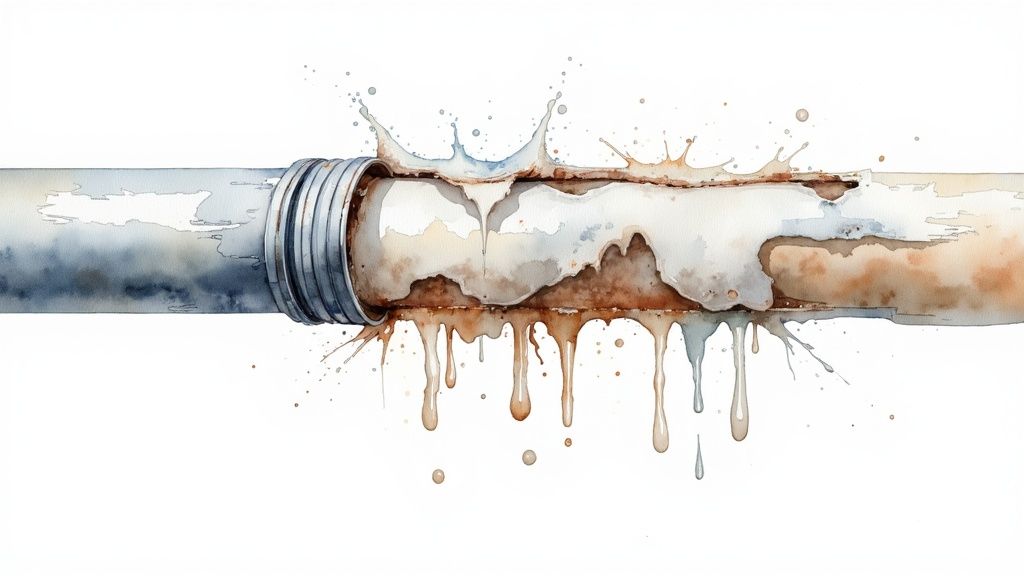
Hard water doesn’t exactly send you a formal announcement, but it definitely leaves a trail of evidence all over your house. You might be juggling a bunch of seemingly random annoyances, never guessing they all point back to one culprit: the minerals dissolved in your water. Learning to spot these clues is the first step toward fixing the problem for good.
One of the most in-your-face signs is limescale, that chalky, crusty white stuff that collects on your faucets, showerheads, and fixtures. It’s basically the mineral debris left behind after the water evaporates. You’ll also see it as stubborn soap scum on your shower doors or as a cloudy film that makes your glassware look permanently dirty, even right out of the dishwasher.
Ever wash your hands and feel like you can’t quite rinse the soap off? That slippery, filmy feeling is a classic sign of hard water. The minerals react with soap to create a residue that just doesn’t want to wash away.
Less Obvious Clues to Look For
The effects of hard water aren’t just limited to your kitchen and bathroom. Some of the most frustrating signs are more subtle, messing with everything from your laundry to your morning shower.
Keep an eye out for these other common symptoms:
- Stiff, Scratchy Laundry: Those same mineral deposits work their way into fabric fibers, leaving your towels feeling rough and your clothes looking dull and faded.
- Dull, Lifeless Hair: Mineral buildup on your hair can weigh it down, stripping its natural shine and making it a pain to style.
- Persistently Dry Skin: Just like it leaves a film on your fixtures, hard water leaves a residue on your skin. This can clog pores and lead to constant dryness and irritation.
Once you start connecting these dots, you realize you’re not dealing with bad soap, a faulty washing machine, or a less-than-stellar shampoo. The real problem is flowing straight from your tap.
How Hard Water Wrecks Your Plumbing and Appliances
Hard water is more than just a minor inconvenience. Those dissolved minerals are silently waging a costly war on your home’s most vital systems. This gradual buildup, known as limescale, is mostly made of calcium and magnesium deposits, and it’s the culprit behind expensive damage and appliances that die way too soon.
Think of limescale in your plumbing like cholesterol in an artery. Over time, these mineral deposits stick to the inner walls of your pipes, slowly narrowing the path for water to flow. This restriction forces your entire system to work harder, which tanks your water pressure and puts a strain on every fixture. Eventually, you’re looking at serious clogs and even leaks.
A dripping outdoor faucet, for example, is often a symptom of this internal wear and tear. If you’re seeing that, we have a detailed guide on how to repair a leaking hose bib.
The Hidden Toll on Your Appliances
This internal damage is particularly brutal on your appliances. The constant flow of mineral-heavy water takes a huge toll, slashing their lifespans and crippling their performance long before you’d expect.
Your water heater is especially vulnerable. When limescale coats the heating elements, it acts like an insulator, forcing the unit to burn way more energy just to heat the water. Your utility bills creep up, and the appliance can fail years ahead of schedule.
It’s the same story for your other expensive equipment:
- Dishwashers: Mineral gunk clogs the spray arms and leaves that permanent, cloudy film on your glassware.
- Washing Machines: Limescale can damage sensitive internal parts and leave your clothes feeling stiff and scratchy, no matter how much fabric softener you use.
- Coffee Makers: The internal tubing gets clogged with scale, slowing down your morning brew until, one day, it just stops working completely.
When you’re dealing with stubborn mineral buildup on your faucets and fixtures, check out these expert tips for removing calcium deposits from faucets. But remember, cleaning is just a temporary fix. The only way to truly protect your investments is to tackle the hard water at its source.
Is Hard Water Safe for Your Health?
After hearing all about limescale buildup and damaged appliances, it’s completely normal to ask: “If it’s doing that to my pipes, what’s it doing to my body?”
Thankfully, the answer is pretty straightforward. For the vast majority of people, hard water is perfectly safe to drink and use every day.
The very minerals that make water “hard”—calcium and magnesium—are actually essential nutrients. Your body needs them for everything from strong bones to healthy metabolic function. While you won’t get your full daily dose from the tap, the water you drink can certainly contribute a small amount to your overall intake.
The World Health Organization (WHO) has found no convincing evidence that water hardness causes adverse health effects in humans. The concerns are almost always about aesthetics and equipment, not health.
So, you can rest easy knowing that even if your water leaves annoying spots on your glassware, it’s not a threat to your well-being.
An Unexpected Health Connection
Here’s where the story gets interesting. Some large-scale studies have actually found a potential upside to drinking hard water. Researchers have noticed some interesting correlations between communities with hard water and certain positive health trends.
Most notably, some studies point to a possible link with cardiovascular health. A few major epidemiological reports have suggested that drinking water with higher concentrations of calcium and magnesium might be associated with a lower risk of cardiovascular disease. The U.S. National Research Council even notes that for many people, hard water can be a meaningful dietary source of these minerals. You can dive into the specifics of this research on hard water and health outcomes on PMC.
While the science is still developing, it confirms one key thing: the minerals in your water are far from harmful. The real reasons to tackle hard water have everything to do with protecting your home and appliances, not your health.
Proven Solutions for Treating Hard Water
Knowing you have hard water is one thing; doing something about it is another. Luckily, you’ve got options. Some are quick, spot-treatments for immediate relief, while others are permanent, whole-home solutions that get to the root of the problem.
If you’re just dealing with a crusty showerhead or a slow-running faucet, a simple vinegar soak can work miracles overnight. The acetic acid in vinegar is fantastic at breaking down the limescale deposits that clog things up. Just remember, this is a temporary fix—it cleans up the mess but doesn’t stop it from coming back.
Choosing A Whole-Home System
To truly put an end to your hard water headaches, a whole-home treatment system is the way to go. These are installed right where the main water line enters your house, meaning every single tap, appliance, and pipe gets protected, treated water.
You’ll generally come across two main types of systems:
- Ion-Exchange Water Softeners: This is the classic, tried-and-true solution. These systems use a special resin to grab the hard minerals—calcium and magnesium—and swap them out for “soft” sodium ions.
- Salt-Free Water Conditioners: Instead of removing the minerals, these systems use clever technology (like template-assisted crystallization) to change their physical structure. This keeps the minerals from sticking to surfaces and building up as scale.
The key difference is that water softeners physically remove the hardness minerals, while conditioners just change them so they can’t cause damage. Deciding between the two really comes down to your water’s specific chemistry and what you’re trying to achieve.
This image shows just how big of an impact the right system can have on your water quality.
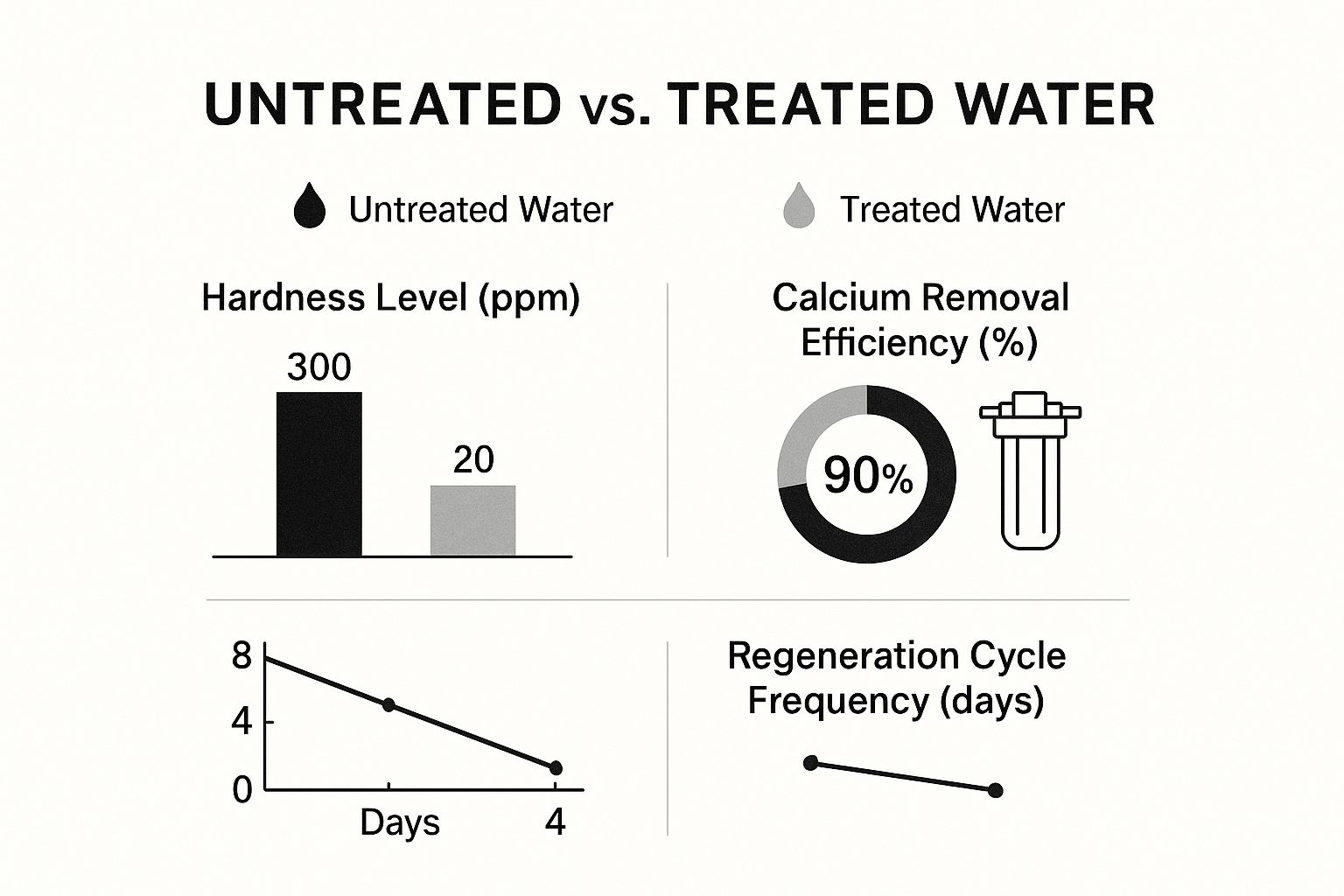
As you can see, a quality system can dramatically reduce hardness levels and is incredibly efficient at getting those pesky minerals out of your water.
Comparing Hard Water Treatment Systems
To help you weigh your options, this table breaks down the key differences between the two most common whole-house systems.
| Feature | Ion-Exchange Water Softener | Salt-Free Water Conditioner |
|---|---|---|
| How It Works | Removes calcium & magnesium ions, replacing them with sodium ions. | Alters mineral crystals so they can’t stick to surfaces and form scale. |
| Primary Benefit | Completely eliminates limescale buildup; softer skin and hair; less soap usage. | Prevents scale buildup in pipes and appliances without adding sodium to your water. |
| Maintenance | Requires regular salt refills (usually monthly). The system also performs a regeneration cycle. | Virtually maintenance-free. No salt, no electricity, and no backwashing required. |
| Installation Complexity | More complex, requires a drain line for the regeneration process and a power source. | Simpler installation, often doesn’t require a drain or electricity. |
| Cost | Higher initial cost and ongoing expense for salt. | Typically a lower initial cost with no ongoing expenses. |
| Best For | Homes with very hard water (>10 GPG) where complete mineral removal is the top priority. | Homes with moderate hard water or for homeowners who want to avoid using salt. |
Ultimately, the best choice depends on how severe your hard water is and your personal preferences regarding maintenance and sodium.
While a whole-home system stops future damage, you might still need to clean up existing problems. For example, if you have stubborn residue on your windows, you can learn how to remove water spots from glass using targeted methods.
Getting the right system installed correctly is key to enjoying years of trouble-free, soft water. For those who are ready to tackle the project themselves, our guide on how to install a water softener walks you through every step.