
When you hear "sewer line problem," do you immediately picture a backhoe tearing up your beautiful lawn? For a long time, that nightmare scenario was the only option. But what if there was a better way?
So, what is trenchless sewer repair? Think of it like modern surgery. Instead of a massive, open incision, surgeons use tiny entry points to fix the problem from the inside. Trenchless repair does the same for your home's plumbing, fixing buried pipes through small access holes. It's keyhole surgery for your sewer line.
The Modern Fix for Buried Pipe Nightmares
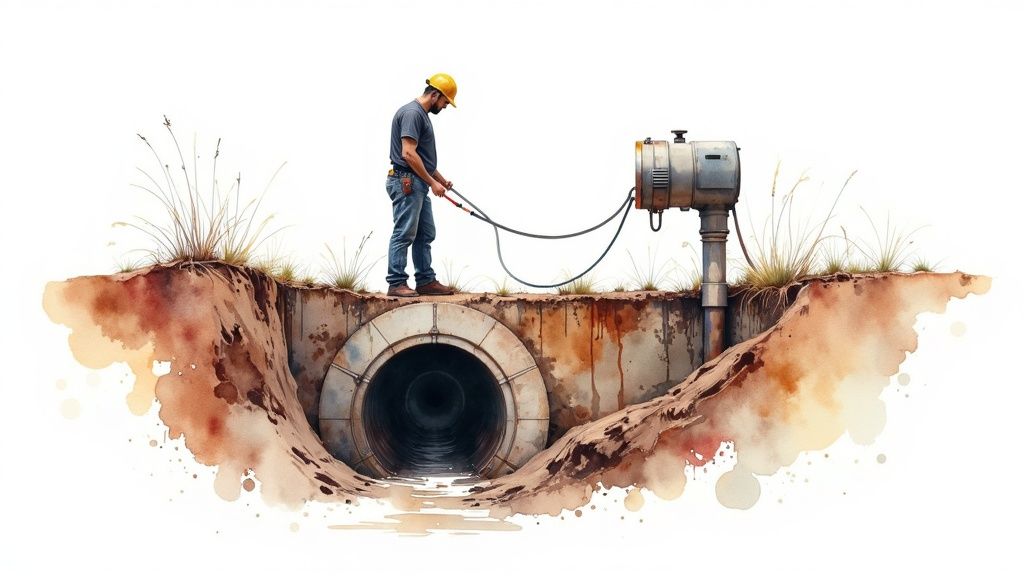
For decades, a broken sewer line meant total excavation. A crew would bring in heavy machinery to dig a massive trench from your house all the way to the street. Your yard, garden, driveway, and patios—anything in the way—would be destroyed. The pipe repair was just the first step; the real pain often came from putting your property back together again.
In extreme cases with unstable or waterlogged soil, fixing a buried pipe was even more disruptive, sometimes requiring the extensive machinery and logistics of dredging. It was a messy, time-consuming process that could drag on for weeks.
A Smarter and Cleaner Approach
Trenchless technology completely changes the game. By avoiding that huge, open trench, it delivers a faster, cleaner, and surprisingly often more affordable solution. It solves the root issue—the broken pipe—without creating a massive new problem: a ruined landscape.
Instead of turning your yard into a construction zone, the entire operation is managed from one or two small, strategically placed pits. This surgical precision is a lifesaver for anyone who has invested time and money into their landscaping, driveways, or patios. The goal is to leave your property looking like we were never even there.
Comparing The Old and The New
The difference is night and day. When you put the two methods side-by-side, it's easy to see why homeowners are making the switch.
- Property Disruption: Traditional digs mean maximum destruction to your lawn, trees, and hardscaping. Trenchless repair leaves your yard almost entirely intact.
- Project Timeline: An old-school excavation can take days, sometimes even weeks, to complete. Most trenchless jobs are finished in just one day.
- Long-Term Value: Trenchless methods don't just patch the old pipe; they create a brand-new, joint-free pipe inside the old one. This new line is often stronger than the original and can last 50+ years.
It’s not just a different technique; it’s a total shift in how we handle underground plumbing problems. It turns a potential disaster into a manageable, one-day project. If you're curious about what leads to these issues in the first place, understanding what causes sewer backup can shed more light on the situation.
How No-Dig Repairs Actually Work
It sounds a bit like magic, doesn't it? Fixing a pipe buried feet underground without tearing up your yard. But it's not magic—it's just smart engineering. Trenchless sewer repair is a highly precise process, using advanced tech to see, prep, and restore your sewer line entirely from the inside out.
It all starts with a critical first step: a high-definition camera inspection. This isn't just a quick peek; it's a full-on diagnostic mission to understand exactly what's happening down there.
We feed a specialized, waterproof camera through an existing access point—usually a cleanout—and run it through the entire length of your sewer line. This gives us a live video feed of your pipe's interior, letting us pinpoint the exact location and severity of the problem.
Seeing The Unseen Underground
The camera becomes our eyes, revealing issues that would otherwise be a total mystery. With incredible accuracy, it can spot all the common culprits behind sewer backups.
- Root Intrusion: We can see where tiny roots have wormed their way into the pipe and grown into huge, pipe-clogging masses.
- Cracks and Fractures: The camera picks up everything from hairline stress fractures to major breaks in the pipe wall.
- Corrosion and Scaling: In older cast iron lines, we often see years of mineral buildup and rust that have narrowed the pipe and weakened its structure.
- Misaligned Joints: Shifting ground can pull pipe sections apart, creating gaps that let sewage leak out and dirt get in.
Without this video evidence, any repair would just be a guess. The inspection gives us the hard data we need to map out the right repair strategy and ensure it’s going to work. It’s how we confirm you're even a candidate for a trenchless solution in the first place.
This diagnostic step is absolutely non-negotiable for a professional job. It takes all the guesswork out of the equation and ensures the fix is designed for the actual condition of your pipe, saving you from failed repairs or paying for work you don't need.
Preparing The Pipe For Renewal
Once we’ve diagnosed the problem, we have to prep the pipe. You simply can't install a new, structural lining inside a dirty, obstructed pipe and expect it to last. That’s where hydro-jetting comes in.
Think of it as pressure washing the inside of your sewer line. We use a high-pressure water hose—blasting water up to 4,000 PSI—with a special rotating nozzle. This powerful stream scours away everything clinging to the pipe walls: decades of grease, scale, sludge, and even tough tree roots.
This cleaning phase is vital. The goal is to get the pipe’s interior back to its original, smooth surface. A perfectly clean pipe is the only way the new lining can bond securely to the old "host" pipe, creating a seamless, durable repair. If you're curious, you can learn more about what hydro-jetting is and how it works in our detailed guide.
With the pipe fully inspected and sparkling clean, the stage is set. Whether we're relining the existing pipe or bursting it to pull in a new one, this prep work guarantees the final product is strong, reliable, and ready to serve your home for another 50 years or more.
Comparing The Two Main Trenchless Methods
Once a professional has scoped your sewer line with a camera and given it a thorough cleaning, the real repair work can start. While "trenchless" covers a handful of techniques, two methods really stand out as the industry workhorses: Cured-in-Place Pipe (CIPP) Lining and Pipe Bursting.
Each one offers a brilliant solution to a buried pipe problem, but they get the job done in fundamentally different ways. Understanding how they work is the key to figuring out which approach is the right fit for your home's specific issue. This is definitely not a one-size-fits-all scenario; the best method hinges entirely on the condition of your existing pipe.
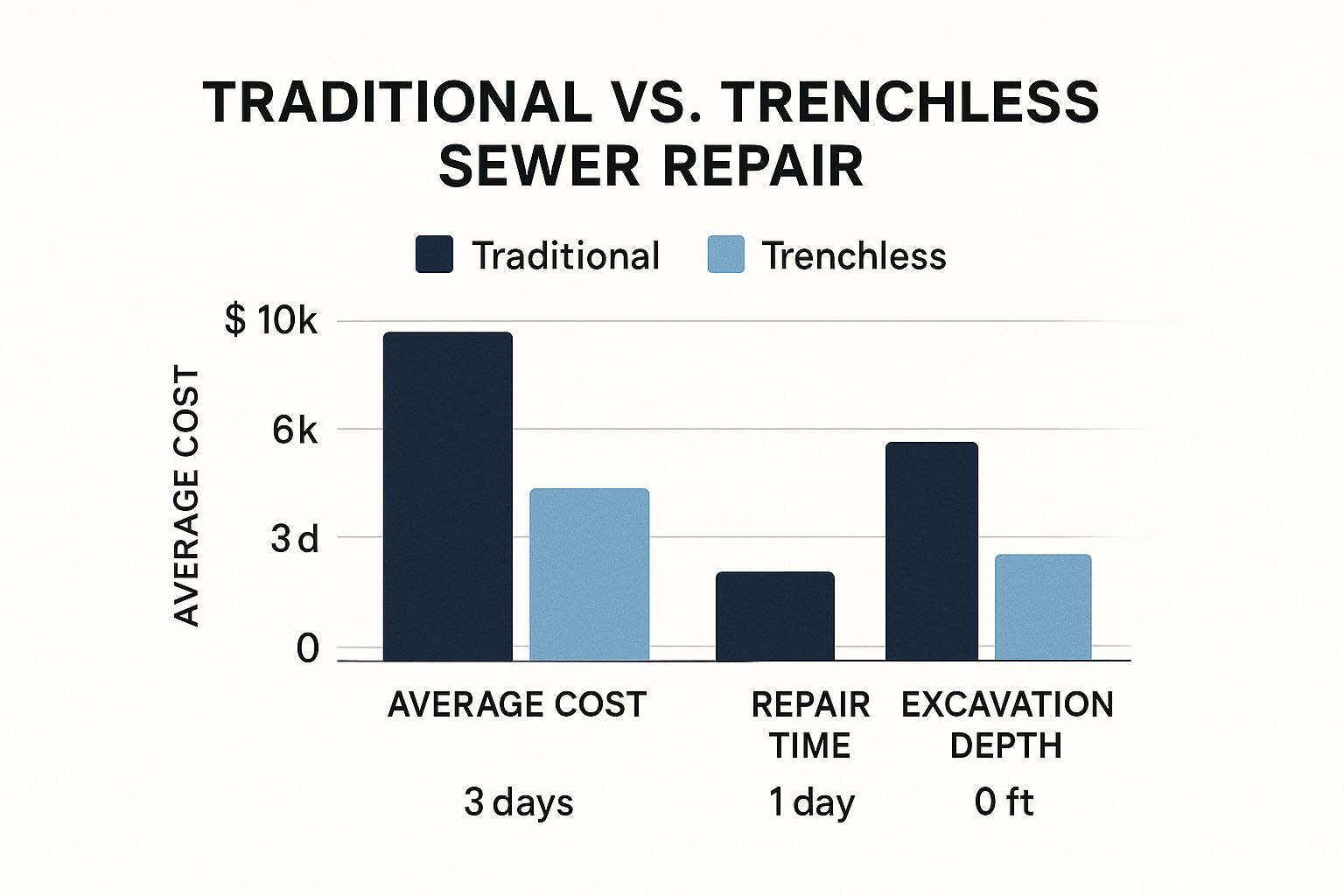
As you can see, the advantages are compelling across the board, making a no-dig approach an attractive choice from the get-go.
CIPP Lining: The Pipe-Within-A-Pipe
Cured-in-Place Pipe (CIPP) Lining is far and away the most common and versatile type of trenchless repair out there. The idea behind it is surprisingly simple but incredibly effective: we essentially build a brand-new, seamless pipe directly inside your old, failing one.
Think of your damaged sewer line as a cracked, leaky straw. CIPP is like sliding a soft, flexible, slightly smaller straw soaked in a powerful epoxy into the old one. We then inflate it so it presses tightly against the walls and let it harden into a rock-solid, brand-new pipe on the inside.
Here’s a quick rundown of the process:
- Liner Prep: A flexible, felt liner is measured and cut to the exact length of the pipe section we're repairing.
- Epoxy Saturation: This liner gets completely saturated with a special two-part epoxy resin. This is what will become the new pipe.
- Inversion: Using air pressure, we turn the resin-soaked liner inside out and shoot it down the length of the host pipe. This process presses it firmly against the interior walls.
- Curing: An inflatable bladder is then pushed through the liner and filled with air, holding it in place. The epoxy hardens over a few hours—a process we can speed up with steam or hot water.
Once the resin has fully hardened, the bladder is deflated and pulled out. What's left behind is a smooth, jointless, and incredibly durable new pipe. Innovations like CIPP lining are constantly improving repair outcomes, and you can learn more about these evolving trenchless service market trends.
Pipe Bursting: The Power of Full Replacement
So, what happens if the existing pipe is too far gone to just be relined? If it's completely collapsed or has sagged so badly that its flow is restricted, Pipe Bursting becomes the go-to solution. This method is less of a repair and more of a total replacement.
If CIPP lining creates a new pipe inside the old one, Pipe Bursting is like dragging a brand-new, stronger pipe through the old one, shattering the damaged pipe outward as it goes.
This powerful technique relies on a winch and a heavy-duty steel cable:
- Small access pits are dug at both ends of the sewer line.
- A thick cable is fed through the entire length of the old, damaged pipe.
- A cone-shaped "bursting head" is attached to one end of the cable, and the new, high-density polyethylene (HDPE) pipe is attached right behind it.
- From the other end, a hydraulic winch starts pulling. The bursting head violently breaks the old pipe apart, pushing the fragments into the surrounding soil.
- The new pipe is pulled directly into the newly created space, giving you a brand-new sewer line.
Pipe Bursting is the ultimate fix for pipes that are beyond saving. It's also the only trenchless method that can be used to upsize a sewer line—for example, replacing an old 4-inch pipe with a new 6-inch one to handle more flow for a growing family or a home addition.
CIPP Lining vs Pipe Bursting: Which Method Is Right for You?
Choosing between CIPP Lining and Pipe Bursting isn't a matter of personal preference; it’s a decision driven by the diagnosis from a sewer camera inspection. A qualified plumbing expert will analyze the pipe's condition, its material, and your home's needs to recommend the best path forward.
To help you get a clearer picture, this table breaks down the key differences and typical applications for each method.
| Feature | Cured-in-Place Pipe (CIPP) Lining | Pipe Bursting |
|---|---|---|
| Best For | Pipes with cracks, holes, root intrusion, or corrosion that are still structurally intact. | Severely damaged, collapsed, or offset pipes that are too far gone to be relined. Also used to increase pipe diameter. |
| Pipe Diameter | Slightly reduces the inner diameter (typically by about a quarter-inch), but the new, smoother surface often improves flow anyway. | Maintains or increases the original pipe diameter, boosting flow capacity. |
| Excavation | Minimal to none. Usually performed through an existing cleanout access point. | Requires two small access pits at the start and end of the pipe run. |
| Material | Works on a wide variety of pipe materials, including cast iron, clay, and PVC. | Primarily used for brittle pipes like clay, cast iron, or concrete that can be fractured easily. |
In the end, both CIPP Lining and Pipe Bursting deliver on the core promise of trenchless repair: a long-lasting, reliable fix without tearing up your property. By understanding the basics of how they work, you can have a much more informed and confident conversation with your contractor about securing the future of your home's plumbing.
The Real-World Benefits of a No-Dig Solution
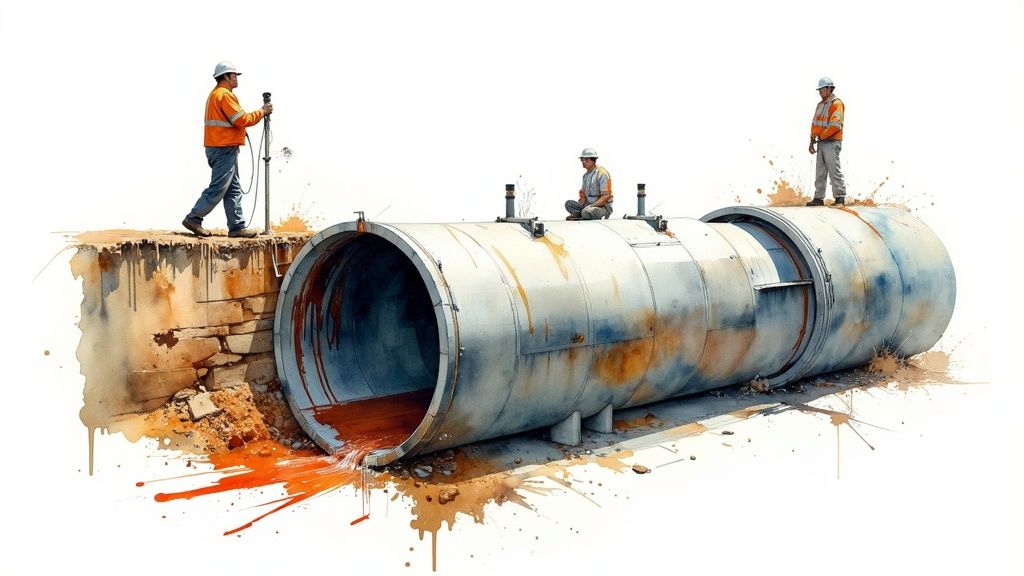
So, why are homeowners increasingly choosing trenchless methods when their sewer line gives out? The most obvious reason is saving their yard from being torn apart, but the real advantages go much deeper than just aesthetics.
Opting for a no-dig repair is a smart move—a long-term investment that pays off in time, money, and durability. It’s not just about appearances; it’s about protecting your property and gaining some serious peace of mind.
Significant Cost Savings Beyond the Quote
At first glance, a quote for a trenchless repair might look a bit higher than one for traditional excavation. But that initial number is misleading because it doesn't tell the whole story. The real cost of an old-school dig hits you after the pipe is fixed.
Traditional digging leaves you with a second, massive bill for restoration. Just think about what your sewer line runs under.
- Lawns and Gardens: This means buying new sod, topsoil, and replacing expensive, mature plants and shrubs. We're talking thousands of dollars right there.
- Hardscaping: The costs explode if the trench has to cut through a concrete driveway, a custom stone patio, or a paver walkway.
- Sprinkler Systems: Underground irrigation lines almost always become casualties, adding professional repair costs to the tally.
When you add up these “hidden” expenses, trenchless almost always comes out as the more affordable option. It completely sidesteps that massive post-job cleanup and rebuilding phase, saving you a ton of money and a world of stress.
A Faster and Less Disruptive Process
Time is another huge piece of the puzzle. A conventional sewer replacement can turn your property into a muddy, noisy construction zone for days—sometimes even weeks. The constant drone of machinery and the gaping trench are a major disruption to your life.
Trenchless repair is the complete opposite. Most jobs are wrapped up in a single day. The whole process is incredibly efficient and self-contained.
A crew can show up in the morning, set up their equipment at a couple of small access points, and finish the entire repair by the evening. Your life, and your property, are back to normal almost immediately.
This speed is a game-changer, especially for busy families or businesses that can't afford significant downtime.
A Longer-Lasting and More Durable Solution
Don't think of trenchless repair as a quick fix; it's a full-on upgrade. The materials we use today, like epoxy-resin liners and high-density polyethylene (HDPE) pipes, create a brand-new, seamless pipe inside the old one. In many cases, it's actually stronger than the original ever was.
These modern pipes are built to last and have several key advantages:
- Corrosion-Proof: Unlike old cast iron, these new materials will never rust or deteriorate.
- Root-Resistant: The smooth, joint-free lining gives tree roots nowhere to sneak in.
- Increased Flow: The slick interior surface of the new pipe can actually improve your sewer's flow capacity.
With a design life of 50 years or more, a trenchless repair is an investment you make once and don't have to think about for decades. It's no wonder this technology is booming. The trenchless pipe repair market is already valued at around $2.5 billion and is only expected to grow, driven by its clear benefits over costly traditional methods. You can learn more about the projected growth of the trenchless repair market and what's fueling it. This trend really underscores the confidence that homeowners and cities alike have in this technology.
Let's Talk Money: Breaking Down Trenchless Repair Costs
When homeowners start looking into trenchless sewer repair, the first question is almost always about the price. It's a fair question, but looking at the initial quote is only half the story. You have to understand the total investment to see the real picture, because those upfront numbers can be deceiving.
On the surface, traditional excavation might look cheaper. But that price only covers the digging and the pipe fix. It conveniently leaves out the thousands of dollars you'll have to spend putting your property back together afterward. This is where the true value of a no-dig solution really shines.
What Goes Into the Final Price?
The cost of a trenchless project isn't a simple, flat rate. Every job is different, and several key factors will influence the final number. A professional inspection is the only way to get a precise quote, but knowing these variables helps you understand what's shaping your estimate.
Here’s what we look at:
- Pipe Length and Diameter: It's a simple matter of materials. Longer, wider pipes need more liner or more new HDPE pipe, which bumps up the cost.
- The Extent of the Damage: Fixing a few cracks is a lot simpler than dealing with a pipe that's severely corroded or has collapsed sections. More damage means more prep work and potentially more complex solutions.
- Which Method We Use: Pipe bursting often costs a bit more than CIPP lining. It requires two access points instead of one and involves more heavy-duty equipment.
- How Easy Is It to Get To? Accessibility plays a big role in labor time. A cleanout in an open, unfinished basement is a dream scenario. One hidden under a custom-built deck? That’s going to take more time and effort.
Comparing the Total Project Cost
The real conversation about cost happens when you stack up the entire financial picture of trenchless vs. traditional. The initial quote for a trenchless repair usually lands somewhere between $80 and $250 per foot, but that number is pretty much all-inclusive.
Now, look at the traditional quote. It might seem more attractive, often falling between $50 and $200 per foot. The problem is, that number is a mirage. It completely ignores the massive restoration bill that’s waiting for you on the other side.
A quote for traditional excavation is just the starting line for your expenses. The final bill can easily double once you start paying to rebuild your yard and driveway. What looked like the "cheaper" option quickly becomes a much more expensive and stressful headache.
The Hidden Price Tag of Digging
Picture this: your main sewer line runs right under your beautiful paver patio, past your prized rose bushes, and straight through your concrete driveway. A traditional trenching job will obliterate all of it, and the bill for putting it all back is yours alone.
These "hidden" costs pile up fast:
- Landscaping: Just re-sodding your lawn can run $1 to $2 per square foot. If you lose mature trees or custom garden beds, you could be looking at thousands.
- Hardscaping: Pouring new concrete for a driveway or patio costs $8 to $18 per square foot. If you have custom stonework or pavers, the replacement cost is even higher.
- Oops…More Repairs: It’s not uncommon for excavation to damage underground sprinkler lines or other utilities, adding another unexpected repair bill to the pile.
When you tack these expenses onto the initial digging quote, the total cost for a traditional repair almost always soars past the price of a trenchless fix. By avoiding the destruction in the first place, the price you’re quoted for a no-dig repair is the price you actually pay. No surprise landscaping bills. No shocking concrete invoices. It’s not just a modern convenience; it’s a smarter, truly cost-effective investment in your home.
When Is Trenchless Repair Not the Right Answer?
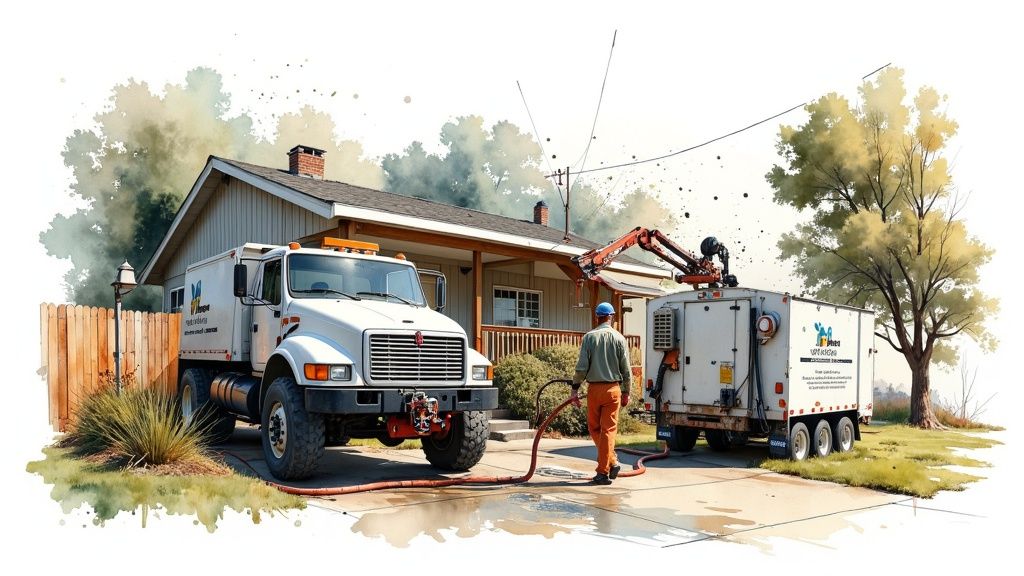
Trenchless sewer repair is a fantastic tool in our arsenal, but it's not a silver bullet for every single pipe problem. Knowing its limits is just as important as appreciating its strengths. A good plumber will give you an honest assessment to make sure you're investing in the right fix, not just the easiest one.
After all, the goal is a permanent solution. Sometimes, that means admitting a no-dig method just won't cut it. Being upfront about this builds trust and makes sure you, the homeowner, are making a truly informed decision.
Situations Where We Have to Dig
A camera inspection is the only way to know for sure, but some pipe conditions are immediate red flags that tell us a trenchless fix is off the table.
Here's what a seasoned pro is looking for:
- Completely Collapsed Pipes: If a section of your sewer line is totally flattened or crushed, there's no open channel for a new liner or a bursting head to get through. In this case, we have to do some digging to cut out that collapsed portion and replace it.
- Severe Back-Pitch or Sagging: Trenchless methods are brilliant at restoring the inside of a pipe, but they follow the original path of that pipe. If your line has a major "belly" or sags in the middle, relining it won't fix the gravity-flow problem. You'll still get backups.
- Improperly Connected Pipes: Sometimes, old repairs were done poorly, leaving behind misaligned joints. A new liner often can't navigate these kinds of severe offsets, which means we’ll need to do a spot repair to fix the connection first.
It's a crucial reality check. While trenchless technology is booming—with North America holding about 36.2% of the global market—that popularity doesn't change the laws of physics. For those interested in the industry trends, you can read more on the projected growth of trenchless pipe rehabilitation.
A key takeaway is that trenchless repair fixes the pipe itself, not its path. It can’t magically lift a sagging sewer line or correct a severe slope issue that was installed incorrectly from the start.
Asking the Right Questions
The best thing you can do is arm yourself with a little knowledge. When a contractor proposes a trenchless repair, asking a few smart questions can help confirm it’s genuinely the best approach for your home.
Ultimately, figuring out how to determine if you need to repair or replace your sewer line is the first step. By understanding these limitations, you can have a much more meaningful conversation with your plumber and feel confident that the solution actually fits the problem.
A Few Lingering Questions on Trenchless Sewer Repair
Even after you've wrapped your head around the methods and benefits, it's completely normal to have a few more questions. After all, this is a major investment in your home. Let's tackle some of the most common things homeowners ask us before they commit.
How Long Does a Trenchless Repair Actually Last?
This is the big one, and the answer should give you real peace of mind. A trenchless repair isn't a bandage. It's a permanent fix. Whether we're lining your old pipe or bursting a new one through, you're getting a brand-new, structural pipe that's built to last for 50+ years.
Think about it: the modern epoxy resins and seamless HDPE pipes we use are actually stronger and more durable than the old cast iron or clay they're replacing. They're corrosion-proof and create a smooth, joint-free path that makes it incredibly difficult for tree roots to get back in. In many cases, the new pipe will outlive the rest of the home's original plumbing.
Will My Property Be a Complete Mess During the Repair?
Not at all. This is the whole point of going trenchless. The entire process is engineered to be as tidy and non-invasive as possible. All the work happens underground, accessed through just one or two small, carefully dug pits.
The core promise of a no-dig solution is leaving your property looking almost exactly as we found it. We save your lawn, garden, driveway, and patios, meaning your daily routine is barely interrupted while we work.
Can Trenchless Methods Fix Any Sewer Problem?
Trenchless technology is a fantastic solution for a wide range of issues, but it's not a silver bullet for everything. It's a home run for fixing things like cracks, leaks, corrosion, and even significant root damage, as long as the original pipe still has its basic shape.
However, there are a couple of scenarios where it won't work. If a pipe is completely collapsed, there's no path for a new liner or bursting head to follow. Likewise, if the pipe has a severe dip or "belly" that collects waste, a liner will just conform to that same bad slope. In those rare cases, a good plumber will walk you through other options, which might involve a small, targeted excavation.
How Do I Choose a Qualified Trenchless Contractor?
Picking the right crew for the job is absolutely critical. This isn't standard plumbing work; it requires specialized training and some very expensive equipment.
Here's what to look for:
- Proven Experience: Ask for proof they have a solid track record specifically with trenchless projects.
- Video Evidence: A reputable contractor will always provide "before" and "after" video from their sewer camera inspection. This is your guarantee of a job done right.
- Proper Credentials: Make sure they are fully licensed and insured for this type of advanced plumbing work right here in the Denver area.
Ready to see if a no-dig solution is right for your Denver home? The experts at Professional Plumber Denver have the technology and experience to diagnose your sewer issues and provide a lasting, minimally invasive repair. Contact us today for a professional camera inspection and a clear, honest estimate.