
Ever wonder what that capped pipe in your yard or basement is for? That’s your sewer cleanout, and it’s one of the most important parts of your home’s entire plumbing system. Think of it as a dedicated access hatch for your main sewer line.
This cleanout is the pipe that connects your home’s wastewater system to the municipal sewer. It’s the single point of entry that allows a professional to get in and fix things when they go wrong.
The Unsung Hero of Your Plumbing System
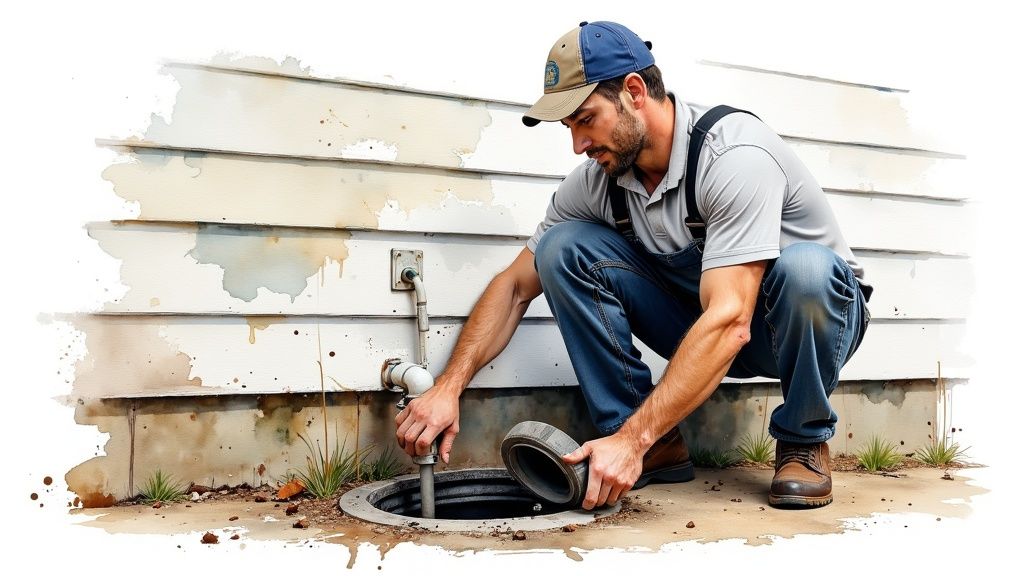
Without a sewer cleanout, dealing with a major clog or backup would be a nightmare. We’d be talking about digging up your beautiful lawn or, even worse, breaking through your foundation just to reach the main line. It’s a messy, expensive, and disruptive process.
The cleanout changes all that. It gives us a direct, non-invasive path to the problem.
Frankly, having a cleanout is the difference between a straightforward, one-hour fix and a multi-day excavation project. It lets us get right to the source of the trouble, whether it’s a blockage or a broken pipe, without turning your property into a construction zone.
Why This Little Pipe Is a Big Deal
Knowing what your sewer cleanout is and where to find it can turn a plumbing catastrophe into a manageable inconvenience. It’s the key to several critical services:
- Busting Major Clogs: This is where we insert heavy-duty equipment like hydro-jetters or large mechanical augers to obliterate stubborn blockages from grease, roots, or other debris.
- Performing Video Inspections: We can run a specialized camera down the line to pinpoint the exact location of problems like cracks, collapses, or invasive tree roots. No more guesswork.
- Streamlining Maintenance: A cleanout makes routine cleaning simple and effective. You can learn more about why this is so important in our guide to sewer maintenance.
To give you a quick overview, here’s a breakdown of why this component is so vital.
Sewer Cleanout At a Glance
| Key Aspect | Description | Why It Matters |
|---|---|---|
| Primary Function | A capped pipe providing direct access to the main sewer line. | Allows for quick diagnosis and repair without destructive digging. |
| Main Use Cases | Clearing blockages, performing camera inspections, and preventative cleaning. | Addresses everything from minor clogs to major line breaks efficiently, saving homeowners time and money. |
| Financial Impact | Drastically reduces the cost of sewer repairs by eliminating the need for expensive excavation. | A small access point prevents a small problem from turning into a $5,000 – $20,000 excavation project. |
| Emergency Response | Enables plumbers to immediately tackle sewage backups, preventing property damage and health hazards. | In a backup situation, quick access is crucial to minimize damage and restore sanitation to your home. |
Ultimately, the sewer cleanout is your first line of defense against the biggest and most expensive plumbing problems a homeowner can face. It’s a simple feature that provides enormous peace of mind.
How Plumbers Use a Cleanout to Save Your Drains
Think of your home’s plumbing system like a tree. You have all the small branches—the drains from your sinks, toilets, and showers—and they all connect to one big trunk: your main sewer line. The cleanout is simply a direct access port into that main trunk.
When a serious clog backs everything up, this little cap is a total game-changer. Instead of trying to force a small drain snake through a tiny pipe from your kitchen sink, we can go straight to the source. It’s like getting a crew directly onto the highway to clear a massive traffic jam, rather than trying to navigate all the little side streets to get there.
Direct and Powerful Access
From this one strategic spot, we can bring in the heavy-duty equipment needed to tackle the real problem in the main line. This direct approach is not only faster, but it’s also much safer for the smaller, more delicate pipes inside your house. Those pipes just weren’t built to handle the big guns.
We typically use two main tools through the cleanout:
- Heavy-Duty Augers: You might know them as “snakes.” These are powerful, professional-grade machines that can chew through tough blockages like invasive tree roots, years of caked-on grease, or whatever else might be stuck down there.
- Hydro-Jetting Hoses: This is basically pressure washing for your pipes. We use high-pressure water jets to scour the inside of the line, blasting away sludge and debris until it’s as clean as the day it was installed.
By going through the cleanout, a plumber can attack the problem right where it starts. That means less mess inside your home, less time on the job, and a far more effective cleaning that helps prevent the same clog from coming back.
Diagnosing Problems with Precision
The cleanout isn’t just for clearing blockages; it’s also our best window into the health of your sewer line. If you’re dealing with constant backups, we can feed a special fiber-optic camera through the cleanout to get a live look at what’s happening inside the pipe.
This is how we spot serious issues like cracks, collapsed sections, or tree root intrusion before they turn into a full-blown sewer line failure. Our team dives deeper into this process in our guide to sewer camera inspections.
At the end of the day, that simple access point turns a potentially messy and expensive ordeal into a controlled, efficient service. It allows us to solve your worst drain nightmares with minimal disruption to your home and your life.
How to Find and Identify Your Sewer Cleanout
When your drains start backing up, the last thing you want is a scavenger hunt for your sewer cleanout. Knowing its location ahead of time is one of those simple pieces of homeowner knowledge that can turn a full-blown panic into a quick fix.
If you have to call a plumber for an emergency clog, being able to point them directly to the cleanout saves them time and saves you money. They can get straight to work instead of billing you for the search.
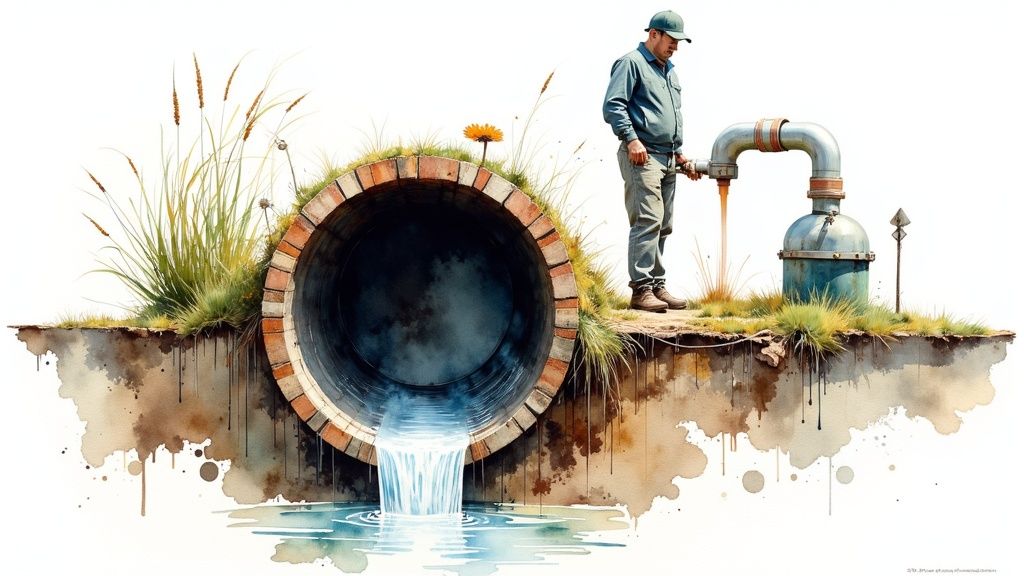
Let’s start outside. The most common spot for a sewer cleanout is in your front or side yard. Picture a straight line from where your home’s main drain pipe exits the foundation to the city sewer main under the street—your cleanout is almost always somewhere along that path.
What to Look For Outdoors
Scan your yard for a pipe that’s either flush with the ground or sticks up just a few inches. It’s easy for them to get hidden by overgrown grass, mulch, or landscaping, so you might need to poke around a bit.
Here’s what you’re looking for:
- Size and Material: It will be a pipe about 3 to 4 inches in diameter. Newer Denver homes typically have a white PVC or black ABS plastic cleanout. If you’re in an older home, you might find a much thicker cast iron pipe.
- The Cap: The pipe will be sealed with a cap that has a noticeable square or rectangular raised nut in the center. This is designed for a plumber’s wrench to get a solid grip to twist it open.
If you’ve searched the yard and come up empty, your next stop is inside.
Checking Indoor Locations
Sometimes, the main cleanout is located inside the house, which is pretty common in older homes or properties with unique layouts.
The usual suspects are the basement, crawl space, or a ground-floor utility closet. Look for a capped pipe, often coming out of the floor, near the foundation wall where you’d expect the sewer line to exit the house. It’ll have the same features as an outdoor one—a 3- or 4-inch pipe with a threaded cap.
Plumbers and city planners have understood the need for this kind of access for a long time. While the first major U.S. sewer systems popped up in the late 1850s, it took a while for easy maintenance access to become standard practice. Today, with major cities dealing with thousands of blockages every year, having an accessible cleanout is more important than ever. If you’re curious, you can learn more about the fascinating history of sanitation systems on Wikipedia.
Understanding Different Sewer Cleanout Types
Just like you wouldn’t use a side street for highway traffic, not all sewer cleanouts are created equal. The type you have on your property determines how a plumber can tackle a clog, and understanding the difference can save a lot of headaches.
Most homes have a simple single cleanout. This is a one-way street, giving a plumber access to the sewer line in a single direction—usually pointing out toward the city’s main line. It gets the job done for most common blockages.
But for some properties, especially those with long runs of pipe, a more versatile setup is a game-changer. This is where the two-way cleanout comes in.
Single vs. Two-Way Access
A two-way cleanout is exactly what it sounds like. It’s an access point that allows a plumber to run their tools in two different directions, giving them far more strategic options than a single cleanout ever could. You can often spot one by its ‘Y’ or ‘T’ shape, which will have two separate caps instead of one.
With a two-way cleanout, a plumber can:
- Go Towards the Street: This is the standard route for clearing clogs located between your house and the municipal sewer main.
- Go Towards the House: This is the big advantage. It lets a plumber clear a blockage that’s closer to your foundation, perhaps under a concrete slab, without needing to find or create another access point.
This dual-access capability is incredibly valuable for tracking down and clearing tricky blockages. Knowing what you have helps you communicate the situation clearly to a pro when you call them.
Think of it this way: a one-way cleanout is like a one-way street, while a two-way is a major boulevard. It fundamentally changes the routes available to solve a traffic jam in your pipes.
To give you a clearer picture, here’s a breakdown of the cleanouts you might find on your property.
Comparison of Sewer Cleanout Types
| Cleanout Type | Description | Primary Location | Best Use Case |
|---|---|---|---|
| Single Cleanout | A single pipe with one cap, providing access in one direction (usually towards the street). | Typically in the yard, basement, or crawlspace. | Clearing straightforward blockages in the main sewer line. |
| Two-Way Cleanout | A Y- or T-shaped fitting with two caps, allowing access both towards the street and towards the house. | Usually installed in the yard, near the property line or foundation. | Diagnosing and clearing complex or hard-to-locate blockages. |
| Test Tee Cleanout | A T-shaped fitting found inside the home, often in a basement or near a plumbing stack. | Basements, crawlspaces, or utility rooms. | Isolating and testing specific sections of the home’s drain system. |
Each type serves a specific purpose, but the two-way cleanout offers the most flexibility for a plumber facing a tough clog.
Beyond the type, the material matters too. Most newer homes in Denver will have cleanouts made of white PVC plastic. If you’re in an older home, you might see heavy-duty cast iron, which is incredibly tough but can be prone to rust and corrosion over many decades.
This image highlights the most common places you’ll find a sewer cleanout.
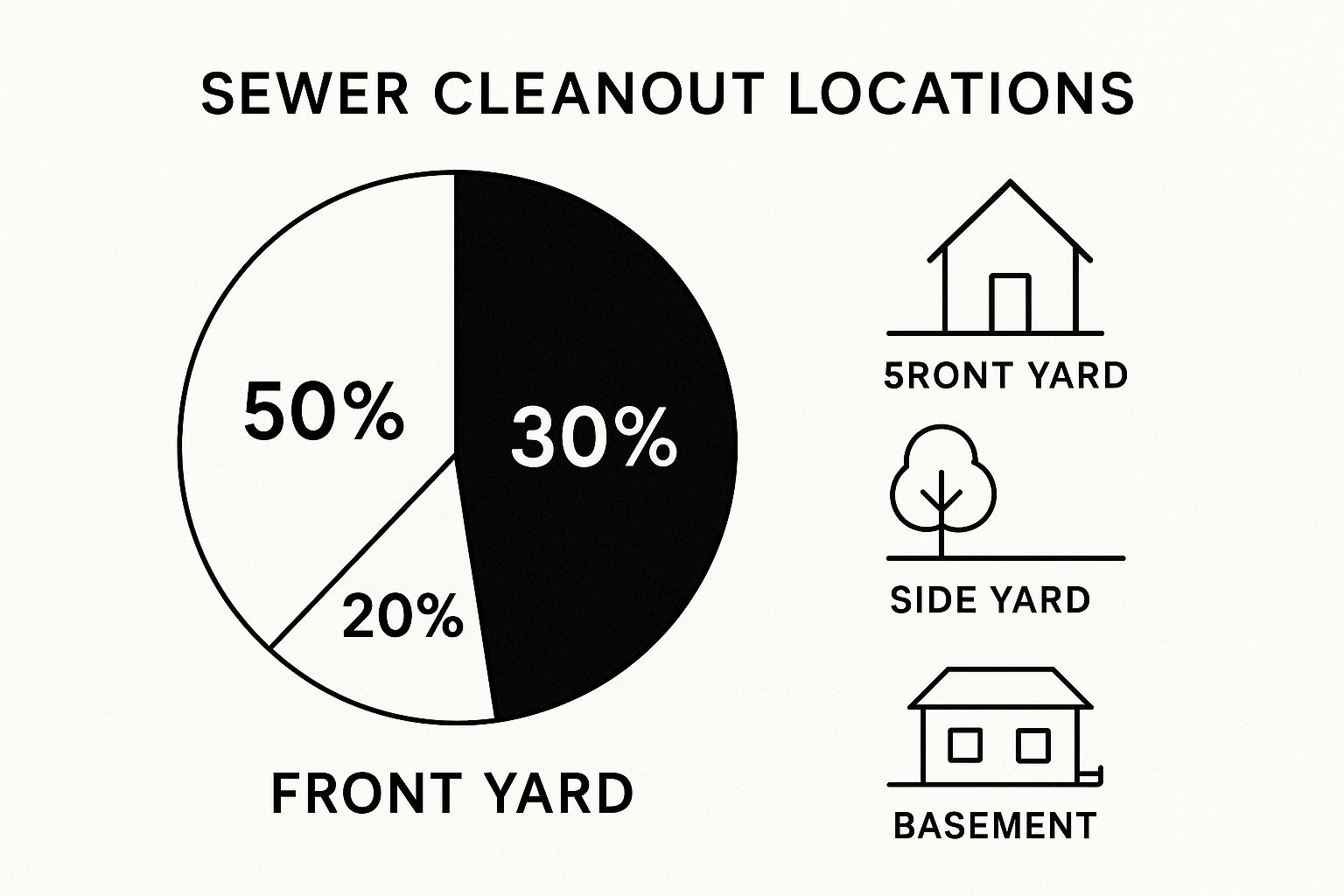
As you can see, there’s a 50% chance it’s located in your front yard. If you can’t find yours, that’s almost always the best place to start looking.
Why Denver Plumbing Codes Mandate Sewer Cleanouts
Here in Denver, a proper sewer cleanout isn’t just a “nice-to-have” feature for your home—it’s often required by law. Think of it this way: modern plumbing codes are built to protect everyone, from the individual homeowner right up to the city’s entire sanitation system. And the humble cleanout is a key player in that effort.
Local regulations are pretty specific about where these access points need to go. You’ll typically find them mandated where the main sewer line leaves the house and then at regular intervals on longer stretches of pipe, usually no more than 100 feet apart. This isn’t arbitrary; it’s to guarantee that no matter where a clog happens, a plumber has a safe and direct way to get to it.
Protecting Public and Private Property
If you live in one of Denver’s classic older homes built before these codes were standard, adding a cleanout is one of the smartest investments you can make. It’s your first line of defense against the kind of messy, destructive sewage backup that no one wants to deal with in their basement or yard.
These codes are a critical safeguard. They exist to prevent catastrophic backups on private property and to protect Denver’s shared sanitation infrastructure from overflows that can create serious public health risks.
This isn’t just a Denver thing, either. It’s a standard practice recognized around the world. As cities grow, so does the need for maintainable infrastructure. In fact, between 2000 and 2022, the number of people connected to sewer systems globally jumped by 65%, hitting about 3.36 billion. You can dig into more of this data on global sanitation trends from Statista.
At the end of the day, having a code-compliant cleanout is more than just checking a box. It’s about protecting your property’s value, keeping your home hygienic, and ensuring your plumbing works the way it should for years to come.
Common Sewer Cleanout Questions Answered
https://www.youtube.com/embed/hY8umsGRe0o
Even when you know the basics about your sewer cleanout, a real plumbing problem can bring up a lot of specific questions. Getting straight answers is the key to making smart, calm decisions when a backup is looming. Here are the most common questions we hear from homeowners around Denver.
Should I Open the Cleanout Myself to Fix a Clog?
Tempting as it might be, it is strongly advised against opening a sewer cleanout on your own. When your main sewer line is clogged, the pipe is holding back a tremendous amount of wastewater under pressure.
If you twist off that cap, you could release a sudden, high-volume surge of raw sewage all over your property. Not only is this a mess, but it’s a serious health hazard. Professional drain cleaning tools are also incredibly powerful and can easily damage your pipes if you don’t know exactly what you’re doing. It’s a job for a licensed plumber with the right safety gear and experience.
What Is a Leaking Sewer Cleanout Cap Telling Me?
A leaking cap on your sewer cleanout is a major red flag. This isn’t just a simple drip; it almost always means there’s a serious clog downstream—somewhere in the pipe between the cleanout and the city’s main line.
The pressure from that blockage is literally forcing wastewater up and out through the cap’s threads. Do not try to tighten the cap! All that does is trap the pressure, which could force the raw sewage back up into your home’s drains, causing a much more catastrophic and expensive mess. Call a plumber right away.
A leaking cleanout is your plumbing system’s final warning signal before a major interior backup. It’s not a small drip to ignore; it’s a sign of a complete blockage that needs immediate professional attention.
Does My Sewer Cleanout Need Regular Maintenance?
The cleanout fitting itself doesn’t really need maintenance, but you should always know where it is and make sure it’s easy to get to. Every so often, it’s a good idea to walk over and check that the cap is secure and the area around it is clear of overgrown grass, dirt, or landscaping.
The best maintenance is proactive, especially for older homes or properties with mature trees. A professional camera inspection every few years can spot invasive tree roots before they cause a complete collapse. For homes with recurring sludge or grease issues, more advanced cleaning might be the answer. You can learn more about how hydro jetting thoroughly cleans pipes on our blog.
How Is a Sewer Cleanout Different From a Septic Tank Lid?
This is a really common point of confusion, and it’s an important distinction. A sewer cleanout is simply an access point to the pipe that connects your home’s plumbing to the public sewer system. If you get a monthly bill from the city for water and sewer, you have a sewer line and should have a cleanout.
A septic tank lid, on the other hand, is the access point for a private, on-site wastewater treatment system. If you have a large tank buried in your yard that a truck has to come and pump out every few years, you have a septic system. The two are completely different and serve separate infrastructures.
Dealing with a main line clog or just want to be prepared? The experts at Professional Plumbers Denver have the tools and experience to handle any sewer issue safely and efficiently. Contact us today for fast, reliable service in the Denver area!