At its simplest, a water filtration system is a gatekeeper for your water. It uses a physical barrier, a chemical reaction, or even a biological process to pull unwanted impurities out of the water that flows through your home.
Think of it as a sophisticated strainer, catching everything from visible sediment to invisible chemicals. The goal is simple: to make sure every drop you use is cleaner, safer, and tastes better.
Your Guide to Purer Water
Ever notice a faint chlorine smell from your kitchen tap or see a slight cloudiness in your glass? While our municipal treatment plants do a fantastic job making water safe, it’s a long journey from the plant to your faucet. Along the way, water can pick up new contaminants.
A home filtration system acts as that crucial last line of defense, right at the point of use. It stands guard, screening out these intruders before they get into your drinking glass, shower, or coffee maker. This final step ensures the water your family drinks, cooks with, and bathes in is the best it can be.
What Do Water Filters Actually Remove?
The main job of any filter is to target and remove specific troublemakers in your water. Depending on the system you choose, it can tackle a whole range of issues affecting your water’s taste, odor, and overall safety.
Figuring out what’s in your local water is the key to picking the right filter. For those of us in Colorado, understanding Denver’s unique water quality is a great starting point, as it sheds light on local issues like hard water minerals and their impact on plumbing.
Most home systems are designed to go after a few common culprits:
- Sediment and Particulates: This is the physical grit—dirt, sand, rust, and silt—that makes water look cloudy.
- Chemical Disinfectants: Chlorine and chloramine are great for killing bacteria during treatment, but they often leave behind a chemical taste and smell.
- Heavy Metals: Nasty contaminants like lead, mercury, and arsenic can sometimes leach into the water from old pipes and pose serious health risks.
- Volatile Organic Compounds (VOCs): This category includes various industrial chemicals and pesticides that can seep into groundwater sources.
Before we dive deeper, here’s a quick look at the common contaminants found in tap water and why you might want them gone.
Common Water Contaminants and Their Effects
| Contaminant Type | Examples | Potential Effects |
|---|---|---|
| Physical | Sediment, Silt, Rust, Dirt | Cloudy appearance, unpleasant texture, can clog pipes and appliances. |
| Chemical | Chlorine, Pesticides, Herbicides | Poor taste and odor, potential long-term health risks. |
| Biological | Bacteria, Viruses, Cysts | Can cause gastrointestinal illnesses and other infections. |
| Heavy Metals | Lead, Mercury, Arsenic | Serious health issues, especially with long-term exposure. |
| Minerals | Calcium, Magnesium (Hard Water) | Scale buildup in pipes/appliances, dry skin, soap scum. |
This table is just a snapshot, but it shows how different impurities can affect both your health and your home’s infrastructure.
At its core, a water filtration system gives you control over one of the most essential elements of your daily life. It provides peace of mind, knowing you’ve taken a proactive step to protect your family’s health and well-being.
The principles behind this are universal, even if the applications vary wildly. While we’re focused on your home, looking at how other fields use this technology, like in modern pond water filtration systems, can give you a broader appreciation for the science of purification.
By targeting these specific impurities, a good filtration system doesn’t just improve your water’s taste—it also helps protect your plumbing and appliances from the damage caused by scale buildup and corrosion.
How Water Filtration Systems Actually Work
It helps to think of a water filtration system less as a single gadget and more as a multi-stage process. Picture a high-tech security checkpoint for your water. Each checkpoint, or filter media, is designed to stop a specific type of unwanted “intruder,” making sure only the purest water makes it to your tap. This isn’t just one action but a series of carefully planned steps.
At its heart, filtration boils down to two core principles working in tandem: physical removal and chemical interaction. These two methods are the foundation for nearly every home water filter you’ll find, from a simple pitcher on your counter to a robust whole-house unit.
The First Line of Defense: Physical Filtration
The first stage is usually physical filtration, and it’s as straightforward as it sounds. It’s the mechanical job of straining out solid gunk from the water. Think of it like a coffee filter—it lets the liquid brew through but stops all the solid grounds from ending up in your cup.
In a water filter, this job belongs to the sediment filter. Typically made from materials like polypropylene or ceramic, it’s packed with microscopic pores. These pores are measured in microns, and to give you some perspective, a single human hair is about 50 microns wide. A good sediment filter can snag anything larger than 5 microns, effectively trapping:
- Sand and Silt: Tiny grains of rock and soil that found their way into the water supply.
- Rust Flakes: Small particles that break off from older, corroding pipes.
- Dirt and Debris: General gunk that can make your water look cloudy.
This first step is absolutely critical. By clearing out all the larger grit, the sediment filter acts as a bodyguard for the more sensitive and expensive filter layers that come next. It helps the whole system last longer and run better. Without it, the other filters would clog up in no time, tanking the system’s performance and driving up your maintenance costs.
The Second Stage: Chemical Adsorption
Once the physical junk is out of the way, the water moves on to a much more refined cleaning process. This is where chemical interactions take over, and the most common method is called adsorption. It’s easy to mix this up with absorption. While absorption is like a sponge soaking up water, adsorption is when contaminants stick to the surface of something, almost like static cling.
The undisputed champion of this stage is activated carbon. Now, this isn’t your standard barbecue charcoal. It’s been treated with oxygen to create millions of tiny pores, which gives it a ridiculously large surface area. In fact, a single gram of activated carbon can have a surface area the size of a football field.
Adsorption is basically a chemical magnet. As water flows over the activated carbon, contaminants like chlorine, pesticides, and volatile organic compounds (VOCs) are pulled toward its massive surface area and get stuck, while the clean water molecules pass right on by.
This infographic gives a great visual of how these different filter media work together to clean up your water, from trapping the big particles to grabbing microscopic chemical impurities.
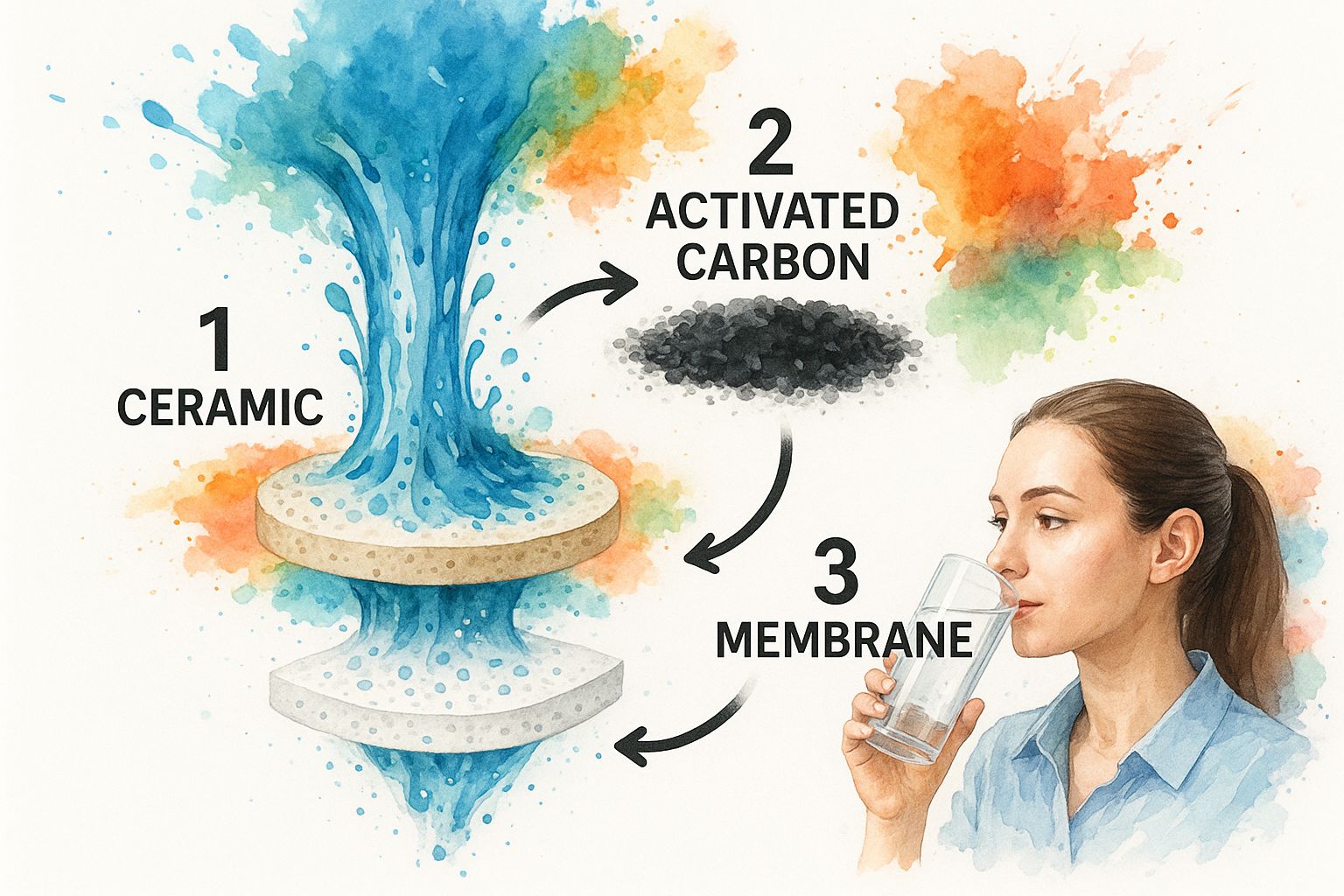
You can clearly see the water passing through distinct layers, with each one zeroing in on and removing different types of contaminants in sequence. This layered defense is what makes modern filtration so effective—it combines multiple purification methods into one seamless operation. Once you understand this flow, you can really see how a filter transforms regular tap water into something far cleaner and safer, one step at a time. It’s a journey from cloudy and contaminated to clear and pure.
Exploring the Different Types of Water Filters

It’s one thing to understand how water filters work in theory, but picking the right one from a sea of options is a whole different ballgame. Let’s walk through the most common types you’ll find, each designed with a specific need, budget, and lifestyle in mind.
From a simple pitcher you can pop in the fridge to a robust system that treats every drop of water coming into your home, there’s a solution for pretty much everyone. The market is booming for a reason. Valued at USD 15.88 billion in 2024, the global water filters market is expected to jump to USD 26.42 billion by 2032. This growth means more innovative choices for us, but it also makes it crucial to know what you’re looking for.
H3: Point-of-Use Filters for Targeted Purity
Think of Point-of-Use (POU) filters as specialists. They’re designed to treat water right where you use it most, like your kitchen sink or refrigerator’s water dispenser. They are a fantastic and often affordable way to dip your toes into home filtration, focusing on the water you drink and cook with.
These systems come in a few popular flavors:
- Water Pitcher Filters: The easiest entry point. These pitchers use a simple gravity-fed carbon filter to cut down on chlorine and improve taste. Perfect for renters or anyone who wants a no-fuss, no-installation solution.
- Faucet-Mounted Filters: These little gadgets clip right onto your kitchen faucet. A quick flip of a switch lets you choose between filtered water for drinking and unfiltered water for washing dishes.
- Countertop Filters: These sit beside your sink and connect to the faucet with a small tube. They usually pack more of a punch than pitchers, offering more advanced filtration that can tackle a wider range of contaminants.
While they’re incredibly convenient, POU filters are limited. They only treat water at a single tap and you’ll need to stay on top of changing the filters to keep them working effectively.
H3: Under-Sink Filtration Systems
If you’re ready for a more permanent and powerful solution but don’t want to re-plumb the whole house, an under-sink filter is a brilliant option. It’s tucked away in the cabinet under your kitchen sink, connected directly to the cold water line, and sends purified water up to its own dedicated faucet.
This setup has some serious perks over countertop models. It’s completely out of sight, which keeps your kitchen looking clean and uncluttered. More importantly, the larger filter cartridges last much longer—typically six months to a year—and can handle more complex, multi-stage filtration.
Under-sink systems strike that perfect balance between high performance and everyday convenience. You get top-notch filtered water on demand, right where you need it, without sacrificing an inch of counter space.
These systems are pros at removing things like chlorine, lead, pesticides, and cysts, which makes a noticeable difference in the taste and quality of your tap water.
H3: Reverse Osmosis Systems
When you want the absolute purest water possible, Reverse Osmosis (RO) is the gold standard. Usually installed under the sink, these systems use a multi-stage process to remove more than 99% of all dissolved solids.
At its heart, an RO system pushes water through a special semipermeable membrane. The pores in this membrane are so incredibly tiny that almost nothing but pure water molecules can squeeze through.
It’s exceptionally good at blocking:
- Heavy Metals: Lead, arsenic, mercury, and chromium.
- Dissolved Salts: Sodium, chloride, and fluoride.
- Other Contaminants: Nitrates, nitrites, and a long list of chemicals.
Because the process is so aggressive, it also strips out beneficial minerals. To solve this, many modern RO systems now have a final remineralization stage that adds healthy minerals like calcium and magnesium back into the water before it gets to your glass.
H3: Whole-House Water Filtration Systems
For the ultimate peace of mind, a whole-house water filtration system is the most comprehensive solution you can get. Also known as a Point-of-Entry (POE) system, it’s installed right where the main water line enters your home. This means every single tap—from the kitchen sink and shower to the washing machine—delivers clean, filtered water.
This is a true game-changer. It doesn’t just improve your drinking water; it protects your entire plumbing system and every water-using appliance from sediment, chlorine, and other chemicals that can cause damage over time.
For those of us in Denver dealing with mineral-heavy water, a whole-house system can make a world of difference. If you’re wondering what that means for your home, our guide explaining what hard water is breaks it down. By treating water at the source, you’re protecting your home’s infrastructure and improving your daily life in ways you can feel, from softer skin and hair to cleaner, brighter laundry.
Comparison of Home Water Filtration Systems
With so many options, choosing the right system can feel overwhelming. This table offers a quick, side-by-side look at the most popular choices to help you find the best fit for your home and lifestyle.
| System Type | Best For | Typical Cost | Key Benefit |
|---|---|---|---|
| Water Pitcher | Renters, individuals, or those on a tight budget. | $20 – $50 | Extremely affordable and requires no installation. |
| Faucet-Mounted | Convenience in the kitchen for drinking and cooking water. | $30 – $100 | Easy to install and allows switching between filtered/unfiltered. |
| Under-Sink | High-quality filtered water from a dedicated kitchen tap. | $150 – $500 | Out-of-sight installation with long-lasting, powerful filters. |
| Reverse Osmosis | Maximum purity, removing over 99% of contaminants. | $200 – $1,000+ | Unmatched purification for the cleanest possible drinking water. |
| Whole-House | Comprehensive treatment for every tap and appliance. | $800 – $3,000+ | Protects plumbing and improves water quality throughout the home. |
Ultimately, the best filter is the one that solves your specific water concerns without breaking your budget. Whether you start small with a pitcher or go all-in with a whole-house system, you’re taking a great step toward cleaner, better-tasting water.
What a Water Filter Actually Does for You
It’s easy to get bogged down in the technical details of filtration systems, but what really matters is the difference they make in your day-to-day life. Once you move past the specs and media types, you start to see the real-world wins—changes you can taste, see, and feel. This isn’t just about fancy hardware; it’s about upgrading your health, protecting your home, and even saving a little money along the way.
It’s no surprise that more and more homeowners are deciding to take control of their water. The global market for these systems was valued at around USD 14.23 billion in 2025 and is expected to more than double to USD 35.18 billion by 2034. That kind of growth tells a story: people are waking up to the value of having clean, safe water on tap. For a deeper dive into this trend, you can find more market insights on custommarketinsights.com.
Water That Tastes (and Smells) Like Water Again
The very first thing most people notice is the huge improvement in taste and smell. City water treatment does a great job of killing germs, but the chlorine they use often leaves a distinct, swimming-pool-like odor and aftertaste. It’s effective, but not exactly appetizing.
A good water filter, especially one with an activated carbon stage, is a pro at grabbing those chlorine molecules and other chemical disinfectants. What you’re left with is water that tastes crisp, clean, and completely refreshing. Suddenly, everything from your morning coffee to a simple glass of water tastes noticeably better.
Health Protection and True Peace of Mind
Honestly, this is the big one. There’s a certain peace of mind that comes with knowing the water your family drinks is genuinely clean. While U.S. tap water is among the safest in the world, our aging infrastructure can be a wild card. Lead from old pipes, agricultural runoff, and trace industrial chemicals can sometimes find their way into the system.
A solid filtration system acts as your last line of defense, catching these invisible intruders before they ever reach your glass. This is a game-changer for any household, but it’s especially critical if you have young kids or family members with sensitive health conditions.
Installing a water filter is more than a home improvement project; it’s a proactive step to protect your family’s health. You can be confident in every single drop.
And this protection goes beyond what you drink. A whole-house filter purifies the water you shower and bathe in, too. Removing harsh chemicals like chlorine can make a real difference, often leading to softer skin and healthier hair.
Long-Term Savings in Your Pocket
Sure, there’s an initial cost, but a home filtration system can genuinely save you a lot of money over time. How? By kicking the bottled water habit for good. The cost of all those single-use plastic bottles adds up fast, and that’s before you even think about the environmental toll.
Let’s just look at the math:
- Bottled Water: The average person can easily spend hundreds of dollars a year on bottled water.
- Filtered Water: After the initial setup, you’re looking at mere pennies per gallon for pure, clean water.
Making the switch means you get premium-quality water straight from your tap for a tiny fraction of the cost.
Defend Your Plumbing and Appliances
Clean water doesn’t just benefit your body; it benefits your house. Here in Denver, we know all about hard water and the scale buildup it leaves behind. That chalky residue is a menace to your plumbing and any appliance that uses water.
By installing a whole-house filter or a water softener, you stop that mineral buildup in its tracks. The benefits add up quickly:
- Longer Appliance Life: Your dishwasher, washing machine, water heater, and coffee maker will run more efficiently and last years longer without being clogged by scale.
- Clearer Pipes: You can avoid the headache and expense of clogged pipes and major plumbing repairs down the road.
- Better Efficiency: Appliances that aren’t fighting against mineral deposits work better and use less energy, which can even trim your utility bills.
How to Choose the Right Filtration System
With so many different types of water filters out there, picking the right one can feel overwhelming. The good news is that you can cut through the noise by asking a few key questions. A little strategy goes a long way in pinpointing the exact system your household actually needs.
Instead of getting bogged down in technical jargon, let’s create a clear roadmap. When you focus on your water, your goals, and your budget, making a confident, informed decision becomes much easier.
Step 1: Understand What’s In Your Water
Before you can solve the problem, you need to know what the problem is. What exactly are you trying to remove from your water? Your water quality report holds the answer.
Every year, your local municipality is required to publish a Consumer Confidence Report (CCR). This document details the contaminants found in your water supply and their levels. You can almost always find it on your water provider’s website, and it’s your first clue for understanding what you’re up against—be it chlorine, sediment, or other specific chemicals.
If you have a private well or just want a deeper dive, a professional water test is the way to go. This will give you a precise breakdown of your water’s chemistry, including its pH, hardness, and the presence of any heavy metals like lead.
Step 2: Define Your Filtration Goals
Once you know what’s in your water, the next step is deciding what you want to accomplish. Different systems are built for different jobs, so getting clear on your goals is crucial.
Are you mainly concerned with:
- Improving Taste and Odor? If your biggest complaint is a chlorine-like smell or funky taste, a simple activated carbon filter is often all you need.
- Removing Specific Contaminants? For serious issues like lead, arsenic, or pesticides, you’ll need a more robust system, like reverse osmosis.
- Softening Hard Water? Tired of that scaly buildup on your appliances and soap scum in the shower? Then your goal is water softening, which might mean a dedicated system or a combination unit.
Knowing your “why” will instantly narrow your options and steer you toward the right technology.
Choosing a water filtration system is a personal decision based on your unique water quality and health priorities. The goal is to find a solution that provides not just cleaner water, but also complete peace of mind.
Step 3: Consider Your Household and Budget
The final piece of the puzzle comes down to practical matters: your household size, water usage, and budget. What works for a single person in an apartment will be completely different from what a large family needs in a multi-story home.
Think about the upfront cost of the system and the long-term maintenance, like filter replacements. It’s a booming market—the water treatment industry is projected to hit USD 88.02 billion by 2033. This growth means there’s a huge range of options at various price points, all driven by our collective demand for better water. You can discover more insights about water treatment systems on GrandviewResearch.com.
To help you decide, consider the scope of filtration you need:
- Point-of-Use (POU): These systems, like pitchers or under-sink filters, are more affordable and treat water at a single faucet. They’re perfect for purifying the water you drink and cook with.
- Point-of-Entry (POE): Often called a whole-house system, this is a bigger investment that treats all water as it enters your home, protecting your plumbing and appliances along with your drinking water.
By balancing these three factors—your water quality, your goals, and your budget—you can confidently pick the perfect system. For a closer look at specific models, check out our guide on finding the best water filter for your house.
Keeping Your System Running Like a Dream
Putting in a new water filtration system is a great move, but it’s not quite a “set it and forget it” deal. The best way to think about it is like your car—it needs a little regular attention to keep performing at its peak and giving you that amazing, clean water you invested in. If you let it go, you don’t just lose performance; your filter can actually become a breeding ground for the very things you’re trying to remove.
Staying on top of maintenance is really about protecting your investment and making sure your system does its job day in and day out. It’s how you guarantee that the water coming out of your tap is just as pure as it was on day one.
The No-Fuss Maintenance Checklist
Good news: keeping your system in great shape isn’t complicated. A simple routine for changing filters and cleaning the unit will go a long way in extending its life and keeping your water quality high. When a filter gets clogged, it just can’t work properly, which can lead to funky-tasting water, weak water pressure, and even damage to the system itself.
Here are the key things to keep on your radar:
- Change Those Filters on Schedule: This is non-negotiable. Stick to the manufacturer’s timeline, which is usually somewhere between 3-12 months, depending on your system type and how much water your household uses.
- A Quick Clean-Up: When you swap out the old filter, take five minutes to wash the housing (the part the filter sits in) with some warm, soapy water. This simple step stops gunk and bacteria from building up.
- Do a Leak Patrol: Every so often, just take a quick look at all the connections and fittings. You’re looking for any drips or moisture. Finding a tiny leak early can save you from a massive headache and water damage later on.
Letting a filter go past its prime is like trying to wash dishes with a filthy sponge. Once it’s full, it can’t grab any more contaminants. Worse, it can start releasing them back into your water, completely defeating the purpose of having a filter.
Setting Up a Simple Maintenance Routine
The secret to never forgetting maintenance is to make it an easy habit. Don’t leave it to guesswork. Set up a schedule and pop some reminders in your phone’s calendar so you can just take care of it without a second thought.
Here’s a basic timeline you can tweak to fit your specific system:
- Once a Month: Do a quick visual check. Look for drips, listen for any weird sounds, and make sure your water pressure feels normal.
- Every 3-6 Months: This is the sweet spot for replacing most point-of-use filters, like the ones under your sink or attached to your faucet.
- Once a Year: If you have a whole-house system, this is usually when you’ll need to swap out the main sediment pre-filters. It’s also the perfect time to give the whole setup a deeper clean or even have a pro come out for a quick inspection.
A Few Common Questions Answered
When you start digging into water filtration, a few questions always seem to pop up. Let’s clear the air on some of the most common ones so you can feel confident about what these systems do for your home.
Do Water Filters Strip Out Healthy Minerals?
That’s a fantastic question, and the answer really hinges on the type of filter you’re looking at. Most common filters, like activated carbon systems, are selective. They’re designed to grab impurities like chlorine and sediment but let beneficial minerals like calcium and magnesium pass right on through.
On the other hand, you have systems like reverse osmosis (RO), which are incredibly thorough. An RO system is so powerful it removes just about everything—including those good minerals. To solve this, many modern RO units now come equipped with a remineralization stage that adds a healthy dose of minerals back into the water before it gets to your glass.
How Can I Tell if I Actually Need a Water Filter?
Your first stop should be your local Consumer Confidence Report (CCR). Every municipal water provider publishes one, and it’s a detailed breakdown of what’s in your water and at what levels. It’s public information, usually right on their website.
Beyond the report, trust your senses. If your water tastes or smells off, or if you know you have older pipes, a professional water test is the best way to get a definitive answer. A filter is a no-brainer if tests show contaminants near or above EPA limits, but it’s also a great choice if you simply want that extra layer of confidence in your water quality.
At its heart, asking “what is a water filtration system” is really about finding a way to take control. It’s about establishing a final line of defense against contaminants, right where it matters most—your home.
What’s the Difference Between a Water Filter and a Water Softener?
This is a mix-up we see all the time, but they have two very different jobs. Think of a water filter as a purifier. Its mission is to improve safety and taste by removing things like chlorine, pesticides, bacteria, and lead.
A water softener, however, is a specialist. It’s built for one thing: to remove the “hard” minerals (calcium and magnesium) that cause scale buildup in your pipes and appliances. It doesn’t purify the water for drinking; it protects your home’s plumbing. It’s why many homeowners with hard water use both—a whole-house softener and a dedicated filter for their drinking water.
Ready to take the next step toward better water for your family? If you have more questions or want to explore the right system for your Denver home, the team at Professional Plumbers Denver is here to help. Contact us today for a professional consultation and we’ll find the perfect fit.