
Picture this: you hear the unmistakable sound of water rushing where it shouldn't be. A pipe just burst in the middle of a cold snap. It’s a nightmare scenario for any homeowner, but knowing how to shut off water is your first and most critical defense against disaster.
Why This Five-Minute Lesson Is Your Best Home Defense
Learning this isn't just another item on your home maintenance checklist; it's a powerful tool for protecting your finances. A major water leak can rack up thousands of dollars in damages in just a few minutes, destroying floors, drywall, and cherished belongings. Being able to take control in a water emergency is incredibly empowering.
This guide will walk you through the simple steps to confidently handle a water crisis. You'll learn how to find and use both the main shutoff for your entire house and the smaller, individual valves for fixtures like sinks and toilets. Think of it as the most important five-minute lesson you can learn to protect your home and your sanity.
The Real Cost of Water Damage
The need for this skill becomes crystal clear when you look at the numbers. Across the United States, a staggering 6 billion gallons of treated water leak from water systems every single day. While a lot of that is on the municipal side, it paints a picture of the immense pressure and potential for failure in the pipes running right into your home. Knowing you can stop that flow instantly is a game-changer.
Stopping a leak is about more than just saving water—it's about preventing structural rot, mold growth, and the costly repairs that follow. Every second you save by acting quickly translates directly into money saved.
Understanding potential hazards, like major water pipeline issues, is exactly why you need to know where your shutoff valve is. A sudden pipe burst, often caused by freezing temperatures or simple corrosion, can unleash a devastating amount of water. For a closer look at the "why" behind these disasters, check out our detailed guide on what causes pipes to burst. Mastering this one skill puts you in control when everything feels out of control.
Locating Your Main Water Shutoff Valve
When a pipe bursts, the last thing you want is to be on a frantic scavenger hunt for a hidden valve. Knowing how to shut off water to your entire home starts with finding that one critical control point before you ever need it. Taking a few minutes to locate it now can save you from a world of panic and water damage later.
Your home's main water shutoff valve is the gatekeeper, controlling every drop of water that flows in from the city's supply. Let's walk through how to find it.
This visual guide gives you a great idea of what to look for and where. Typically, the main shutoff is located right where the water line enters your home, often near your water meter.
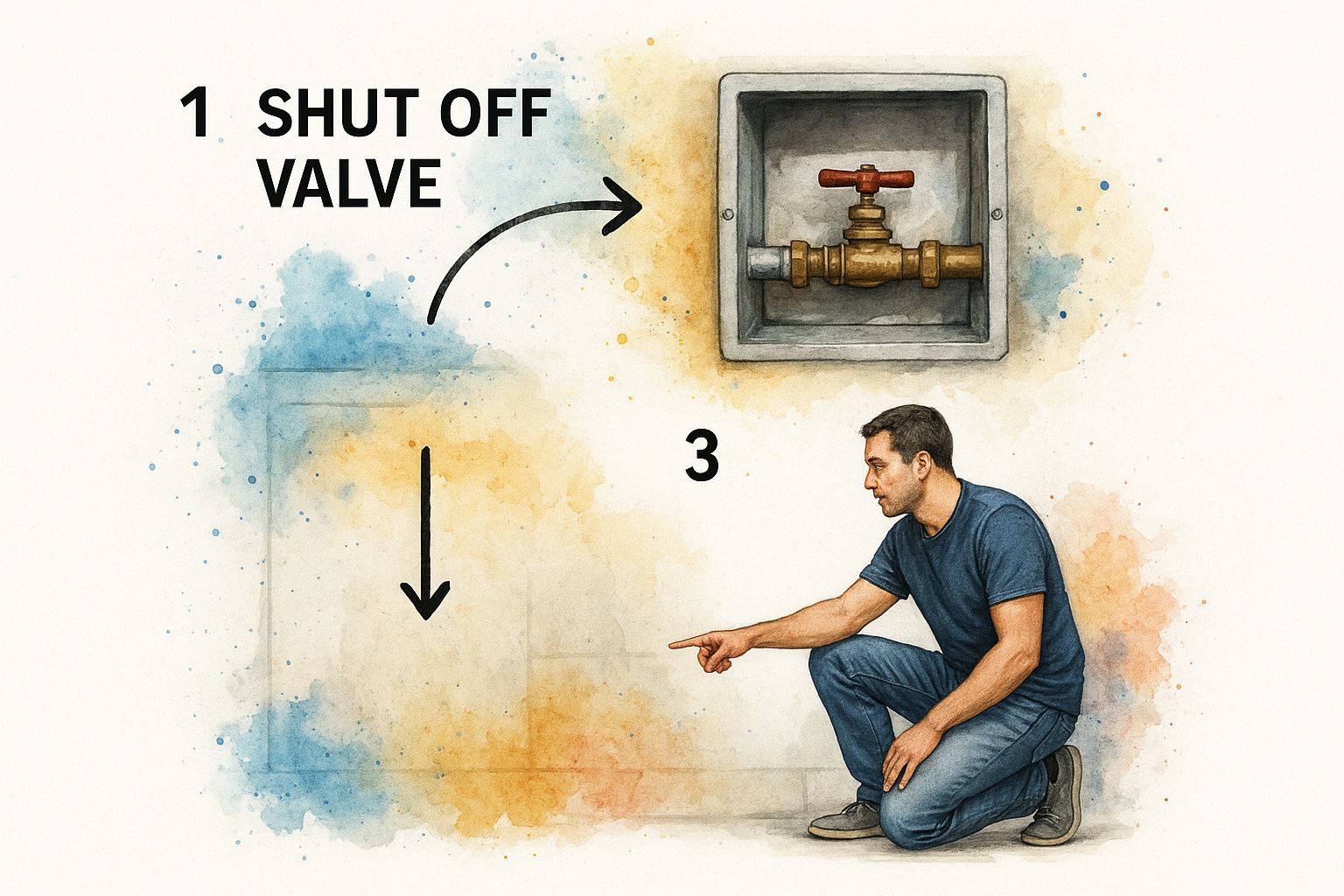
As you can see, once you know the general layout, what seems like a stressful search becomes a quick, decisive action.
Where to Look First: Common Hiding Spots
While every Denver-area home is unique, builders tend to be creatures of habit. The main water line almost always enters your property from the side of the house facing the street. That's your starting point.
Here are the most common places you'll find it:
- Basements: Scan the front foundation wall. You should see a pipe coming through the concrete, with the valve and water meter installed right there.
- Crawl Spaces: It's a similar setup to a basement, but you'll need a good flashlight. Look along that front wall, near where the ground level is outside.
- Attached Garages: Check the interior walls, especially the one that backs up to the main living area of the house.
- Utility Closets: If your furnace and water heater are tucked into a closet, there's a good chance the main water shutoff is in there with them.
This knowledge is more critical than ever. Across the U.S., a water main breaks every two minutes. It's a sobering statistic, and it gets worse: nearly 20% of all treated drinking water is lost to leaks before it even gets to a tap. A staggering 87% of these losses are from physical pipe failures, not simple billing issues, as detailed in reports on the global water crisis found on ionexchangeglobal.com. Your ability to quickly shut off the water is the first and most important line of defense.
Knowing where your main shutoff valve is can be tricky, especially in older Denver homes or properties with unique layouts. This table should help narrow down your search.
Common Locations for Main Water Shutoff Valves
| Home Feature | Most Likely Valve Location | What to Look For |
|---|---|---|
| Full Basement | Along the front foundation wall | A pipe coming through the concrete, usually near a water meter. |
| Crawl Space | Near the access door or front wall | Look for a pipe coming up from the ground or through the wall. |
| Slab Foundation | Utility closet or garage | Often near the water heater on a wall adjacent to the outside. |
| Older Home (Pre-1970s) | Could be in an exterior pit or box | Look for a small metal or concrete lid in the yard near the street. |
Remember, these are just the most common spots. If you've checked them all and still come up empty, it might be time for a professional to help you locate and tag it.
What Does the Valve Look Like?
Once you're in the right area, you need to know what to look for. The main shutoff is almost always the very first valve on the pipe that enters your house, located just before the water meter (the device that measures your usage).
You’ll typically find one of two styles.
Pro Tip: Don't get this confused with the shutoff for your sprinkler system or the one on your water heater. The main valve is the big one—it controls everything.
Your valve will likely be either a gate valve or a ball valve.
- Gate Valve: This looks like a small wheel or a round spigot-style handle. You turn it clockwise, usually several times, to shut it off completely.
- Ball Valve: This is the more modern style, featuring a straight lever handle. When the handle is parallel with the pipe, the water is on. A single quarter-turn, so the handle is perpendicular to the pipe, shuts it off.
Ball valves are generally more reliable and far less likely to get stuck from mineral buildup over the years. Whichever type you have, once you find it, do yourself a favor: tie a bright, waterproof tag on it. That way, anyone in the house can find it in a hurry.
How to Use Your Main Water Valve the Right Way
Okay, so you've found the valve. That's a huge step. Now comes the important part: actually turning it off without creating an even bigger headache. How you do this depends entirely on the type of valve your Denver home has.
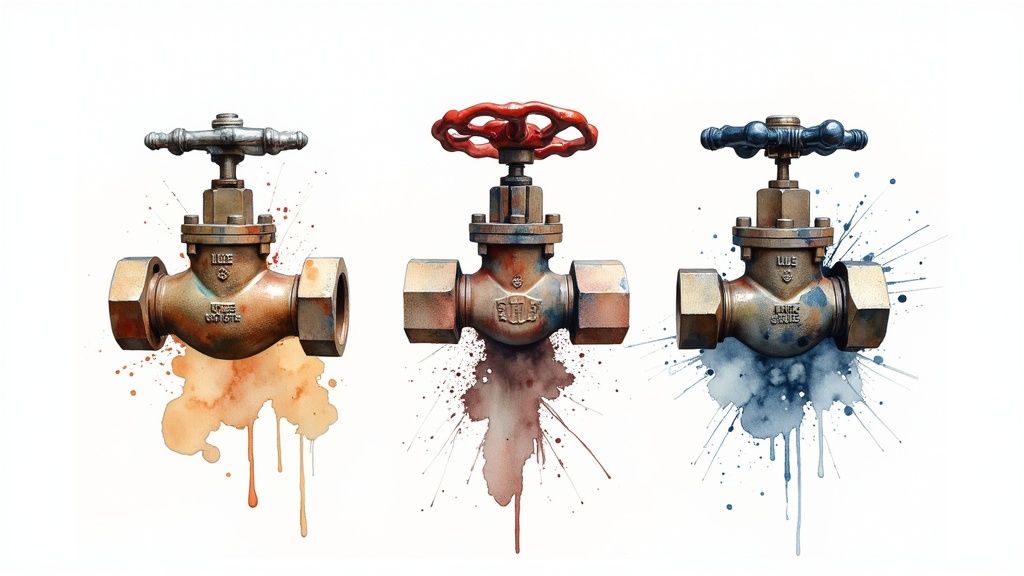
Most houses I see have one of two kinds—a ball valve or a gate valve. Knowing which one you're looking at is key when water is spraying everywhere and every second counts.
Ball Valves vs. Gate Valves
-
Ball Valve (Lever Handle): This is the modern, easy-to-use style. When the water is on, the lever handle sits parallel with the pipe. To shut it off, you just give it a firm quarter-turn. The handle will now be perpendicular to the pipe. Simple as that.
-
Gate Valve (Round Handle): These are the older, spigot-style handles. To close one of these, you need to turn the round handle clockwise—remember "righty-tighty"—several full rotations. Keep turning until it feels snug and stops on its own.
Here's a pro tip I can't stress enough: Never force a stuck valve. If it won't turn, grabbing a wrench and cranking on it is a recipe for disaster. You can easily snap the valve stem, turning a controllable leak into a geyser.
Once you think you've got it turned off, you need to double-check. Head to the lowest faucet in the house (a basement sink or first-floor bathroom works well) and open both the hot and cold taps. The water pressure should drop to a trickle and then stop completely. If it does, congratulations, you've successfully shut off the water.
If you’re still having trouble, we have another guide that goes into more detail on how to turn off your water main with a few extra troubleshooting tips.
One last thing—do your future self a huge favor. Tie a bright, waterproof tag to that main valve handle right now. It makes the valve impossible to miss, saving you precious time and panic during your next plumbing emergency.
Using Fixture Shutoff Valves for Localized Leaks
Not every water emergency means you have to sprint to the main valve and shut down the whole house. For those more common annoyances—a toilet that won't stop running or a faucet that’s started dripping—the solution is usually much simpler. Learning how to shut off water to just a single fixture is a skill every homeowner should have. It lets you stop a problem in its tracks while the rest of your home's plumbing works as usual.
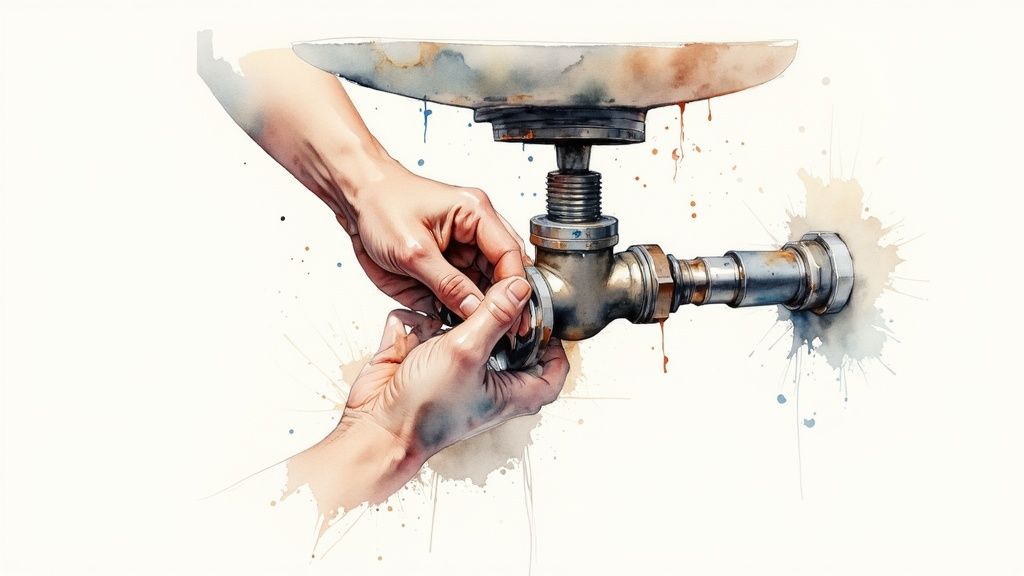
These little valves are your first line of defense, often called "stop valves" or "angle stops." Knowing how to use them can turn a panic-inducing leak into a minor, manageable repair.
Where to Find Fixture Valves
The good news is that these valves are rarely hidden. Once you know what you’re looking for, you’ll start seeing them everywhere. They’re almost always located right next to the fixture they control.
Here’s a quick rundown of the most common places you'll find them in a Denver-area home:
- Toilets: Check the wall right behind the toilet, usually close to the floor. You’re looking for a small, typically oval-shaped handle on a valve connected to the water line running up to the tank.
- Sinks: Open the cabinet under your kitchen or bathroom sink. You should see two valves coming out of the wall, each with its own handle—one for hot and one for cold.
- Washing Machines: Look behind the washer itself. It’s common to see a recessed plastic box in the wall containing two spigot-like valves, one for hot and one for cold.
This kind of hands-on knowledge is becoming even more important. The market for smart water leak detection systems is expected to jump from $5.6 billion in 2025 to around $8.4 billion by 2032, as more homeowners use technology to catch leaks early. You can discover more insights about the market on metastatinsight.com to see how tech is changing home water management. But even without fancy gadgets, knowing your fixture valves gives you the same power to stop a leak fast.
Quick Guide to Fixture Shutoff Valves
For a quick reference, here’s a simple table summarizing where to look for the shutoff valves on your home’s most common fixtures and how to operate them.
| Fixture | Valve Location | How to Turn Off |
|---|---|---|
| Toilet | On the wall behind the toilet, near the floor. | Turn the oval or football-shaped handle clockwise until snug. |
| Sink Faucet | Under the sink, inside the cabinet. There are two. | Turn both handles clockwise (hot and cold) until they stop. |
| Washing Machine | Behind the appliance, often in a recessed wall box. | Turn both spigot-like handles firmly to the right (clockwise). |
| Dishwasher | Typically under the kitchen sink, connected to the hot water line. | Find the smaller valve teeing off the hot water supply and turn its handle clockwise. |
Keep this info handy, and you’ll be prepared to tackle most minor leaks without shutting down your entire home.
How to Operate Them Correctly
Once you’ve found the valve, using it is incredibly straightforward. Just like your main shutoff, remember the old saying: "righty-tighty." Turn the handle clockwise until it gently stops. You don’t need to muscle it; just turn until it feels snug and secure. That's all it takes to cut off the water supply to that one appliance.
A Pro Tip: I always tell homeowners to gently turn each fixture valve off and on again once a year. This little bit of maintenance keeps them from getting stuck or "frozen" from mineral buildup, so they'll work perfectly when you actually need them in an emergency.
After you've closed the valve, always double-check your work. Turn on the faucet or flush the toilet to make sure the water flow has completely stopped. This simple confirmation gives you the peace of mind to figure out your next steps for a repair without the pressure of a running leak.
When Shutoff Valves Won't Cooperate
You've found the valve, but there's a problem: it won't budge. In a perfect world, a quick turn of the handle is all it takes. But we live in the real world, and especially in older Denver-area homes, things can get a little stuck.
Years of sitting untouched can cause mineral deposits to build up, essentially cementing the valve in place. You might be tempted to grab the biggest wrench you own and put some muscle into it, but I’m telling you from experience: don't do it.
Applying brute force is the fastest way to snap a valve stem. If that happens, a small leak instantly becomes a major flood, and you've just created a much bigger, more expensive problem.
What to Do with a Stuck Valve
Instead of forcing it, try a few gentler tricks first.
- A Light Tap: Gently tap the body of the valve (not the handle or pipe) with a small hammer. Sometimes, the vibrations are just enough to break up the corrosion and loosen its grip.
- The Gentle Wiggle: Try wiggling the handle back and forth, just a tiny bit. This can help break the seal that minerals have formed inside the valve over time.
If neither of those tricks works with reasonable hand pressure, it’s time to stop. That valve is telling you it needs professional attention.
The Curb Stop: Your Last Resort (and a Job for the Pros)
If your main shutoff is broken, missing, or just won't turn, you might spot a small metal lid in your yard or sidewalk near the street. Underneath is the curb stop valve. This is the utility company's main shutoff for your property, and it's their property, too.
Operating this valve requires a special long-handled "key," and you should never try to turn it yourself. It's easy to break, and the liability for that damage would fall squarely on you.
The most important skill in a water emergency is knowing your limits. A stubborn valve isn't a test of your strength; it's a clear signal that it's time to call a plumber.
Forcing the issue can lead to catastrophic pipe breaks. If you're already dealing with a serious leak and can't get the water off, check out our guide on what to do when your basement has flooded for the immediate next steps. Don't risk making a bad situation worse—if the valve won't turn, make the call.
Got Questions? We've Got Answers
Even when you know where your shutoff valves are, you're bound to have a few questions. I've heard them all over the years, so let's walk through some of the most common ones that come up for Denver homeowners. Getting these details straight is what gives you real peace of mind.
How Often Should I Test My Main Water Shutoff?
Think of it like an annual check-up. You should give your main shutoff valve a quick test at least once a year. It’s a simple step, but it’s crucial. Over time, valves can get stiff or seize up from mineral buildup, and the last thing you want is to discover it's stuck during a real emergency.
The test is easy:
- Gently turn the valve all the way to the "off" position.
- Go to the nearest faucet and turn it on—no water should come out.
- Turn the valve back on, and you're all set.
If it feels incredibly difficult to turn, don't try to force it. That’s your cue to call in a professional plumber.
Is It a Problem to Leave the Main Water Off for a While?
Absolutely not. In fact, it’s one of the smartest things you can do if you’re heading out of town for a vacation or leaving the house empty for an extended period. Turning off the main water supply is your best defense against coming home to a flooded house from a surprise leak.
Here's a pro tip: If you have an older, tank-style water heater, you need to shut that off too. Letting the water heater run without any water feeding into it can burn out the heating elements and cause some serious damage.
What’s the Difference Between My Valve and That One Out by the Street?
The valve inside your house is yours to control—it’s your home’s main point of defense. The one out at the street, usually under a heavy metal cover in the yard or sidewalk, is called the curb stop.
That curb stop belongs to the city or your local water utility. It controls the water flow from the public main to your property line and requires a special long-handled key to operate. You should never try to mess with the curb stop yourself; it’s strictly for utility personnel.
When you're facing a plumbing puzzle you can't solve, from a valve that won't budge to a full-blown emergency, it's always best to call in the experts. For any plumbing headaches in the Denver area, Professional Plumbers Denver is ready to help 24/7. Get in touch with us for fast, reliable service at https://professional-plumbers-denver.com.

Recent Comments