
When it comes to tankless water heaters, the most common headaches are usually no hot water at all, water that can’t make up its mind on temperature, and mineral buildup—a notorious issue here in Denver thanks to our hard water.
More often than not, these problems aren’t as catastrophic as they seem. They often trace back to something simple, like an overloaded system, a clogged filter, or a simple ignition failure. The trick is knowing what to look for.
Your First Stop for Troubleshooting Common Problems
That moment when you turn the shower handle and get blasted with icy water is never fun. When things go wrong, you need answers, and you need them fast. Let’s walk through how to quickly diagnose what’s happening with your unit.
Instead of just guessing, we’ll connect the dots. Is the water completely cold? Does it get hot for a second and then go lukewarm? Is the unit making a weird rumbling sound? Every symptom is a clue that points you in the right direction, saving you a whole lot of time and frustration.
Quick Diagnostic Triage
Think of the table below as your troubleshooting cheat sheet. It’s designed to help you match what you’re experiencing with the most likely culprit. Find your symptom, see the probable cause, and know what to do first.
Pro-Tip: Before you start taking things apart, always check the absolute basics. Is the unit plugged in and getting power? For gas models, is the gas valve open? Did a circuit breaker trip? You’d be surprised how many “emergencies” are solved with these simple checks.
Here’s a guide to help you get started on your own diagnostics.
Quick Diagnostic Guide for Tankless Heaters
| Symptom | Possible Cause | Your First Step |
|---|---|---|
| No Hot Water | Ignition failure, low water flow, or power loss. | Check for error codes on the display and ensure the unit has power. |
| Lukewarm Water | Undersized unit, mineral buildup, or a faulty mixing valve. | Try running fewer hot water appliances at once to see if it improves. |
| Fluctuating Temps | Clogged inlet filter or a “cold water sandwich” effect. | Clean the small screen on the cold-water inlet pipe. |
| Strange Noises | Mineral scale buildup on the heat exchanger (kettling). | Schedule a professional system flush and descaling service. |
This quick guide should give you a solid starting point. If the first step doesn’t resolve the issue, it’s often a sign that a deeper problem is at play, and it might be time to call in a pro.
Why a Quality Installation Is Your Best Defense
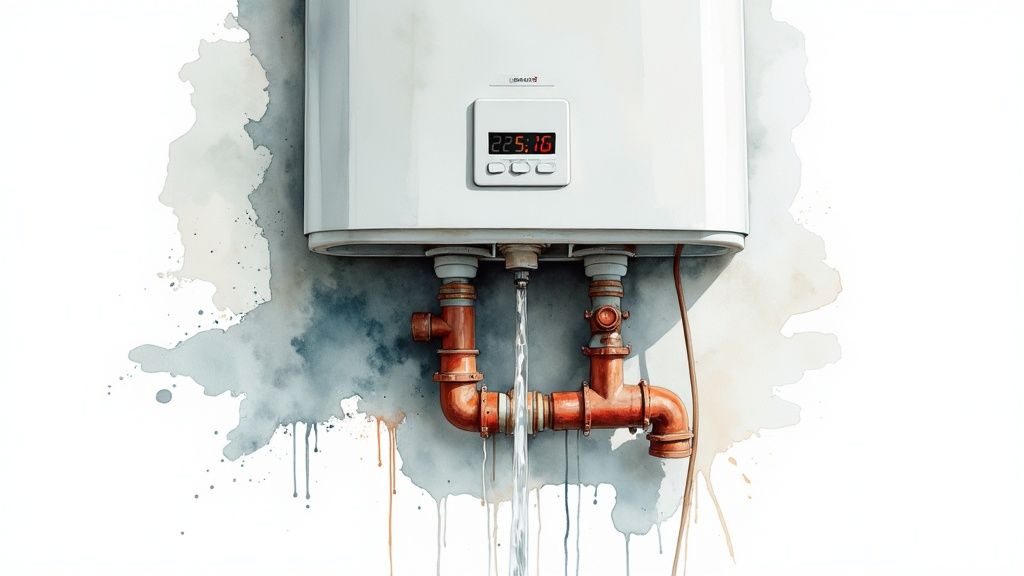
It’s a frustrating situation. Your tankless water heater is acting up again, and you’re starting to blame the unit itself. But what if the real problem isn’t the machine, but the way it was put on the wall in the first place? Many of the most common and maddening issues can be traced right back to a flawed installation.
Think of it like building a house on a shaky foundation. No matter how perfect the rest of the structure is, it’s bound to have problems. A botched installation does the same thing to your water heater, creating a blueprint for failure that will cause you headaches for years to come.
This is especially critical here in Denver. Our high altitude means the air is thinner, which directly impacts how gas appliances burn fuel. If a unit isn’t properly calibrated for our specific conditions from day one, it’s going to struggle, leading to poor performance and a much shorter lifespan.
The Anatomy of a Flawed Installation
A bad installation is rarely just one big mistake. More often, it’s a series of small, overlooked errors that add up over time, creating the very problems you might be troubleshooting right now.
Here are a few common shortcuts that cause big trouble:
- Undersized Gas Lines: The heater is essentially starved for fuel. This means it can’t generate enough heat, leading to ignition failures and that dreaded lukewarm shower.
- Improper Venting: This one is a major safety concern. Incorrect venting can cause the unit’s high-limit switch to constantly trip, shutting it down. Far worse, it can lead to dangerous carbon monoxide leaks inside your home.
- Missing Isolation Valves: These simple valves make routine maintenance, like flushing the system, quick and easy. Without them, what should be a straightforward job becomes a complicated and costly plumbing project.
These aren’t just minor inconveniences. These mistakes actively damage your water heater and can put your family’s safety at risk.
A professional installation isn’t just about connecting a few pipes. It’s a precise process that involves calculating gas flow, ensuring safe ventilation, and calibrating the unit specifically for Denver’s high-altitude environment.
The Long-Term Cost of Cutting Corners
Hiring a cheaper, unlicensed installer might look like a great way to save a few bucks upfront, but it almost always ends up costing you more down the road. It’s a classic case of “pay now or pay a lot more later.”
Faulty setup is a leading cause of equipment failure, contributing to an estimated 20-30% of all water heater breakdowns due to things like poor venting and incorrect pressure settings.
When you’re facing serious issues from a bad install, you need a pro you can trust. Understanding how plumbing businesses attract clients can sometimes help you spot the reliable ones. Ultimately, investing in a certified plumber who knows Denver’s specific building codes and environmental challenges is the single best thing you can do to avoid future breakdowns. We go into more detail on this topic in our guide on why a professional plumber should install your water heater.
Simply put, a correct, code-compliant installation is your best defense against future headaches.
Decoding Error Codes And Operational Glitches
When your tankless water heater acts up, it usually tries to tell you what’s wrong. That little screen flashing a weird code is your system’s way of crying for help. But let’s be honest, those codes can feel like a foreign language. Let’s break down what your heater is saying and what to do about it.
One of the strangest things people experience is the infamous “cold water sandwich.” You know the drill: you’re enjoying a hot shower, then BAM—a blast of icy water hits you, only to be followed by hot water again. This happens because the unit turned off after the last use. When you turn the faucet on again, you’re getting the cold water that was just sitting in the pipes before the freshly heated water can make its way to you.
Understanding Error Codes
Think of error codes as clues from a detective. A code for “ignition failure” points to a completely different issue than one for “low water flow.” Your owner’s manual is always the best first stop, since codes can be different between brands like Rinnai and Navien. Still, most of them point back to a few usual suspects.
When you suddenly have no hot water, it’s easy to assume the worst. But before you panic, here’s a simple way to think through the problem.
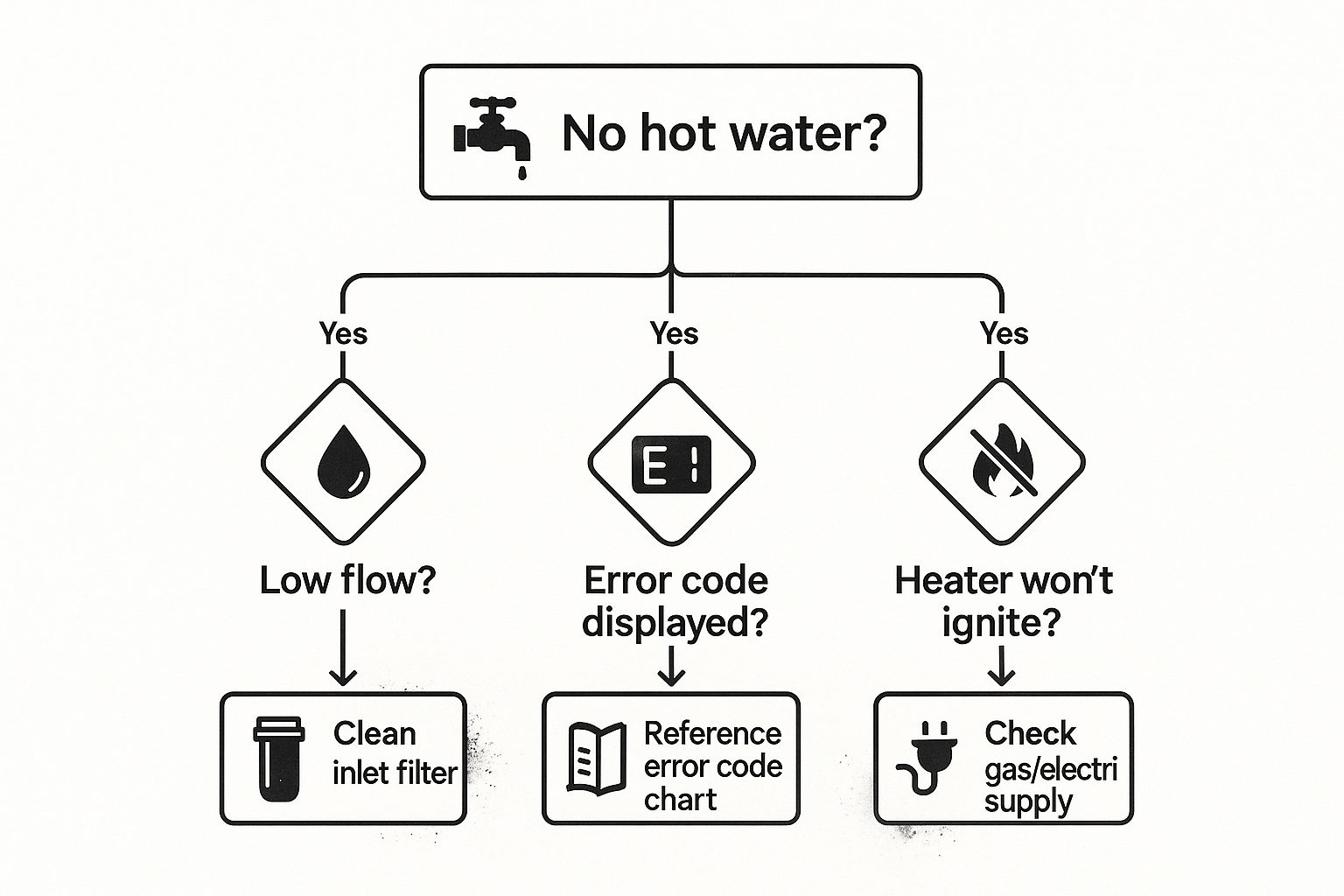
As you can see, the fix is often something simple. It’s always worth checking the easy stuff—like a dirty filter or making sure your gas is on—before calling for backup.
What Your Water Heater Is Trying to Tell You
Error codes are a great starting point, but sometimes your heater is telling you something without flashing a code at all. Here’s a quick guide to some common error types and what they usually mean.
| Error Code (Example) | Plain English Meaning | Recommended Action (DIY or Pro) |
|---|---|---|
| Code 11 (Ignition) | “I can’t light the fire to heat your water.” | Pro |
| Code 10 (Vent) | “Something is blocking my exhaust.” | Pro |
| Code 05 (Flow) | “I’m not getting enough water moving through me.” | DIY (Check/clean filters) |
| Code 71 (Sensor) | “One of my internal sensors has a problem.” | Pro |
| Code 90 (Combustion) | “The mix of air and fuel isn’t right for Denver’s altitude.” | Pro |
This table is just a general guide, but it helps you see that some issues, like cleaning a filter, are things you can likely handle. For anything involving gas, combustion, or internal sensors, it’s always safest to call in a professional.
Common Glitches and Their Meanings
Beyond specific codes, the way your water acts is also a big clue. If the temperature swings wildly, it could mean the inlet water filter is getting clogged up with sediment, or maybe the system is just overloaded trying to run the dishwasher and two showers at the same time. If the unit refuses to fire up at all, it might be something as simple as a dirty flame sensor that needs cleaning or an issue with your gas line.
The cold water sandwich is a classic example of these quirks. A typical gas tankless heater holds about a quart of water inside. Research shows that while these units can supply a hefty 76 to 78 gallons of hot water a day, users do experience those brief cold bursts between uses. It’s just part of how they work.
For a more detailed look at common issues, our guide on the 5 most common tankless water heater problems is a great resource. Learning what’s a simple fix versus what needs an expert’s touch is the key to keeping your tankless system running smoothly for years.
How Hard Water Silently Clogs Your Heater
Picture the inside of your tankless water heater as a network of small, clean pipes—like arteries. When everything is working perfectly, water zips through them without any trouble. But here in Denver, our water is notoriously hard, meaning every drop carries tiny, dissolved minerals like calcium and magnesium.
These aren’t just harmless passengers. As your unit flash-heats the water, those minerals fall out of the solution and cling to the hot surfaces of the heat exchanger. Over time, they build up into a crusty, chalky layer known as limescale. This mineral buildup is one of the most common issues we see, and it acts just like cholesterol, slowly but surely clogging those vital pathways.
The Real Problem with Limescale
This scale buildup isn’t just ugly; it’s a silent killer for your heater’s performance. The layer of minerals creates a barrier, insulating the water from the very heating elements trying to warm it. To get your shower water up to temperature, the heater has to fire up longer and hotter, forcing heat through that stubborn mineral wall.
This constant strain snowballs into bigger problems:
- Skyrocketing Bills: Your unit has to work overtime, which means it’s burning more gas or using more electricity. You’ll see this hit your utility bills.
- Weak Water Flow: As the scale narrows the pipes inside the unit, you’ll start to notice the hot water pressure at your faucets getting weaker.
- Stressed-Out Components: Pushing the system to its limits puts a ton of stress on internal parts, which can seriously shorten the lifespan of your heater.
- Catastrophic Failure: In the worst-case scenario, the heat exchanger gets so clogged that it overheats and cracks. That’s not a simple fix; it’s a complete system breakdown.
It really comes down to this: the harder your heater has to work, the faster it’s going to fail. Mineral scale is the number one thing that forces your unit into a constant state of overdrive.
Protecting Your System from Hard Water Damage
The good news is that you can absolutely prevent scale damage. Your best line of defense is routine maintenance—specifically, a service called descaling or flushing.
This process involves running a special descaling solution (often a food-grade acid, similar to vinegar) through the heater to dissolve all that built-up gunk. We, and most manufacturers, strongly recommend doing this at least once a year.
If you’re looking for a permanent solution, especially in an area with water as hard as ours, a whole-house water softener is the way to go. A softener tackles the problem at the source, removing the calcium and magnesium before the water ever enters your heater. It’s the single best way to protect your investment and keep scale from ever forming in the first place.
Budgeting for Repairs and Proactive Maintenance
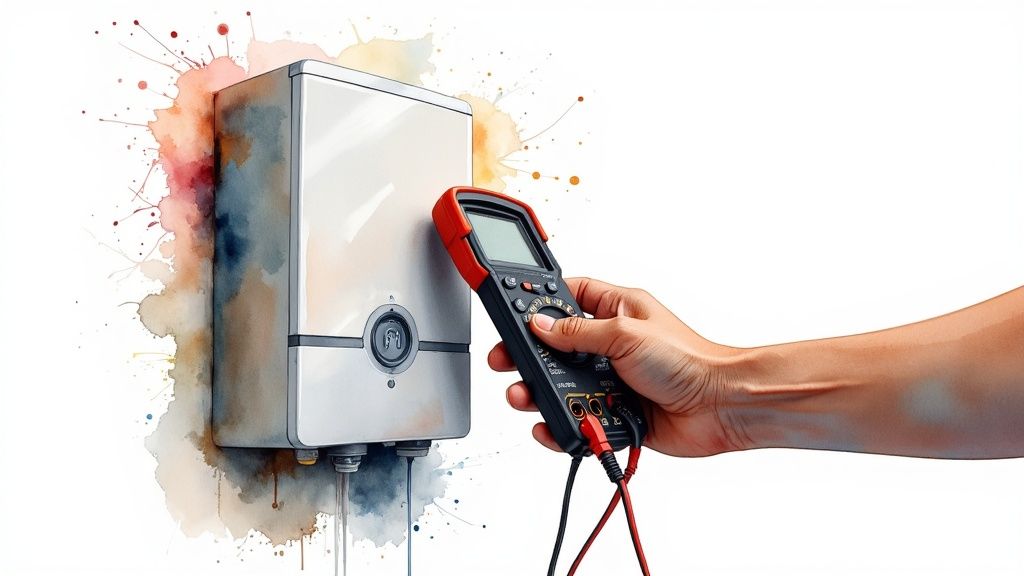
Let’s talk about the part nobody enjoys: the repair bill. When an essential appliance like your water heater acts up, the last thing you want is a financial shock on top of the inconvenience. Understanding what you might face in repair costs helps you plan ahead.
This isn’t about expecting the worst, but simply being a smart homeowner. The cost to fix a tankless unit can swing wildly depending on the problem. A technician might only need to clean a dirty flame sensor, which is a relatively quick and affordable fix. On the other hand, if a major component like the heat exchanger cracks from years of mineral buildup, you’re looking at a much more serious and expensive repair.
Comparing Repair Costs
So, what should you expect? Recent data shows the average tankless water heater service call lands around $600. But that’s just an average. I’ve seen minor jobs cost as little as $75, while complex fixes—like replacing that critical heat exchanger—can easily top $1,300.
Keep in mind that labor rates in our area can also range from $45 to $200 per hour. Knowing these numbers helps you spot a fair quote when you get one. If you suspect something’s wrong, check out these common signs that your water heater needs repairs to help you decide when it’s time to call in a pro.
Maintenance as an Investment
The best way to manage repair costs is to prevent them from happening in the first place. This is where you need to shift your thinking: proactive maintenance isn’t an expense, it’s a smart investment in your home. An annual service visit is your number one defense against an expensive, middle-of-a-cold-shower emergency.
Think of it this way: a scheduled annual flush and inspection costs a fraction of an emergency callout to replace a failed part. You’re not just paying for a service; you’re buying peace of mind and protecting the significant investment you made in that unit.
For those urgent problems that just can’t wait, having access to reliable 24/7 plumbing support can be a lifesaver. But with regular check-ups, you can catch small issues before they snowball, ensuring your heater runs efficiently and reliably for years. Ultimately, that’s what saves you money and a whole lot of stress.
A Simple Maintenance Checklist to Keep Your Heater Happy
When it comes to your tankless water heater, a little prevention goes a long, long way. Being proactive is always easier—and a whole lot cheaper—than reacting to a cold shower surprise on a chilly Denver morning.
Think of it like getting an oil change for your car; you’re stopping small issues from spiraling into massive, expensive breakdowns. This straightforward checklist breaks down the essentials into things you can handle yourself and tasks best left to the pros.
Quick Monthly Look-Sees
These are super simple visual checks. You can knock them out in just a few minutes each month.
- Check the Air Intake Filter: Take a peek at the filter screen. Is it clogged with dust, lint, or other gunk? A blocked filter can suffocate the unit, causing combustion problems and triggering error codes.
- Inspect the Vents: Look outside where your unit vents. Are there any blockages like bird nests, leaves, or debris? Clear, unobstructed vents are non-negotiable for safety and proper operation.
The All-Important Annual Pro Tune-Up
While your monthly checks are great, nothing beats an annual service from a qualified Denver plumber. This is where the real magic happens for keeping your unit healthy long-term, especially with our notoriously hard water.
An annual professional service is the single best thing you can do to get the full 15 to 20-year lifespan out of your tankless unit. It’s the key to maintaining peak efficiency and dodging the costly failures that come from neglect.
Here’s what a thorough annual service should always cover:
- System Flush and Descaling: This is the big one. A technician will circulate a special solution through the heat exchanger to dissolve all that crusty mineral scale. This single step restores water flow and takes a huge amount of strain off the system.
- Burner and Ignition Inspection: The tech will also clean and inspect the burner assembly and the flame sensor. This ensures you get a clean burn and reliable ignition every time you turn on the hot water, preventing those frustrating startup failures.
Frequently Asked Questions About Tankless Heaters
Even after you’ve tried a few troubleshooting steps, you probably still have some practical, day-to-day questions about your tankless water heater. It’s completely normal. Here are a few of the most common things we hear from Denver homeowners about their on-demand systems.
Getting a handle on these details helps you tell the difference between normal operational quirks and genuine tankless water heater issues. That knowledge can save you a lot of stress and maybe even a service call. Let’s get into it.
How Do I Know if My Tankless Heater Is the Right Size?
If you’re getting lukewarm water, especially when the shower and the dishwasher are running at the same time, your unit might be undersized. Sizing a tankless heater isn’t about your home’s square footage; it’s all about flow rate (gallons per minute you use at once) and temperature rise (how many degrees the heater has to warm up your water).
Here in Denver, our groundwater is pretty chilly. That means your unit needs to work harder and achieve a much higher temperature rise than a similar unit down in Phoenix. A pro plumber can calculate your home’s peak hot water demand to make sure your heater can keep up, delivering that endless hot water you were promised without being oversized and inefficient.
Will My Gas Tankless Heater Work in a Power Outage?
Unfortunately, no. It’s a common misconception. While the gas provides the flame, the brains of the operation are all electric. The electronic ignition, the digital display, and all the critical safety sensors need power to function. No electricity, no hot water.
For homeowners in areas with frequent outages, a small battery backup, often called a UPS (Uninterruptible Power Supply), is a great solution. Hooking your heater up to one of these or a larger home generator ensures you won’t be left in the cold when the power goes out.
What Causes Loud Banging Noises in My Heater?
You’ll hear a soft click when the unit fires up, and that’s totally fine. But if you’re hearing loud banging, rumbling, or a high-pitched whistling, you’ve got a problem. That sound is called “kettling,” and it’s a major red flag for severe mineral scale buildup inside the heat exchanger.
Think of it like this: The noise you’re hearing is water getting trapped in the crusty mineral deposits, flash-boiling into steam, and then collapsing. That little explosion puts a ton of stress on the metal and is a clear sign your unit is screaming for an immediate descaling service.
Ignoring those sounds is one of the quickest ways to kill a heat exchanger, which is easily one of the most expensive parts to replace. This is exactly why regular maintenance is so critical—it keeps your system running quietly and efficiently for years.
When you run into tankless water heater issues that are more than you can handle, it’s time to call in the pros. Professional Plumber Denver offers expert diagnostics, repairs, and maintenance to get your system back in prime condition. Contact us today for fast, professional service.
Recent Comments