
When a pipe bursts, it’s not usually a sudden, out-of-the-blue event. It’s more like the final straw. The immense internal pressure that causes the failure is often the result of long-term stress from things like freezing water, chronically high water pressure, or the slow, silent weakening caused by corrosion.
What Really Causes Pipes to Burst?
A burst pipe isn’t just a leak; it’s a full-blown plumbing catastrophe that can unleash hundreds of gallons of water into your home in a startlingly short amount of time. The best way to think about your plumbing is like the circulatory system in your body—it’s built to handle a certain amount of pressure and flow, day in and day out. But when something throws that system off balance, the stress starts to build until the weakest point finally fails.
More often than not, it’s a combination of issues working together that leads to a pipe giving way. For any homeowner, getting a handle on these underlying causes is the first and most important step toward preventing a disaster. The biggest culprits are often the ones you can’t see, quietly creating the perfect conditions for a blowout.
The Hidden Threats Inside Your Walls
These problems work from the inside out, gradually weakening your plumbing until a sudden pressure spike or a cold snap pushes a vulnerable pipe past its limits. Here are the main factors at play:
- Freezing Temperatures: This is the classic cause everyone thinks of, and for good reason. When water freezes into ice, it expands by about 9%. Trapped inside a pipe, that expansion creates a force powerful enough to split steel.
- High Water Pressure: If your home’s water pressure is consistently above 80 PSI, it’s like running your car’s engine in the redline all the time. This constant strain wears down pipe walls, joints, and fittings, drastically shortening their lifespan.
- Corrosion and Age: Time takes its toll on all plumbing, but older pipes made of materials like galvanized steel are particularly susceptible. They can rust from the inside, which thins the pipe walls and makes them brittle and weak.
This image breaks down how these common culprits contribute to pipe failures.
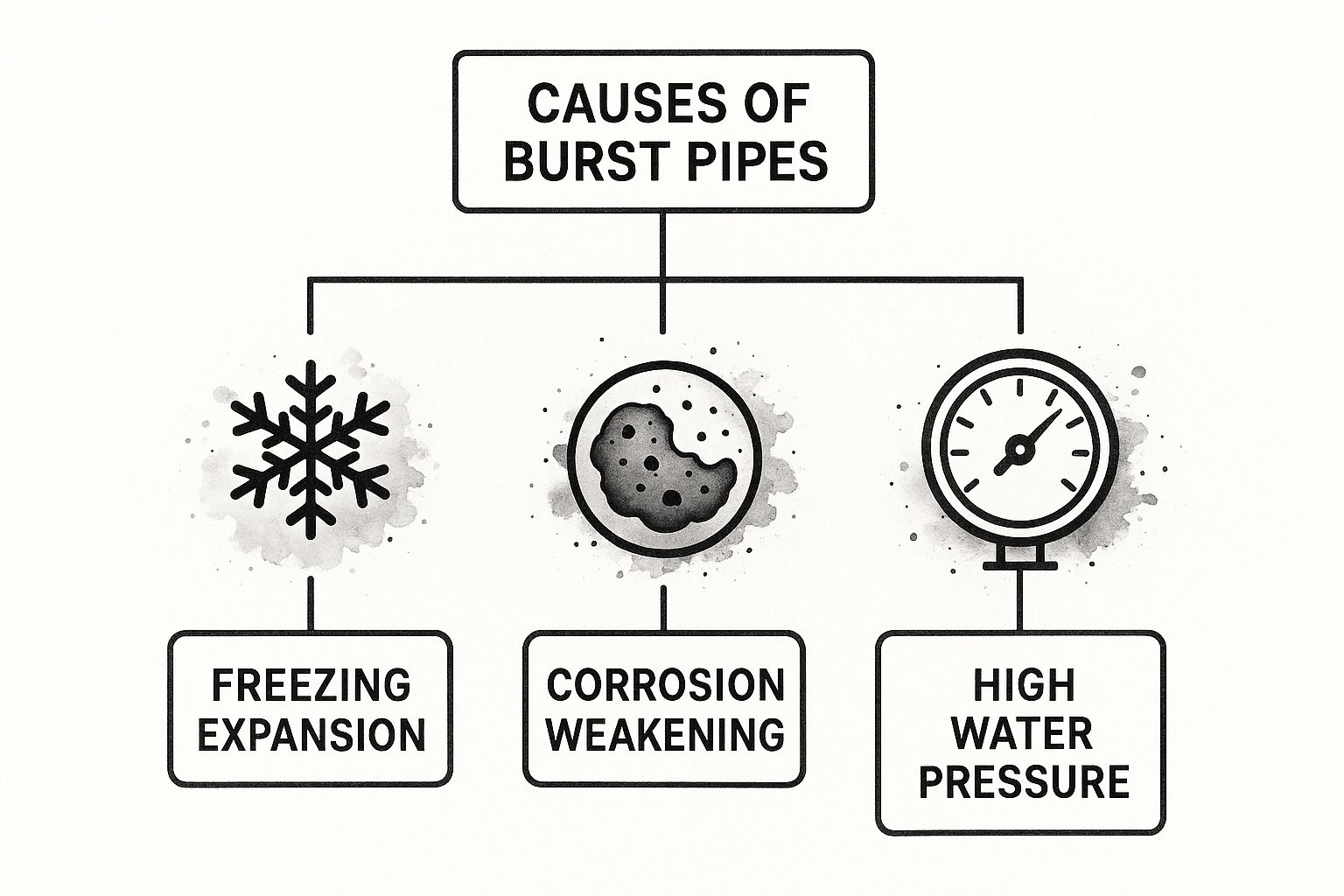
As you can see, freezing, corrosion, and pressure form the trifecta of pipe problems. Each one introduces a different kind of stress on your plumbing system, which is why being proactive is so crucial. If you can learn to spot the early warning signs of these issues, you can take action long before a small problem turns into a major flood.
Primary Causes of Burst Pipes at a Glance
To make it easier to understand, this table summarizes the key factors, how they work, and what you might notice.
| Primary Cause | How It Happens | Common Warning Sign |
|---|---|---|
| Freezing Water | Water expands as it turns to ice, creating immense pressure inside the pipe that eventually causes a split. | Bulging or frosted pipes; no water from a faucet. |
| High Water Pressure | Constant pressure above 80 PSI strains pipes and fittings, leading to wear and eventual failure. | “Water hammer” banging sounds; leaky faucets. |
| Corrosion | Rust and mineral buildup weaken the pipe from the inside, making the walls thin and brittle. | Discolored water; recurring clogs; visible rust. |
Keeping these common causes in mind is the best way to develop a preventative mindset and protect your home’s plumbing.
The Unseen Pressure of Frozen Pipes
When you think about why a pipe bursts in the middle of a Denver winter, it’s natural to picture ice expanding and splitting the metal. That’s the story we all hear. But in reality, the situation is a lot more intense—and it’s all about pressure.
The real culprit isn’t the ice itself, but the immense water pressure that gets trapped behind the ice. Think of it like this: as water starts to freeze inside a pipe, it usually forms an ice plug near a cold spot, like an exterior wall. This plug effectively corks the pipe, trapping the rest of the liquid water between the ice and a closed faucet somewhere down the line.
As the temperature keeps dropping, more water molecules crystallize into ice, expanding and pushing against that trapped water. With nowhere to go, the pressure builds and builds to an incredible degree. We’re talking about thousands of pounds per square inch, far more than any residential pipe is built to withstand. The final break often happens in a seemingly safe, warmer section of the pipe—wherever the metal has its weakest point.
The Physics of a Freeze
The science here is pretty simple but incredibly powerful. When water turns to ice, its volume increases by about 9%. That expansion is what creates the initial force that sets this whole catastrophic chain reaction in motion.
This isn’t just a local problem; it’s a serious headache in cold climates everywhere. For a stark reminder of just how damaging this can be on a massive scale, you only have to look at the lessons from the Winter Storm Uri disaster, which caused widespread plumbing failures across Texas.
A burst pipe isn’t caused by ice expanding outward, but by the intense water pressure that builds up between the ice plug and a closed faucet. The pipe fails because the trapped water has no escape route.
High-Risk Zones in Your Home
Not all pipes in your house face the same level of danger. Some are far more vulnerable simply because of where they’re located, lacking the warmth and insulation needed to stay above freezing. Knowing these trouble spots is half the battle.
Keep a close eye on pipes running through these areas as the temperatures start to dip:
- Exterior Walls: These pipes are just inches from the biting cold and get almost no radiant heat from inside your home.
- Attics and Crawl Spaces: Unheated and often poorly insulated, these areas can get just as cold as the outdoors.
- Unheated Basements or Garages: Like attics, these spaces leave pipes completely exposed to plunging temperatures.
- Under Sinks: Cabinets, especially those on an outside wall, can trap cold air and create a perfect micro-climate for a pipe to freeze.
Getting ahead of the problem is key. Before that first hard freeze arrives, it’s worth reading through our complete guide on how to prevent frozen pipes. A few simple precautions can save you from a very messy and expensive emergency.
How High Water Pressure Silently Damages Your Plumbing
When it comes to burst pipes, high water pressure is one of the sneakiest culprits out there. Unlike a sudden freeze, the damage it causes is slow, steady, and often completely invisible—until the day you come home to a flood.
Think of it as chronic high blood pressure for your home’s plumbing. It’s a constant, underlying strain that weakens every single pipe, joint, and fixture over time.
Most home plumbing systems are built to handle pressure between 40 and 80 pounds per square inch (PSI). Anything consistently above that range puts your entire system under duress. This relentless stress doesn’t just wear things out; it actively pushes them toward a catastrophic failure that always seems to happen out of the blue.
The Dangers of Constant Strain
The thing about high water pressure is that it doesn’t just pick on one spot. It’s an equal-opportunity destroyer, hammering away at your whole system. The excessive force erodes pipes from the inside out, compromises the seals in your faucets and toilets, and can even shorten the lifespan of expensive appliances like your water heater, dishwasher, and washing machine.
This constant stress is a huge factor in what causes pipes to burst because it has a knack for finding the weakest link in the chain. That could be an older joint, a slightly corroded section of pipe, or a fitting that was already under tension. Eventually, something has to give.
The ideal water pressure for a home is a balancing act. Too low, and your shower is a frustrating trickle. Too high, and you’re silently pushing every pipe, joint, and appliance toward a premature and costly failure.
This silent damage builds up day after day, making your plumbing more and more vulnerable. The final, dramatic burst is just the loud conclusion to a long, quiet story of degradation.
Understanding Water Hammer
Have you ever shut off a faucet or an appliance and heard a loud, jarring BANG from inside your walls? That sound isn’t a ghost—it’s a phenomenon called water hammer.
It happens when the water flowing through your pipes is forced to stop or change direction in an instant. Picture a freight train slamming into a brick wall. All that momentum has to go somewhere, and it creates a violent shockwave that rattles back through the pipes. This jolt can spike the pressure to several times higher than your normal PSI.
Every time you hear that bang, your plumbing is taking a physical hit. For pipes already weakened by sustained high pressure, this sudden spike can easily be the final straw that triggers a rupture.
Taking Control of Your Home’s Pressure
The good news is that high water pressure is a totally manageable risk. Your first step is figuring out where you stand. You can easily find out your home’s pressure level with an inexpensive water pressure gauge from any hardware store. For a simple walkthrough, check out our guide on how to test water pressure in your home.
If you find that your pressure is consistently above 80 PSI, the best and most effective solution is to have a professional install a pressure reducing valve (PRV). This device gets installed right on your main water line where it enters your home. It acts like a governor, stepping down the pressure to a safe, consistent level before it ever reaches your pipes and appliances.
It’s a relatively small investment that offers powerful protection for your entire plumbing infrastructure against this silent threat.
The Slow Decay of Aging and Corroded Pipes
A sudden deep freeze gets all the attention, but the truth is, most pipe failures are the result of a much slower, quieter enemy: time itself. Think of your plumbing system like any other part of your home—it has a lifespan. After decades of constant use, the forces of aging and corrosion work together to weaken pipes from the inside out.
This slow decay is one of the top reasons pipes burst, especially in older Denver homes. It’s a bit like rust eating away at a car’s frame. You don’t see the damage happening, but it’s there, gradually weakening the structure until a minor bump causes a major failure. One day, a pipe seems fine; the next, it gives way under pressure it used to handle easily.
Of course, not all pipes age the same way. The material running through your walls plays a huge role in how—and how quickly—it will fail.
How Different Pipe Materials Degrade
Knowing what your pipes are made of is the first step in understanding what to look out for. Each material has its own unique story of aging and failure.
- Galvanized Steel: If your home was built before the 1960s, you likely have galvanized pipes. These are steel pipes dipped in a protective zinc coating, but that coating doesn’t last forever. Over many years, it wears away, exposing the steel to water. The result is rust and mineral scale that builds up on the inside, choking off water flow and, more importantly, eating away at the pipe walls until they’re paper-thin.
- Copper: Copper is a fantastic material and highly resistant to rust, but it’s not indestructible. Certain water conditions, especially acidic water (with a low pH), can trigger a nasty process called pitting corrosion. This creates tiny, almost invisible pinhole leaks that can suddenly rupture when water pressure spikes.
- Plastic (PVC and CPVC): While plastic pipes can’t rust, they have their own weakness: they can become brittle with age. Exposure to sunlight or even just decades of temperature swings can make them fragile. A stray nail during a remodel or stress from a poorly installed support is often all it takes to cause an old plastic pipe to crack.
This isn’t just a problem for individual homeowners; it’s a massive infrastructure challenge. In the U.S. and Canada, there are roughly 260,000 water main breaks every single year, and the vast majority are due to old pipes finally giving out. Research shows that older cast iron mains have the highest failure rates by far, while modern PVC holds up much better. You can read the full research about these infrastructure challenges to see just how much material choice matters.
A pipe burst is rarely a single event. More often, it’s the final, dramatic conclusion to a long story of gradual decay, where years of unseen corrosion finally meet a moment of acute stress.
Why Knowing Your Plumbing’s Age Matters
Here’s a good rule of thumb: if your home is more than 30 years old, you should assume your plumbing is entering its twilight years. It’s time to play detective. Take a look at the exposed pipes in your basement, crawlspace, or under your sinks to get a sense of what you’re dealing with.
Once you know your pipes won’t last forever, you can shift from a reactive mindset to a proactive one. It’s the difference between planning an upgrade on your own schedule and dealing with a watery disaster in the middle of the night.
Hidden Threats: Clogs and Physical Damage
While we often point fingers at freezing weather and old pipes, some of the worst plumbing disasters sneak up on you. These hidden dangers typically fall into two camps: severe clogs brewing inside your pipes and physical damage coming from the outside. Either one can push a pipe to its breaking point.
Imagine a serious clog acting like a dam inside your drain line. Over time, grease, hair, soap scum, and other gunk can build up until they form a solid, impassable wall. The water has nowhere to go but back, creating a pocket of intense pressure right behind the blockage. Your pipes simply weren’t built to withstand that kind of focused force, and it’s a frequent cause of messy drain line bursts.
A pipe doesn’t need to freeze to burst. A stubborn clog can create a high-pressure zone that is just as effective at splitting a pipe wall, turning a simple drainage issue into a major water damage event.
This is why tackling clogs early is so important. If you’ve got a drain that’s slowing down or completely stopped, our guide on how to unclog a drain pipe can walk you through the right steps to clear the blockage before the pressure builds.
When Outside Forces Attack Your Pipes
It’s not just what’s on the inside that counts. The physical integrity of your plumbing is constantly under threat from the world around it. Sometimes the damage is slow and insidious, happening over years; other times, it’s sudden and accidental. The result is always the same: a weakened pipe just waiting for a reason to fail.
Here are a few common ways your pipes can take a beating from the outside:
- Invasive Tree Roots: A classic culprit for underground sewer lines. Tree roots are naturally programmed to seek out water and nutrients, and they can muscle their way into the tiniest cracks in your pipes. Once inside, they expand and can eventually shatter the pipe.
- Accidental Damage: It happens more than you’d think. A misplaced nail while hanging a picture or a screw driven too deep during a renovation can easily puncture a water line hiding in the wall. This starts as a small leak but can quickly turn into a full-blown burst.
- Improper Support: Pipes need to be properly secured and supported. If a hanger or clamp fails, the pipe can sag under the weight of the water inside. This puts enormous stress on the joints and fittings, eventually leading to a catastrophic break.
Your Action Plan for Burst Pipe Prevention
Knowing why pipes burst is one thing, but taking action is what actually protects your home. A good prevention plan tackles each of the major threats we’ve discussed, from Denver’s infamous freeze-thaw cycles to sneaky high water pressure.
Let’s walk through the practical steps you can take to make sure your plumbing stays intact.
Combating Freezing Temperatures
When a cold snap hits, the name of the game is simple: don’t let the water in your pipes turn into a high-pressure ice plug. A few proactive steps are your best defense against the bitter cold.
- Insulate Vulnerable Pipes: Your first line of defense is wrapping pipes in foam sleeves or heat tape. Focus on any plumbing that runs through unheated areas like your attic, crawl space, or basement.
- Seal Air Leaks: Hunt down and seal any cracks or holes in your foundation, especially where pipes enter the house. A little bit of caulk goes a long way in keeping frigid drafts out.
- Let Faucets Drip: During a deep freeze, open a faucet just enough to get a slow, steady drip going. This keeps water moving, which makes it much harder for it to freeze solid.
- Open Cabinet Doors: For kitchen or bathroom sinks on exterior walls, open up the cabinet doors. This allows the warm air from your house to circulate around the pipes and keep them from freezing.
Learning the principles behind winterizing systems, like in this guide on how to winterize your boat, offers great insight into protecting any water system from cold-weather damage.
Managing High Pressure and Aging Pipes
Getting a handle on water pressure and dealing with age-related wear and tear are absolutely key to your plumbing’s long-term health. This usually requires a combination of your own awareness and some professional help.
Your home’s plumbing is a network under constant stress. Prevention isn’t about a single fix but about managing those daily stressors—pressure, age, and temperature—to ensure its long-term integrity and reliability.
If your house is more than 30 years old or you have any reason to suspect high water pressure, it’s time to call in a pro. A licensed plumber can get a good look at your pipes, whether they’re galvanized steel or copper, and spot the early signs of corrosion before they become a disaster.
For high pressure, the fix is usually installing a pressure reducing valve (PRV). Think of it as a gatekeeper for your main water line. It keeps the pressure inside your home’s plumbing within a safe range, typically between 40-80 PSI. It’s a relatively small investment that protects every single pipe, faucet, and appliance from constant, damaging strain.
Answering Your Questions About Burst Pipes
Even when you know what to watch out for, it’s natural to have a few more questions. Let’s tackle some of the most common things homeowners ask about burst pipes so you can feel ready for anything.
What Are the First Signs of a Burst Pipe?
A full-on flood is hard to miss, but your plumbing often gives you subtle warnings before things get that bad. Be on the lookout for a sudden, noticeable drop in your water pressure—that’s a huge red flag.
Other clues include discolored or rusty water coming from your faucets, or strange new sounds like banging, hissing, or dripping from behind the drywall. Don’t ignore those mysterious damp spots on your walls or a water bill that suddenly shoots through the roof for no reason.
Is a Small Drip as Serious as a Burst Pipe?
Yes, and here’s why: think of a small drip as a symptom, not the whole disease. That persistent leak is often a sign of a bigger issue, like system-wide corrosion or dangerously high water pressure, that could easily cause a catastrophic burst down the line.
Even if it doesn’t lead to a bigger break, that tiny drip can cause a world of hurt all on its own. It’s a perfect recipe for mold growth, rotted wood, and even serious damage to your home’s foundation. It needs to be addressed right away.
A small leak is a warning, not a minor inconvenience. It’s your plumbing system’s way of telling you that a bigger failure could be on the horizon if the underlying cause isn’t addressed.
Can I Fix a Burst Pipe Myself?
The first thing you should absolutely do is find your main water valve and shut it off immediately. That’s the most important step to stop the bleeding.
But when it comes to the actual repair, this is a job for a pro. A DIY patch kit might seem like a quick fix, but it’s a temporary bandage at best and one that can easily fail, causing even more flooding. A licensed plumber won’t just slap a patch on it; they’ll fix the break properly and figure out why it happened in the first place, preventing a repeat disaster.
How Often Should I Have My Plumbing Inspected?
It’s a good idea to get a professional to take a look at your plumbing system from time to time. For older homes, say over 20 years old, an inspection every two to three years is a smart, proactive move.
If you’re in a newer home, every five years is a pretty safe bet. These regular check-ups allow a professional to spot hidden problems like early-stage corrosion, pressure issues, or tiny pinhole leaks before they turn into a weekend-ruining emergency.
If you’re in the middle of a plumbing crisis or just want to schedule a check-up to keep your home safe, don’t wait for the situation to get worse. The experts at Professional Plumbers Denver are on call 24/7 to protect your home. Contact us today for fast, reliable service.

Recent Comments