
When your garbage disposal starts sending gross, sludgy water back up into your sink, it’s easy to assume the unit itself is broken. But that’s rarely the case. More often than not, the problem isn’t the disposal at all—it’s a clog somewhere downstream in your plumbing.
The disposal has probably done its job grinding up the food, but now that mixture of water and waste has hit a roadblock. With nowhere else to go, it backs up into the path of least resistance: your sink basin.
Getting to the Bottom of the Backup
It’s an incredibly frustrating moment, seeing that murky, foul-smelling water creep back up. But understanding why it’s happening is the first step to fixing it for good.
Garbage disposals are incredibly common these days—in fact, as far back as 2009, about 50% of U.S. households had one, and that number has certainly climbed. With so many in use, it’s no surprise that clogs from improper use are a frequent plumbing complaint. That reverse flow of waste doesn’t just make a mess; it’s a sanitation headache.
To help you quickly diagnose what’s going on under your sink, here’s a look at the most common culprits behind a backup.
Common Causes of a Garbage Disposal Backup
| Cause | What It Means | Common Items Responsible |
|---|---|---|
| P-Trap Blockage | The U-shaped pipe under the sink is plugged. This is the most frequent spot for clogs to form. | Grease, coffee grounds, eggshells, starchy food scraps. |
| Horizontal Drain Arm Clog | The pipe connecting the P-trap to the main drain is obstructed. Buildup happens gradually here. | Soap scum, grease, and small food particles that have solidified over time. |
| Main Drain Line Clog | A more serious blockage is located further down the home’s primary plumbing line. | Tree roots, flushed wipes, or systemic buildup from multiple drains. |
Let’s dig a little deeper into where that clog might be hiding.
The Usual Suspects: Where Clogs Form
Most of the time, the blockage is in one of three places. Knowing where to look can save you a ton of time and effort.
- The P-Trap: That “U” bend in the pipe right under your sink is designed to hold a bit of water to block sewer gases. Unfortunately, its shape also makes it the perfect trap for heavy food debris and grease, which can easily build up and create a solid plug.
- The Horizontal Drain Arm: After the P-trap, the pipe runs horizontally into the wall to meet the main drain stack. Over time, grease, soap scum, and fine food particles can coat the inside of this pipe, slowly narrowing the opening until it’s completely blocked.
- The Main Drain Line: This is less common but a much bigger problem. If the clog is in your home’s main drain, you’ll likely see issues with other fixtures, too. Is your bathroom sink or shower draining slowly? That’s a huge clue. You can find out more about what leads to this by checking out our guide on what causes sewer backup.
Key Takeaway: Your disposal’s motor is strong, but it’s designed to push water and finely ground particles, not blast through a solid obstruction. When it hits a clog, the water has to go somewhere, and that’s right back up into your sink.
Here’s a classic real-world scenario: You have a double-basin sink. You run the disposal on one side, and suddenly, dirty water starts gurgling up into the other sink basin. This is a dead giveaway that the clog is located in the shared drainpipe just after the two drains connect but before the P-trap. It’s a clear sign of a partial blockage that you need to tackle before it gets any worse.
Your Non-Negotiable Safety Checklist
Before you even think about reaching under that sink, let’s talk safety. I can’t stress this enough: you’re dealing with a combination of electricity, water, and sharp blades. It’s a trio that demands respect. Rushing into this can turn a simple fix into a very bad day.
The absolute first thing you must do is kill the power to the disposal. No exceptions. Just flipping the wall switch isn’t good enough—it’s too easy for someone to accidentally flip it back on while your hands are in the danger zone.
Disconnecting The Power Source
For most setups, this is easy. Just look under the sink, find the disposal’s power cord, and pull the plug straight from the wall outlet.
However, if you don’t see a plug, your disposal is likely hardwired directly into your home’s electrical system. In that case, you need to head to your main electrical panel. Find the circuit breaker labeled for the garbage disposal and flip it firmly to the “OFF” position. This physically cuts the electrical connection.
Pro Tip: After you flip the breaker, walk back to the sink and try the disposal’s wall switch. If you hear nothing—no hum, no click, just silence—you’ve successfully and safely cut the power. I always do this double-check.
Gearing Up for The Job
With the power safely off, it’s time to gear up. The gunk backing up into your sink is nasty stuff, often teeming with bacteria and who knows what else. A little protection goes a long way.
Here’s my go-to list for this kind of job:
- Heavy-Duty Gloves: Don’t use thin dish gloves. Get a pair of thick rubber gloves to shield your hands from both the grime and any sharp bits (like broken glass) that might be stuck in there.
- Safety Glasses or Goggles: This is a big one. When you start working on the clog, water will splash. The last thing you want is that funky, bacteria-laden water in your eyes.
- A Good Flashlight: It’s dark and cramped under the sink, and looking down into the disposal chamber is like staring into a black hole. A bright flashlight is your best friend for actually seeing the problem.
How To Clear The Clog Yourself
Alright, with your safety gear on and the power to the disposal killed, let’s get that sink draining again. We’re going to start with the easiest fixes first and work our way up. Don’t worry, you can handle this.
The trick is to be methodical. It’s tempting to go for the most aggressive solution right away, but you’d be surprised how often a simple plunger is all it takes to get things moving.
The Plunger: A Simple But Powerful Tool
Your first line of defense should be a basic cup plunger. The technique is a little different if you have a double sink, which is a pretty common setup when you have a garbage disposal.
To get the suction you need, you have to create a seal. This means completely blocking off the drain on the other side of the sink. A wet rag stuffed tightly into that drain opening or a good drain stopper works perfectly.
Now, place the plunger directly over the disposal drain, making sure you have a solid seal all the way around. Add a few inches of water to the sink—just enough to cover the plunger’s cup. The water is key; it’s what creates the pressure to bust up the clog.
Give the plunger about 20-30 seconds of strong, steady vertical pumps. When you pop the plunger off, you’ll hopefully be greeted by the satisfying sound of water rushing down the drain.
Inspecting The Disposal Chamber
If the plunger didn’t do the trick, the problem might be right inside the disposal unit itself. I’ve seen it all—bottle caps, fruit pits, even rogue silverware can jam the spinning impellers and bring everything to a grinding halt.
Grab a flashlight and take a look down into the disposal chamber. Can you see anything that doesn’t belong?
Crucially, never, ever stick your hand in there. Grab a pair of long-handled tongs or pliers to carefully fish out any culprits you find.
Sometimes the jam isn’t obvious. Most disposals have a small hexagonal hole on the very bottom of the unit. You can use the small wrench that came with it (or just a standard 1/4-inch Allen wrench) to manually rock the motor back and forth. This motion is often enough to break free whatever is stuck in there.
This visual guide offers a few simple habits to keep this from happening again.
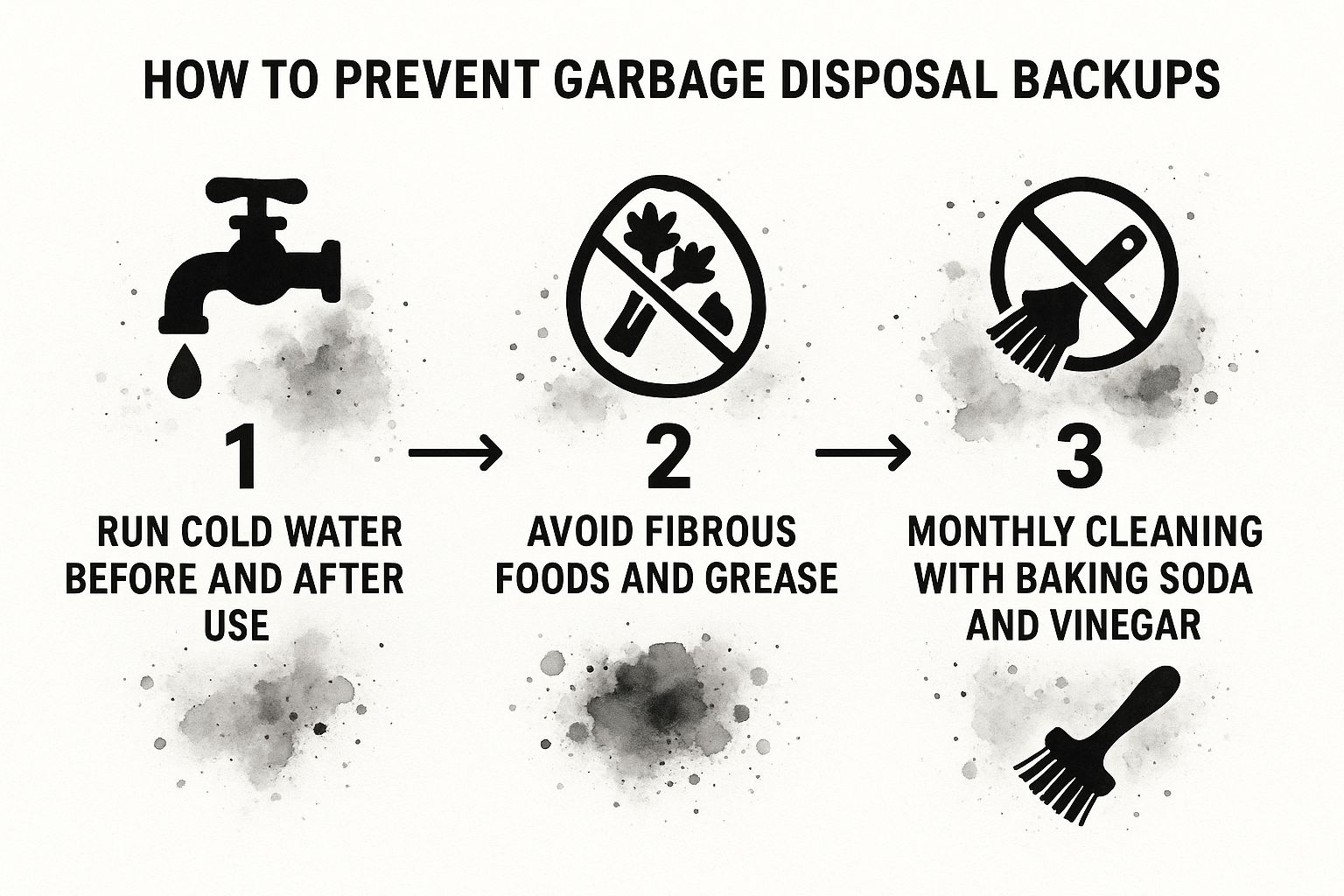
Making these small changes to your kitchen routine can make a huge difference and save you from future headaches.
Tackling The P-Trap Clog
So, the disposal itself is clear and plunging didn’t work. The next logical culprit is the P-trap—that U-shaped pipe hanging out under your sink. That bend is a magnet for grease, coffee grounds, and heavy bits of food that the disposal couldn’t quite liquefy.
First thing’s first: place a bucket directly under the P-trap to catch the inevitable spill of water and gunk. Using a pair of channel-lock pliers, loosen the two large slip nuts holding the trap in place. Once they’re loose, you can usually spin them off by hand.
Carefully wiggle the U-shaped pipe section free. Be prepared—it’s often filled with a pretty foul-smelling sludge. Dump the contents into your bucket or a trash bag and use an old wire brush to scrape the inside of the pipe clean. While you have it apart, it’s the perfect time to learn more about how to clean your garbage disposal and its pipes for a truly fresh start.
When you put it back, hand-tighten the nuts first, then give them one last quarter-turn with the pliers to snug them up.
Key Insight: Be careful not to overtighten the slip nuts when you reassemble the P-trap. They’re usually plastic and can easily crack if you apply too much force, which will just trade one problem for another—a leak. Snug is all you need.
Using A Sink Auger For Deeper Clogs
If even the P-trap was clean, your clog is lurking deeper down the line, in the drain arm that goes into the wall. To reach it, you’ll need a tool called a sink auger (sometimes called a canister snake). It’s a long, flexible cable made specifically for navigating the twists and turns of drain pipes.
- With the P-trap still removed, feed the auger’s cable into the open drainpipe in the wall.
- Keep pushing it in until you feel it stop. That’s your clog.
- Tighten the setscrew on the auger’s handle to lock the cable in place.
- Start turning the handle clockwise. The corkscrew tip will either drill through the clog to break it apart or snag onto it so you can pull it out.
You’ll either feel a sudden release as the blockage breaks up, or you’ll feel it “bite” into the gunk. If it hooks on, you can slowly pull the entire clog out.
Once you feel the pipe is clear, retract the cable slowly. Reassemble the P-trap and then run hot water for a few minutes to flush any lingering debris down the drain for good.
Smart Habits To Prevent Future Backups
Alright, you did it. The clog is gone, and water is flowing freely down the drain again. That’s a great feeling, isn’t it? Now, let’s make sure this is the last time you have to deal with that particular headache.
The best way to fix a clog is to prevent it from ever happening. It all boils down to a few simple habits and being a little more mindful of what you’re asking your garbage disposal to handle. It’s a powerful tool, but it’s not a black hole.
The Biggest Culprits Behind Clogs
First things first, you need to know your enemy. Certain foods are notorious for creating the exact kind of stubborn, sludgy blockages that cause water to back up into your sink.
At the top of the “Most Wanted” list are fats, oils, and grease (FOG). When you pour hot grease down the drain, it looks like a harmless liquid. But once it hits the cold pipes, it solidifies into a thick, waxy coating that narrows the passage, catching other bits of food and quickly forming a major blockage.
To help you remember what’s safe and what isn’t, I’ve put together a quick guide on the worst offenders.
Foods to Never Put Down Your Garbage Disposal
Think of your garbage disposal as a pre-rinse assistant, not a trash compactor. Its job is to break down small, soft food particles. For everything else, the trash can is your best friend. This table breaks down the most common clog-causers I see in the field.
| Food/Item Category | Why It’s a Problem | Examples |
|---|---|---|
| Fats, Oils, & Grease (FOG) | Solidifies in pipes, creating waxy buildup that chokes drainage. | Bacon grease, cooking oil, butter, meat drippings, heavy sauces. |
| Starchy & Expandable Foods | Absorb water and swell, forming a thick, paste-like sludge. | Pasta, rice, oatmeal, potato peels, bread. |
| Fibrous Vegetables | Tough, stringy fibers wrap around the blades, jamming the motor. | Celery, asparagus, corn husks, onion skins, artichokes. |
| Coffee Grounds | Don’t dissolve; they accumulate in the P-trap like dense sediment. | Used or fresh coffee grounds. |
| Eggshells | The thin inner membrane can stick to pipes, catching other debris. | Raw or cooked eggshells. |
| Bones & Fruit Pits | Too hard for the blades to grind, causing loud noises and jams. | Chicken bones, cherry pits, avocado seeds, peach pits. |
Treating this list as law in your kitchen will prevent the vast majority of disposal-related backups.
Easy Routines For A Healthy Disposal
Beyond avoiding the items above, a few simple maintenance tricks can keep your unit running smoothly for years. These aren’t complicated or time-consuming, but they make a world of difference.
The number one rule is to always use cold water when running your disposal. It seems counterintuitive, but cold water helps keep any small bits of fat or grease solid, allowing the blades to chop them up and flush them away. Hot water, on the other hand, melts grease, letting it flow further down the pipes where it will cool, harden, and create a clog.
For more essential advice on keeping your drains clear, it’s worth knowing what not to put down your garbage disposal to avoid future problems.
Keeping It Clean, Sharp, and Fresh
Here are two quick maintenance tricks I tell every homeowner. They’re incredibly effective for how little effort they take.
- Sharpen with Ice: Once a week or so, toss a couple of handfuls of ice cubes into the disposal and grind them up. The ice acts as a gentle scour, knocking built-up gunk off the impellers while also helping to sharpen them.
- Deodorize with Citrus: Don’t just toss those lemon, lime, or orange peels. Cut them into smaller pieces and run them through the disposal with cold water. It cleans the grinding chamber and leaves your whole kitchen smelling fantastic.
These simple, preventative steps are your best defense against another backup. Remember, your kitchen plumbing is part of a larger system, and keeping it healthy is key. For a wider view on this topic, you might find our guide on the https://professional-plumbers-denver.com/blogs/maintenance-of-sewer/ helpful.
Knowing When to Call a Professional Plumber
Tackling a clog yourself can be incredibly satisfying, but it’s just as important to know when to throw in the towel. Sometimes, pushing your luck can turn a simple clog into a much bigger—and more expensive—plumbing disaster. Recognizing your limits is one of the smartest things you can do.
Some issues are just clear red flags. They signal a deeper problem that requires professional equipment and a seasoned expert to solve. Continuing to poke around on your own might just make things worse.
Signs You Need an Expert
If you’ve run through the troubleshooting steps we’ve covered and your sink is still backing up, it’s time to step back. A persistent clog often points to a problem far beyond the P-trap, deep within your home’s main drain lines.
Think of these scenarios as your cue to pick up the phone:
- The Clog Keeps Coming Back: You get the drain cleared, it seems to work for a few minutes, but then the water starts backing up again. This almost always means there’s a more significant blockage further down the line that your home tools just can’t reach.
- Water Is Leaking from the Disposal Itself: See water dripping from the actual housing of the garbage disposal, especially from the bottom? Stop immediately. This could be a broken seal or even a cracked casing, a problem that requires a pro to repair or replace the entire unit.
- The Motor Just Hums: You’ve hit the reset button and even tried the Allen wrench trick to free the blades, but all you get is a low hum. That sound often signals an internal motor failure, and it’s not something you can fix on your own.
- Backups in Multiple Drains: This is the big one. If running the kitchen sink causes water to gurgle up in a nearby bathroom sink, shower, or tub, the clog isn’t just a kitchen issue—it’s in your home’s main sewer line. This is a serious problem that needs professional attention right away.
When a clog stubbornly returns or you see water backing up in multiple fixtures, you’re no longer dealing with a simple sink clog. You’re facing a systemic plumbing issue that requires specialized tools like a high-powered auger or hydro-jetting to resolve safely.
If any of this sounds familiar, or if you’re just not comfortable tackling these fixes yourself, your best bet is to reach out for professional plumbing repair services. A licensed plumber can accurately diagnose the real cause and get it fixed correctly the first time, saving you from future headaches and potential water damage.
A Few Lingering Questions About Sink Backups
Even after you’ve wrestled with a clog and won, a few questions might pop into your head. It’s only natural to want to know what just happened and, more importantly, how to make sure it never happens again. Let’s tackle some of the most common questions I hear from homeowners dealing with a garbage disposal backing up their sink.
Think of this as the final piece of the puzzle, giving you the confidence to handle your kitchen plumbing like a pro.
What About Using Chemical Drain Cleaners?
I get asked this all the time, and my answer is always a hard no. I can’t stress this enough: please do not pour harsh chemical drain cleaners down a sink with a garbage disposal. Those caustic chemicals are terrible for the unit’s metal and plastic components, and I’ve seen them cause corrosion that leads to leaks and total unit failure.
It’s not just your disposal at risk, either. Those chemicals can eat away at your pipes over time and are an environmental nightmare once they get into the water system. When you’re facing a clog, stick to the mechanical methods we’ve discussed—plunging, using a sink auger, or cleaning the P-trap.
My Disposal Is Humming but Not Grinding. What’s That Mean?
A humming sound is actually good news, in a way. It means the motor is getting power, but the flywheel (the spinning plate with the blades) is jammed. Almost every time, this is caused by a foreign object—think a stray piece of bone, a stubborn fruit pit, or even a dropped bottle cap—wedged between the impeller blades and the grinder ring.
The fix is usually straightforward. After you’ve killed the power to the unit, get on the floor and look for a small hexagonal hole right in the center of the bottom of the disposal. You can insert a standard Allen wrench (often called a jam-buster wrench) and crank it back and forth to manually move the blades and dislodge whatever’s stuck in there.
A humming disposal is a sign of a jam, not a dead motor. Manually rocking the blades with an Allen wrench from the bottom of the unit is the correct and safe way to clear the obstruction without risking your hands.
Why Is Gross Water Coming Up the Other Side of My Double Sink?
Ah, the classic double-sink surprise. Seeing grimy water bubble up into the “clean” basin is a dead giveaway that you have a partial clog downstream from where the two drains connect.
Basically, the clog is located in the shared drainpipe, after the P-traps but before the main vertical drain line. Your powerful disposal can force water past this blockage, but the backed-up water finds it easier to travel up the other sink’s drain than to push through the clog. The good news is that the same techniques for cleaning the P-trap or snaking the drain with an auger are exactly what you need to solve this one.
Dealing with a clog that just won’t quit or a problem you’re not comfortable tackling? The expert team at Professional Plumber Denver has seen it all and has the tools to handle any plumbing challenge. Visit us at https://professional-plumbers-denver.com to schedule your service today.

Recent Comments