
When it comes to choosing a new water heater in Denver, the decision often boils down to a classic trade-off: paying more now or paying more later. For most homeowners, the choice between gas and electric hinges on balancing the initial installation expense against the long-term, month-to-month running costs.
A gas water heater, tapping into Colorado’s affordable natural gas supply, typically costs less to operate. However, getting one installed can be a more involved and expensive process. On the other hand, an electric model—especially a modern heat pump—boasts higher energy efficiency and a much simpler setup, but it might lead to a bigger number on your monthly utility bill.
Gas vs. Electric Water Heaters: A Denver Snapshot
Picking the right water heater is about more than just a fuel source. It’s a significant investment in your home’s comfort and your financial health. The best choice for you really depends on what you’re working with: your home’s current setup, how much hot water your family actually uses, and where you want to put your money—upfront or over time.
Key Decision Factors for Denver Homeowners
Here in the Denver area, this decision comes with its own unique set of considerations. Gas heaters have long been a favorite, largely because our natural gas prices keep operating costs down. They also have a faster “recovery rate,” which is just a technical way of saying they can heat a full tank of cold water much quicker. This is a huge plus for larger families or anyone who’s experienced the pain of running out of hot water after back-to-back showers.
But don’t count electric models out. They’re often easier and cheaper to install, which is a major advantage if your home doesn’t already have a gas line run to the water heater location. Gas heaters need specialized venting to the outside, a requirement that can add surprising cost and complexity to the job. This makes an electric unit a no-brainer for smaller homes, new additions, or any situation where adding gas infrastructure is impractical.
Expert Insight: It really comes down to a trade-off. Gas gives you lower running costs but a more complicated installation. Electric offers a straightforward setup but potentially higher monthly bills—though this can be offset by investing in a super-efficient heat pump model.
This visual breaks down the key cost and efficiency differences you can expect between standard gas and electric models.
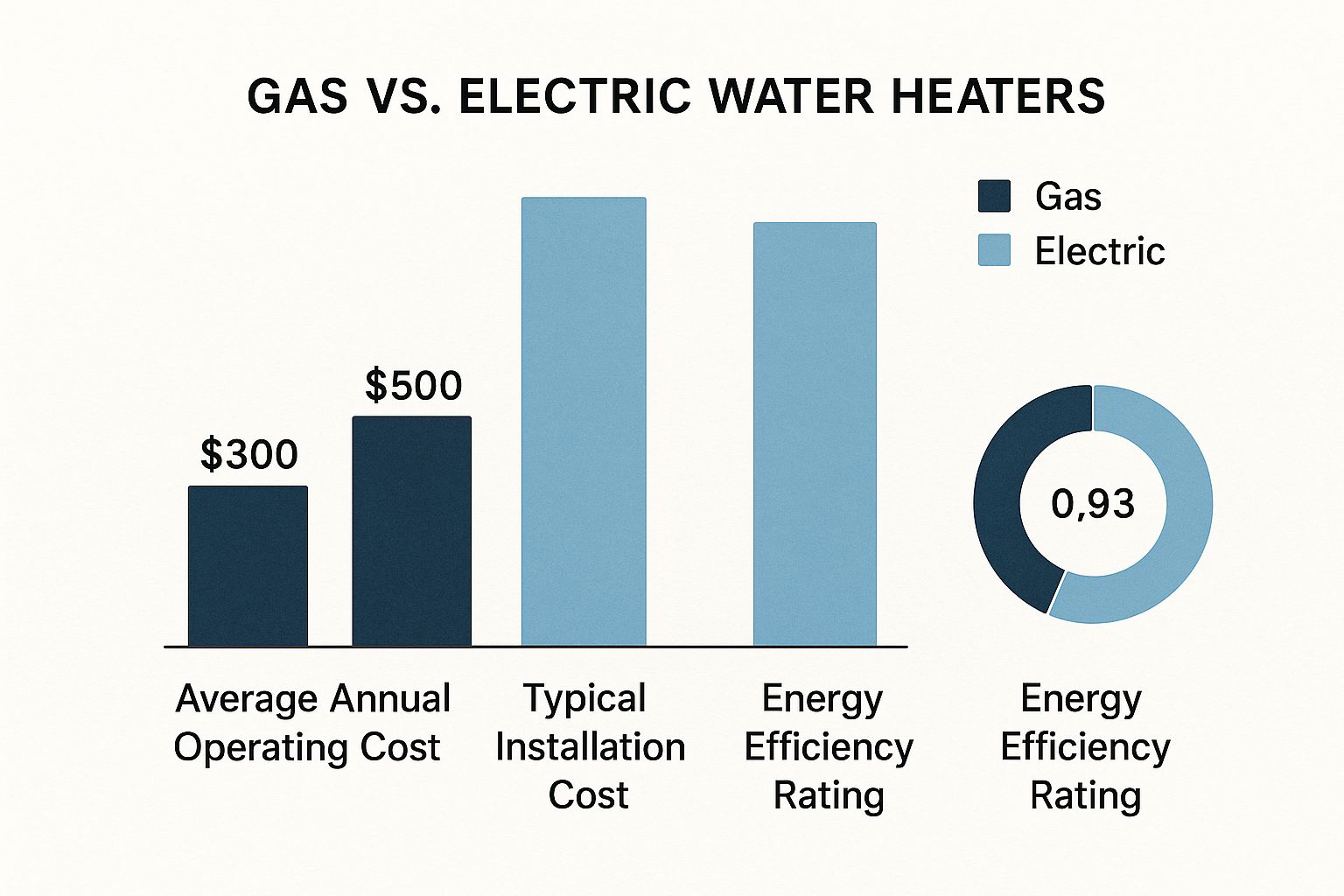
As you can see, while the initial price tag for a gas heater installation is higher, its annual operating cost is significantly lower. An electric heater flips that script: it’s cheaper to buy and install but will cost you more to run every year.
Quick Look: Gas vs. Electric Water Heaters in Denver
To help you see the differences at a glance, we’ve put together a simple table comparing the most important factors for Denver homeowners.
| Factor | Gas Water Heater | Electric Water Heater |
|---|---|---|
| Upfront Cost | Moderate to High ($1,200 – $2,500+) | Low to Moderate ($800 – $1,800+) |
| Operating Cost | Lower (due to affordable natural gas) | Higher (electricity is a pricier fuel) |
| Installation | More complex; requires professional venting | Simpler; no venting needed |
| Performance | Faster hot water recovery rate | Slower hot water recovery rate |
| Energy Efficiency | Less efficient (UEF ~0.67 for standard) | More efficient (UEF ~0.93 for standard) |
This table provides a high-level view, but remember that specific models, home layouts, and your family’s habits will influence the final numbers. Both options are great, but one is likely a better fit for your specific situation here in Denver.
How Technology Is Shaping Your Water Heater Choice
Choosing a water heater used to be a straightforward decision based on fuel type and your monthly utility bills. That’s not the case anymore. Today’s market is buzzing with new technology, bringing smart features, sustainability, and sophisticated energy management into the mix. For any Denver homeowner, getting a handle on these trends is crucial for making an investment that will last.
This wave of innovation is happening for a reason. The global water heater market was valued at approximately $23.7 billion in 2023 and is on track to hit $32.1 billion by 2029. This boom is largely thanks to major advancements, especially in electric models that now boast smart home integration and on-demand heating. These features align perfectly with the broader push for better energy efficiency. You can discover more insights about this growing market and see how it’s changing what’s available to you.
The Rise of Smart and Hybrid Systems
Modern electric water heaters are coming loaded with tech that would have seemed like science fiction a decade ago. Smart features are becoming the new standard, giving homeowners a level of control we’ve never had before.
- Remote Management: You can now tweak the temperature, set a vacation mode to save energy while you’re away, or get maintenance alerts—all from your smartphone.
- Energy Monitoring: Many new units come with apps that show you exactly how much energy you’re using. This helps you spot usage patterns and find real opportunities to lower your bills.
This isn’t just about convenience. It’s about having precise, granular control over one of the biggest energy hogs in your home.
The most significant development here is the hybrid electric water heater, often called a heat pump water heater. It essentially works like a refrigerator in reverse by pulling heat from the surrounding air and using it to heat the water. This process makes it up to three times more efficient than a standard electric resistance model.
How This Impacts Your Decision in Denver
A traditional gas water heater still can’t be beaten for pure heating speed. But the technological advantages of new electric models are making them a very compelling alternative. Hybrid electric heaters, for example, can have operating costs that are on par with—or sometimes even cheaper than—natural gas, especially after you factor in local utility rebates.
If you’re a Denver homeowner focused on sustainability, a smart heat pump water heater offers a powerful one-two punch of low emissions and incredible efficiency. The right choice really comes down to what you prioritize: the raw, fast-heating power of gas, or the smart controls and long-term efficiency that the latest electric systems bring to the table.
Comparing Costs, Efficiency, and Performance
When you’re trying to choose between a gas and an electric water heater, it’s easy to get fixated on the price tag. But the real story is in the total cost of ownership—what you’ll spend from the day it’s installed until the day it’s replaced. For homeowners here in Denver, that calculation has some unique local twists.
A standard gas water heater almost always has a higher upfront cost. A big reason for this is the installation. Gas models have to vent combustion fumes safely outside, which requires specialized work. If your home isn’t already set up with a gas line and the right ventilation, the project can get complicated and pricey, fast.
On the other hand, a standard electric water heater is typically cheaper to buy and much simpler to install. There’s no combustion, no fumes, and no need for venting. This makes installation a breeze, especially if you’re putting it in a new addition or a tight space where running new gas lines just isn’t practical.
Breaking Down Long-Term Operating Costs
This is where the financial equation tends to flip. Even though gas heaters cost more to get started, they’re generally cheaper to run month after month here in the Denver area. Natural gas is simply a more affordable fuel than electricity, which means you’ll almost certainly see a smaller hit on your utility bills over the heater’s life.
An electric water heater, despite its lower installation cost, will lead to higher monthly bills. Because electricity rates are higher, heating the same amount of water just costs more. That ongoing expense can eat up your initial savings sooner than you might think.
Key Takeaway: You’re really looking at a financial trade-off. A gas water heater is a bigger investment upfront that rewards you with lower monthly bills. An electric heater saves you money on day one but will cost you more over its lifetime.
Don’t let the upfront cost be the only deciding factor. Exploring flexible financing options can make a new water heater more manageable, spreading out that initial investment.
Understanding Efficiency and Performance Metrics
When you start comparing specific models, you’ll see a Uniform Energy Factor (UEF) rating. This is the official measure of a water heater’s efficiency—the higher the number, the better.
- Gas Water Heaters: A typical tank model lands around a 0.67 UEF. They naturally lose some heat through the tank walls and up the vent pipe.
- Electric Water Heaters: Standard electric units are far more efficient, with a UEF around 0.93. That’s because nearly all the electricity goes directly into heating the water.
But efficiency isn’t everything. Performance, particularly the recovery rate, is a huge deal for a busy household. This is all about how quickly a heater can get a full tank of cold water hot again. Gas heaters are the clear winner here, heating water nearly twice as fast as electric models. For a big family, that means less waiting between showers.
If you’re curious about ditching the tank altogether, our guide on the pros and cons of tankless water heaters takes a closer look at on-demand technology.
Lifespan and Maintenance Realities
Both gas and electric tank-style water heaters have a pretty similar lifespan, typically clocking in between 10 to 15 years if you take care of them. The secret to getting the most out of either one is regular maintenance, especially flushing the tank once a year to get rid of sediment buildup.
From a maintenance perspective, electric models are a bit simpler since there are no burners or gas lines to worry about. But at the end of the day, both types can fall victim to corrosion and wear and tear. How long your water heater lasts has far more to do with the quality of the unit and your maintenance habits than with its fuel source.
Why Electric Models Are Gaining Popularity
For years, gas heaters were the go-to choice for most Denver homes. But if you’re in the market for a new water heater today, you’ll notice a significant shift. Right here in Colorado and across the country, electric models are quickly becoming the new favorite. This isn’t just a fleeting trend; it’s a change driven by better technology, new homeowner priorities, and a major push toward energy efficiency.
When you’re trying to decide between a classic gas or electric water heater, this shift really matters. It tells you where manufacturers are putting their research and development money, which usually means more advanced and reliable electric options for you. It also gives you a heads-up about where local building codes and government incentives are heading—and they’re increasingly pointing toward all-electric homes.
The Push for Widespread Electrification
A big part of this movement is the global push to electrify everything. As our power grid gets cleaner with more renewable energy sources, swapping out fossil fuel appliances for electric ones is one of the most effective ways for a homeowner to shrink their carbon footprint.
This isn’t just a niche idea anymore—it’s reshaping the market. In 2023, electric water heaters actually brought in the majority of market revenue, capturing approximately 51.3% of the share. This boom is a direct result of people wanting energy-efficient appliances that are easier to install and give them pinpoint control over water temperature.
The rise of electric models isn’t just about being green; it’s about having more and better options. The market’s focus on electric technology has led to a wider variety of choices, from affordable standard tanks to highly efficient heat pump and tankless units.
What This Means for Denver Homeowners
So, how does this growing popularity benefit you directly? For one, as electric models become more common, so do the replacement parts and the number of technicians who know how to service them. That makes long-term ownership simpler and often less expensive. A competitive market also fuels innovation, which means better products that last longer.
Ultimately, the old debate about operating costs is no longer the only factor. Things like installation flexibility, smart home features, and environmental impact are now front and center. If you’re starting to see signs it’s time to replace your water heater, it’s the perfect time to think about whether a modern electric model is the right fit for your home’s future.
Choosing the Right Heater for Your Denver Lifestyle
Moving beyond the technical specs, let’s talk about what really matters: how a water heater actually fits into your daily life here in Denver. The best choice isn’t found on a spec sheet—it’s determined by your family’s habits, your budget, and what you value most.
To get a clearer picture, it helps to walk through a few real-world examples. Seeing how these heaters perform in different households can make it much easier to decide which one makes sense for your own home.
Scenario 1: The High-Demand Family Home
Picture a busy family of five in a classic Wash Park home. Between morning showers, endless loads of laundry, and the dishwasher running constantly, their need for hot water is non-stop. The last thing they need is a cold shower halfway through the morning rush.
For this household, a high-capacity natural gas water heater is the hands-down winner. Its biggest advantage is the rapid recovery rate—it can heat a full tank of cold water incredibly fast. This is crucial for keeping up with back-to-back hot water use. While the initial installation might cost more, the lower price of natural gas in Denver translates to real, tangible savings on monthly bills. It’s a smart long-term investment for any high-use home.
Scenario 2: The Eco-Conscious Urban Dwelling
Now, let’s shift to a couple in a sleek, modern condo in the RiNo Art District. They’re focused on sustainability, want to shrink their carbon footprint, and are eager to use the latest green technology. Their hot water needs are moderate, and they’re looking to cash in on local energy incentives.
This is where a heat pump electric water heater truly shines. These units are incredibly efficient—often three times more so than a standard electric model—which dramatically cuts down on electricity use. When you factor in the rebates available from Xcel Energy and the City of Denver, the higher purchase price becomes far more approachable. It’s a perfect match for their environmental and financial priorities.
Scenario 3: The Savvy Rental Property Owner
Finally, imagine an investor who owns a duplex near the University of Denver. The goal here is simple: find a dependable, low-maintenance unit that doesn’t break the bank upfront and keeps tenants from making emergency calls.
In a rental situation, a standard electric water heater is often the most strategic move. Here’s a quick look at why this works so well for landlords:
- Lower Initial Investment: The unit and installation are significantly cheaper than gas, which frees up capital for other property upkeep.
- Simplicity and Safety: Electric models have fewer moving parts. With no gas lines, burners, or pilot lights to worry about, there’s just less that can fail, meaning fewer late-night service calls.
- Tenant Appeal: Even though tenants handle the utility bills, the reliability of a new, properly functioning water heater is a great selling point.
To get the most out of the investment, scheduling regular service is crucial. You can learn more about protecting your unit by reading up on professional hot water heater maintenance. This simple step can prevent expensive headaches down the road. And anytime you’re making a significant update to your property, it’s wise to review your coverage; this essential guide to homeowners insurance is a great resource.
As you can see, the “best” water heater really depends on the situation. Your home, your family, and your goals will point you to the right choice.
Have More Questions? We’ve Got Answers
It’s completely normal to have a few lingering questions before you pull the trigger on a new water heater. After all, it’s a major home appliance. To help you feel confident about your choice, here are the answers to some of the most common questions we hear from homeowners around Denver.
Getting these details ironed out is the best way to make a smart, practical decision that fits your home perfectly.
Are There Local Rebates in Denver for New Water Heaters?
Absolutely, and they can make a real difference in your upfront costs. Both Xcel Energy and the City of Denver often run rebate programs for new water heaters, especially for high-efficiency units. They’re designed to nudge homeowners toward more energy-smart choices.
Right now, heat pump electric water heaters tend to get the biggest rebates. These incentives can seriously cut down the higher sticker price, putting them on a more even footing with standard gas or electric models. Before you buy anything, it’s always a good idea to check the official DSIRE database and the Xcel Energy site for the latest offers.
How Does Denver’s Altitude Affect Water Heater Performance?
This is a huge one, and it mostly affects gas models. At 5,280 feet, the air is thinner and has less oxygen. This can throw a wrench in the combustion process for a standard gas burner, making it less efficient and, more importantly, potentially unsafe.
Because of our altitude, any gas water heater installed in the Denver area must be rated for high-altitude use or properly adjusted by a certified pro. If it’s not set up right, a gas unit can produce dangerous levels of carbon monoxide. Standard electric water heaters, whether tank or tankless, don’t have this problem because they don’t use combustion.
This little detail makes installing a gas water heater a more specialized job here than it would be at sea level.
Which Water Heater Works During a Power Outage?
This is a major fork in the road for many people. If you’ve ever been through a Colorado winter storm that knocked out the power, you know how important this can be.
- Traditional Gas Tank Heaters: This is your best bet for staying operational when the lights go out. A standard gas tank model relies on a standing pilot light and its own gas line to heat water, meaning it works entirely off the grid.
- Modern Gas & All Electric Heaters: Any gas heater with an electronic ignition, plus all electric models (tank, tankless, and heat pump), will be dead in the water without electricity. Their digital controls, sensors, and heating elements all need power to run.
If having hot water during an outage is non-negotiable for you, a traditional gas tank heater is the most resilient option out there. It’s simple peace of mind for when the power grid lets you down.
Ready to make a decision? The experts at Professional Plumbers Denver have the local knowledge to help you select and install the perfect water heater for your home. Contact us today for a professional consultation and a seamless installation experience.

Recent Comments