
A plumbing vent’s job is simple but absolutely essential: it lets air into your drainage pipes. This one simple task is what allows all the wastewater in your home to flow away smoothly and quietly.
Think about what happens when you try to pour liquid from a can with only one hole punched in it—it glugs and sputters. But once you add a second hole for air to get in, it pours freely. A plumbing vent is that second hole for your entire house.
What Is a Plumbing Vent and Why Your Home Needs One

At its heart, a plumbing vent is just a pipe that runs from your drainage system all the way up to the open air, usually poking out of your roof. It might look simple, but this vent system is a non-negotiable part of modern plumbing, performing two critical jobs that keep your home safe and functional.
Equalizing Air Pressure
The first and most important role of a plumbing vent is to equalize the air pressure in your drain lines. Every time you flush a toilet or empty a full sink, a huge column of water rushes down the drain. This slug of water acts like a piston, creating positive pressure ahead of it and a powerful vacuum behind it.
A plumbing vent acts as a "snorkel" for your drainage system. It provides the air needed to break the vacuum, allowing gravity to pull wastewater away effortlessly and preventing a whole host of problems.
Without that vital supply of air from the vent, the vacuum created by the rushing water would be strong enough to cause all sorts of chaos in your pipes.
Protecting Your P-Traps
This brings us to the vent's second critical job: protecting your P-traps. That little U-shaped bend you see under every sink is a P-trap. Its only job is to hold a small plug of water, which forms an airtight seal to block nasty sewer gases from creeping into your house.
If a vacuum sucks this water seal dry—which it will do without a proper vent—the consequences are immediate and unpleasant.
- Slow Draining: Fixtures will drain at a snail's pace as they struggle to pull air through the water.
- Gurgling Noises: You’ll hear those signature gurgling sounds from your drains, which is the sound of the system gasping for air.
- Sewer Gas Leaks: Most dangerously, toxic and foul-smelling sewer gas can flow freely into your home, creating a serious health hazard.
When you understand what a P-trap is, it's easy to see why the vent is its essential partner. The vent keeps the P-trap's water seal in place, and the P-trap keeps your family safe.
To quickly recap, here are the main jobs of a plumbing vent system and what happens when it fails.
Key Functions of a Plumbing Vent System
| Function | Description | Impact if Failing |
|---|---|---|
| Pressure Equalization | Allows air to enter the drain pipes to balance the air pressure created by flowing wastewater. | Creates a vacuum (negative pressure) that disrupts the natural flow of water. |
| Drainage Efficiency | Prevents vacuums, enabling water and waste to flow smoothly and quickly down the drain via gravity. | Water drains very slowly, often with loud gurgling or bubbling sounds. |
| P-Trap Protection | Supplies air to prevent the water seal inside the P-trap from being siphoned out by pressure changes. | The water seal is lost, breaking the barrier that blocks sewer gases. |
| Sewer Gas Prevention | By protecting the P-trap's water seal, it ensures toxic and odorous sewer gases cannot enter your home. | Foul and potentially harmful sewer gases can seep into your living spaces. |
In short, this system is a silent hero, working behind the scenes (and above the roof) to ensure your plumbing operates correctly and safely.
The Hidden Science Behind Your Drains
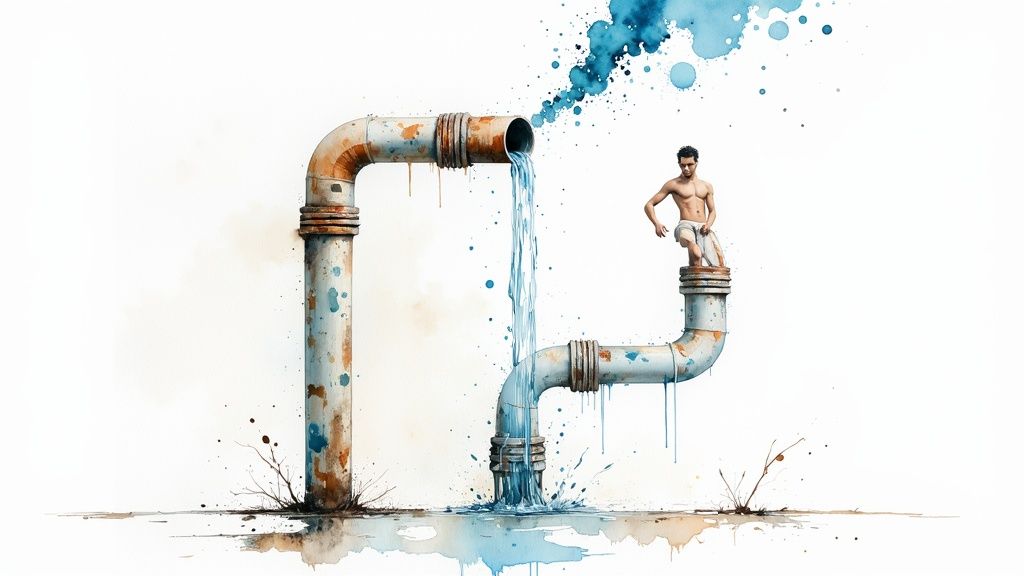
Ever put your finger over the top of a straw full of water? The water just hangs there, almost magically defying gravity. That little trick is a perfect demonstration of negative air pressure—the very same force that would cause chaos in your plumbing if it weren't for your vent system.
This section gets into the simple physics that make your drains work. A home's drainage system isn't just about water going down; it's a delicate dance between water leaving and air coming in. They have to work together.
The main vent stack, that pipe sticking out of your roof, is essentially a snorkel for your entire plumbing system. It creates a permanent, open airway to the outside, and that's the secret to keeping everything flowing smoothly.
The Role of Air Pressure in Drainage
When you flush a toilet or pull the plug on a full tub, a huge amount of water suddenly rushes into the drain pipe. This slug of water acts like a piston, shoving the air in front of it down the line and creating positive air pressure that needs an escape route.
At the exact same time, a vacuum—or negative air pressure—forms in the space right behind that slug of water. If there’s no way for air to fill that void, the system will gasp for air wherever it can, which is when you start hearing strange noises.
Just as a fire needs oxygen to burn, your drains need air to flow. A plumbing vent supplies the "oxygen" that allows wastewater to move smoothly and prevents the entire system from choking on a vacuum.
This is where the vent system proves its worth. It provides a dedicated path for air to rush in and neutralize both of these pressure changes, letting gravity do its work without a fight.
Preventing a Damaging Vacuum
The vent’s most important job is stopping that vacuum from ever forming. As water flows down the drain, the vent allows fresh air to be pulled in from the roof. This incoming air instantly fills the space behind the water, equalizing the pressure and breaking the vacuum before it can do any harm.
Without that fresh air, the suction would be strong enough to siphon all the water right out of your P-traps. A P-trap is that U-shaped pipe under every sink and drain, and its job is to hold a small amount of water to block sewer gas from creeping into your home. A dry P-trap is a direct, smelly invitation for those foul odors.
So, a properly working vent system accomplishes a few key things:
- Smooth Flow: By keeping the pressure neutral, it helps water drain away quickly and quietly.
- Trap Seal Protection: It prevents the siphoning that empties P-traps, which is crucial for keeping your home's air safe.
- System Stability: The whole drain-waste-vent (DWV) system stays balanced, stopping those weird gurgles, bubbles, and slow drains.
So, how does a plumbing vent work in a nutshell? It’s simply a dedicated channel for air. By letting air enter the pipes as water leaves, it keeps the air pressure neutral. This brilliant, yet simple, piece of engineering is what makes modern plumbing work so reliably, keeping water moving out and sewer gas where it belongs—outside.
Understanding Your Home's Venting System
It's easy to think a plumbing vent is just that one pipe you see sticking out of a roof. But in reality, it's a whole network of pipes working in concert behind your walls. Think of it less like a simple snorkel and more like a tree—a main trunk runs up through your house, with smaller branches reaching out to every sink, toilet, and shower.
Once you understand how these different parts connect, the entire system makes a lot more sense. Each pipe has a specific job, and together, they ensure every fixture has the air it needs to drain smoothly and keep your home safe from sewer gases.
The Main Vent Stack
The heart of this network is the main vent stack. This is the big vertical pipe that typically starts near your main sewer line in the basement or crawlspace, runs straight up through the house, and pops out through the roof. It’s the primary "artery" for the whole system, letting fresh air in and nasty sewer gases out.
Because it serves the entire house, the main stack has to be big enough for the job. Plumbing codes are pretty strict here, usually requiring a diameter of at least 3 to 4 inches. This size is crucial to handle the big gulps of air needed when you flush a toilet and helps prevent blockages from things like frost, leaves, or even a bird's nest.
This diagram shows how the main stack acts as the system's backbone.
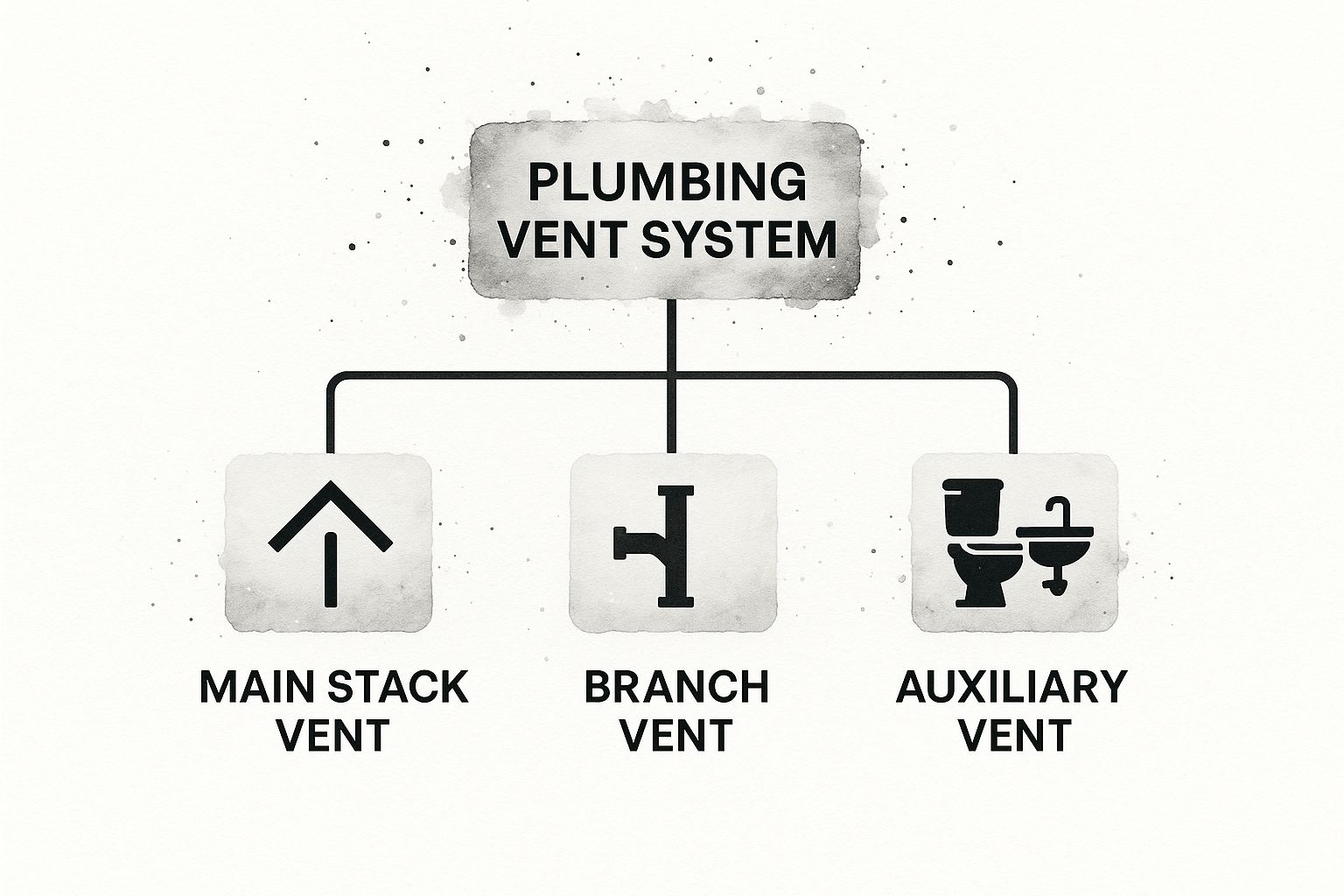
As you can see, all the smaller branch and auxiliary vents eventually feed into the main stack, creating a complete path for air to travel from the roof to each fixture.
Branch Vents and Auxiliary Vents
Feeding into that main stack are smaller branch vents. These are the workhorses that connect directly to your individual fixtures, like a bathroom sink or a cluster of fixtures in the same room. They run both horizontally and vertically, linking a fixture's P-trap back to the main stack and giving air a clear path to follow.
Sometimes, a standard layout just won't work. That's when plumbers get creative with specialized, code-approved venting setups.
- Wet Venting: This is a clever trick where a single oversized pipe does double duty, acting as both a drain for one fixture and a vent for another. A common example is using a sink's drain pipe to also provide air for the toilet right next to it.
- Circuit Venting: This is another highly efficient method. Studies have proven that a single, well-placed vent can serve up to eight different fixtures. The key is designing the horizontal drain pipe so it never gets more than half-full, leaving plenty of space for air to travel over the top of the wastewater. You can dig into the full research on this proven venting method from the International Code Council.
Meet the Air Admittance Valve (AAV)
So, what do you do when you can't run a vent pipe all the way through the roof? This is a common problem for things like a kitchen island sink. The solution is often an Air Admittance Valve (AAV). This is a neat little one-way mechanical valve that opens automatically when it senses the negative pressure of draining water, letting air into the pipe. It then snaps shut to block any sewer gases from escaping into your home. AAVs are fantastic problem-solvers, but remember, they are mechanical parts that can eventually fail and some local codes have restrictions on where and how they can be used.
How to Spot a Failing Plumbing Vent
When your plumbing vent is doing its job, you'll never even know it's there. It works silently in the background, a critical but invisible part of your home's drainage system. But when it starts to fail, your drains will begin sending out some pretty obvious distress signals.
Learning to recognize these warning signs is key. A blocked vent can cause all sorts of strange plumbing behaviors, and catching them early can save you from a much bigger, messier headache down the road.
The problem always boils down to one simple thing: a lack of air. If the vent is clogged, your drainage system can't equalize the pressure, so it starts gasping for air wherever it can find it. This struggle creates a handful of predictable and unmistakable problems.
Audible and Visual Warning Signs
Often, the first clues of a vent issue are sounds and smells you just can't ignore. Your drains will literally start calling out for help as they struggle to work without proper airflow. If you notice any of these signs, it’s a strong hint that your vent system needs attention.
- Persistent Gurgling Sounds: This is the classic sign. You flush a toilet, and as the sink drains, you hear a loud, gurgling protest. That’s the sound of your drain desperately trying to pull in air through the water in the pipe because its main air supply—the vent—is cut off.
- Slow Draining Fixtures: Is more than one drain in your house suddenly moving at a snail's pace? While a single slow drain usually points to a simple clog, sluggish performance in multiple fixtures, especially in the same bathroom, often signals a larger vent issue.
- Bubbling Toilets: This one is a dead giveaway. If your toilet bubbles and gurgles when you drain a nearby bathtub, you have a vent problem. The rushing water from the tub creates a vacuum, and with the vent blocked, it yanks air from the easiest source available: your toilet's P-trap.
- Sewer Gas Smells: This is the most serious red flag. If you catch a foul, sewage-like odor in your bathroom or kitchen, it means the vacuum in your pipes is strong enough to siphon all the water right out of a fixture's P-trap. You can explore the purpose of a P-trap to understand just how crucial that water barrier is for keeping dangerous gases out of your home.
A blocked plumbing vent forces your entire drainage system to hold its breath. The gurgling, slow drains, and foul odors are all signs that your system is suffocating and desperately needs air.
Performing an Initial Visual Check
If you suspect a blockage, there’s a quick and safe check you can perform yourself from the ground. More often than not, the culprit is simple debris clogging the vent opening on your roof.
Grab a pair of binoculars and, from a safe spot on the ground, take a close look at your vent pipe. You're searching for obvious obstructions—things like a bird’s nest, a thick buildup of leaves and twigs, or maybe even a misplaced ball or toy. In colder climates, it's also common for frost to completely seal the pipe shut during the winter.
If you spot a clear blockage, the safest next step is to call a professional. They have the right tools and training to get on the roof and clear it out without any risk.
Why Modern Plumbing Vents Are a Safety Standard
Today’s plumbing codes can feel strict, but they weren't just made up out of thin air. They were written in response to some pretty serious public health disasters. To really get why plumbing vents are so essential, you have to rewind to the early days of indoor plumbing, a time when sewer gas—and the diseases it carried—was a constant, unwelcome guest in people's homes.
Those first systems were a dangerous experiment. There were no real rules, so vents were often skipped altogether. If they were installed, they were typically too small and clogged up easily. This created a perfect storm for disaster. Every time someone flushed a toilet or drained a sink, the suction would pull all the water right out of the P-traps.
Modern plumbing codes are a direct result of historical public health failures. The venting standards we have today come from over a century of learning how to make indoor plumbing truly safe for everyone.
With the water barrier gone from the traps, there was nothing to stop toxic, flammable gases from pouring out of the sewer and straight into living rooms and kitchens. The modern convenience of indoor plumbing became a serious health hazard.
Learning from Past Mistakes
The problem was especially bad in early American cities. Back then, plumbing stacks were vented through the roof, but without any standardized pipe sizes. This usually meant the vents were far too small and would easily get blocked, especially by frost in the winter. As you can imagine, this led to constant trap seal failures and homes filled with dangerous sewer gas. You can read more about these early American plumbing challenges on plumbingsupply.com and see how they directly influenced the rules we follow now.
This history lesson is important because it shows that a plumbing vent is much more than just a pipe—it's a critical safety device. The evolution from those hazardous early setups to today's carefully designed codes proves a fundamental point: proper venting is a cornerstone of public health.
It took decades of engineering, trial and error, and a much better understanding of how air pressure and water behave in a pipe. The strict rules we have now for vent size, location, and materials exist for one simple reason: to make sure the system works perfectly, every single time, protecting your home and your family. It’s not just about passing an inspection; it’s a proven safety standard that keeps our homes healthy.
Common Plumbing Vent Questions Answered
Even when you know how the system is supposed to work, real-world questions always pop up. Let's tackle some of the most common things homeowners ask about their plumbing vents, giving you clear, practical answers to feel more confident about your home's plumbing.
Can a Plumbing Vent Run Horizontally?
Absolutely, but there's a catch. A horizontal vent pipe can’t just be run flat; it needs a specific, slight upward slope. This isn't just a friendly suggestion—it’s a non-negotiable plumbing code requirement. The pipe must pitch gently upward as it moves away from the drain line it serves.
Why the fuss? Gravity. This slope ensures any moisture that condenses inside the pipe flows back down into the drain. If the pipe were perfectly level or, even worse, sloped the wrong way, water would collect and create a pool. That standing water would eventually block the pipe, cutting off airflow and causing the very drainage nightmares the vent was meant to prevent.
How Far Can a Drain Be From Its Vent?
This is a big one, and the answer is strictly governed by plumbing codes. The distance from a fixture's P-trap to its vent connection—what we call the "trap-to-vent distance"—is critical. If that section of pipe is too long, water rushing down the drain can build up enough speed to siphon all the water right out of the trap, rendering it useless.
The maximum distance you're allowed depends on the diameter of the drain pipe itself. A bigger pipe can handle a longer run before needing a vent.
Common Trap-to-Vent Distances
| Drain Pipe Diameter | Maximum Distance to Vent |
|---|---|
| 1.25 inches | 5 feet |
| 1.5 inches | 6 feet |
| 2 inches | 8 feet |
| 3 inches | 12 feet |
Sticking to these measurements is key to making sure the vent can break the vacuum before it has a chance to suck the trap dry.
When Can I Use an Air Admittance Valve?
An Air Admittance Valve (AAV), which you might hear called a "cheater vent," is a clever little one-way mechanical valve. It opens to let air into the drain system but stays sealed to keep sewer gas from getting out. They are fantastic problem-solvers for tricky spots where running a traditional vent pipe up through the roof is a huge headache—think kitchen island sinks.
But AAVs have their limits. They're usually only approved for single fixtures or a small, connected group. You can never use an AAV to replace your home's main vent stack. And since they are mechanical devices with moving parts, they will eventually wear out and need to be replaced, so they must always be installed somewhere you can easily get to them.
Do I Need a Plumber to Fix a Clogged Vent?
It really depends on the clog. If you can safely see a simple blockage—a clump of leaves, a small bird's nest—right on top of the pipe from the ground, you might be tempted to clear it. But let's be clear: any job that involves getting up on your roof comes with serious safety risks.
For any issue that requires climbing onto the roof or involves a clog you can't see from the ground, calling a professional is the smartest and safest move. They have the right safety equipment, like harnesses, and specialized tools to snake out deep clogs without damaging your pipes or your shingles.
Trying to blast out a deep clog with a garden hose can often just push the debris down further, making the problem worse. If you're dealing with vent issues along with other plumbing headaches, our guide on common plumbing problems and how to fix them can offer some more insight.
If you're hearing gurgling drains, watching sinks empty slowly, or smelling foul odors in the Denver Metro area, don't just hope the problem goes away. The team at Professional Plumbers Denver has the expertise to find and fix any plumbing vent issue, safely and correctly. Contact us today for reliable service you can count on at https://professional-plumbers-denver.com.

Recent Comments