
That jolt of icy water when you expect a hot shower is a rude awakening, especially on a chilly Denver morning. When you get no hot water from your tankless water heater, the cause is usually one of a few common culprits. We'll start with the most likely suspects—power loss, gas supply issues, or an overloaded system—which you can check in minutes.
Why Your Tankless Heater Suddenly Stopped Working
When your on-demand hot water supply abruptly shuts down, there's always a reason. Unlike old-school tank heaters that just run out of stored hot water, a tankless unit that stops working is actively signaling a problem. The issue could be as simple as a tripped breaker or something more complex, like a failing internal component.
Think of this guide as your first-pass diagnostic check before you even think about opening a toolbox. By walking through the most common reasons for a sudden shutdown, you can figure out pretty quickly if you're dealing with a simple fix or a job for a pro.
Common Causes of Failure
Your tankless water heater is a smart piece of equipment, but it relies on a perfect sequence of events to work its magic. If anything interrupts that chain reaction, the whole process grinds to a halt. In my experience with Denver homes, the most frequent culprits are:
- System Overload: You're simply asking for more hot water than the unit can produce at once. Think running two showers while the dishwasher is going full blast.
- Power Disruption: This one surprises people. Even gas-powered tankless heaters need electricity to run their electronic controls and ignition systems.
- Gas Supply Interruption: It sounds obvious, but a closed gas valve or an issue with your main gas line will stop the burner from ever lighting.
- Ignition Failure: Sometimes, a dirty flame sensor or a blocked vent is all it takes to prevent the unit from firing up safely.
A common mistake homeowners make is underestimating how small disruptions affect these sensitive systems. For example, even a brief power flicker can be enough to trip the unit's internal safety controls, requiring a manual reset.
Before we dive deeper, this checklist can help you quickly run through the most common issues. It's the same mental checklist I run through when I first arrive at a job site.
Quick Diagnosis Checklist for No Hot Water
| Potential Cause | What to Check | Simple Fix or Next Step |
|---|---|---|
| System Overload | Are multiple hot water taps running? | Turn off some appliances to reduce demand. If hot water returns, your unit may be undersized for your needs. |
| Power Issue | Is the unit plugged in? Check the circuit breaker. | Plug it in or flip the breaker back on. If it trips again, call an electrician. |
| No Gas Supply | Is the gas valve to the unit open? Check other gas appliances. | Open the valve. If other gas appliances are also out, contact your utility provider. |
| Blocked Vents | Look at the intake and exhaust vents outside. | Clear away any leaves, snow, or debris blocking the pipes. |
This table covers the low-hanging fruit. If you've gone through these checks and still have no hot water, it’s time to consider a more involved problem.
Is It a Simple Fix or a Bigger Problem?
Knowing the difference between a minor hiccup and a serious malfunction is key. Power, gas, and overload issues are almost always things you can spot and solve yourself in a few minutes without any special tools.
But if those basic checks don’t bring your hot water back, you might be looking at a deeper problem. This could be anything from heavy mineral scale buildup inside the heat exchanger (a common Denver issue) to a failing flow sensor. For a detailed breakdown of what to do next, our comprehensive guide on handling no hot water from a tankless water heater offers step-by-step solutions specifically for homeowners. Catching the signs early can prevent a small annoyance from turning into a major, expensive repair.
Checking the Essentials: Power, Gas, and Water Flow
Before we dive into the guts of the unit, let's start with the basics. It’s amazing how often the fix for no hot water from a tankless water heater is something simple. Your heater needs three things to do its job: power, gas, and a steady flow of water. Running through these checks takes just a few minutes, requires zero tools, and can save you a lot of headaches (and a service call).
Even if you have a gas-fired unit, it still needs electricity to run its brain—the digital display, the sensors, and the ignition system. No power, no hot water. It's that simple.
Confirming Your Power Supply
First things first, head to your electrical panel. Find the breaker that controls your water heater. Has it tripped? You'll know if the switch is in the middle or the full "off" position.
If it is tripped, flip it all the way off, then firmly back to the "on" position to reset it. If it trips again right away, stop what you're doing. That’s a clear sign of a deeper electrical problem that needs a professional electrician.
Don't forget to check the outlet itself. Many tankless heaters are plugged into a GFCI outlet (the kind with the little "test" and "reset" buttons). If that button has popped out, press "reset" and see if that brings your unit back to life.
Pro Tip: We get a lot of quick storms here in Denver. A brief power flicker is often all it takes to trip a sensitive breaker or GFCI. That's why this should always be your very first step.
Verifying the Gas Is On
If the power looks good, let's move on to the fuel. Your tankless heater isn't going to heat anything without gas.
Find the gas pipe that runs directly to your water heater. You'll see a small shutoff valve with a handle. For the gas to be flowing, that handle needs to be parallel with the pipe. If it's perpendicular (making a "T" shape with the pipe), the gas is off. Just turn the handle a quarter turn to line it up with the pipe.
An easy way to double-check if your whole house has gas is to try another gas appliance. Can you light a burner on your stove? If not, the issue is likely with your main gas line, and you'll need to call your utility company.
Investigating Water Flow Rate
This is the one everyone forgets, but it's a huge deal for tankless systems. These heaters have a built-in safety feature that requires a minimum flow of water to fire up—usually around 0.5 gallons per minute (GPM). If the water is just trickling out of the tap, the heater won't even try to turn on.
The most common reason for this, especially with Denver's hard water, is a clogged faucet aerator or a gunked-up showerhead. Mineral deposits build up over time and choke the flow.
Here’s a quick test:
- Turn on the hot water at the sink where you're having the problem. Does the flow feel weak?
- Unscrew the little screen (the aerator) from the very tip of the faucet.
- Now, turn the hot water back on without the aerator. If you get a strong, rushing flow and the heater kicks on, you’ve found your culprit.
Cleaning out that tiny filter is an easy, five-minute fix that can get your hot water running again instantly. While tankless heaters are incredibly efficient, studies have shown that things like flow rate can impact the user experience when compared to older tank systems. For a deeper dive, you can check out a detailed 2010 study on tankless water heater performance.
How to Read Error Codes and Fix Ignition Issues
So, you've confirmed the unit has power and the gas is on, but you're still stuck with cold water. Your next best clue is probably blinking right at you from the unit’s digital display. Those little letters and numbers are error codes, and they're the system's way of telling you exactly what's wrong. Honestly, they're the fastest way to figure out why you have no hot water from a tankless water heater.
Don't let them intimidate you. Think of an error code as a shortcut to the right page in the owner's manual. It saves you from a world of guesswork and points you directly to the source of the problem.
Decoding Common Ignition Failure Codes
Most error codes you'll encounter point to just a handful of common problems. While every manufacturer—Rinnai, Navien, Rheem, you name it—has its own set of codes, a huge percentage of them relate to ignition failure. In plain English, this means the unit tried to fire up the burner to heat your water, but for some reason, it couldn't.
You might see a code that translates to "Ignition Failure" or "Flame Loss." This is your signal to investigate the parts responsible for actually creating and maintaining the flame.
Often, the issue is a dirty flame sensor. This little rod's only job is to confirm that the burner is lit. When it gets coated with gunk (which happens over time), it can't "see" the flame and tells the system to shut off the gas as a safety precaution. It's a classic issue. While you can look for simple blockages, most fixes for ignition components are best left to a pro.
From Vents to Sensors: What to Check Safely
Before you even dream of grabbing a screwdriver and opening up the unit's cover, there are a few simple and safe things you can check yourself when you see an ignition-related error.
- Check the Vents: Here in Denver, it’s not uncommon for high winds, heavy snow, or even a bird's nest to block the intake or exhaust vents. Take a quick walk outside and look. A blocked vent means no air, and no air means no ignition. Simple as that.
- Look at the Condensate Line: The newer high-efficiency units create condensation that has to drain away. If that little drain line gets clogged or freezes solid (a real possibility in our winters), a sensor will shut the whole operation down to prevent a watery mess.
Pro Tip: Almost all the "safe for homeowners" fixes for ignition errors are external. Focus your energy on clearing obstructions from vents and drains. Never, ever try to take apart the burner or gas valve yourself.
This image gives you a good starting point for a logical diagnostic flow when you first realize the water isn't heating up.
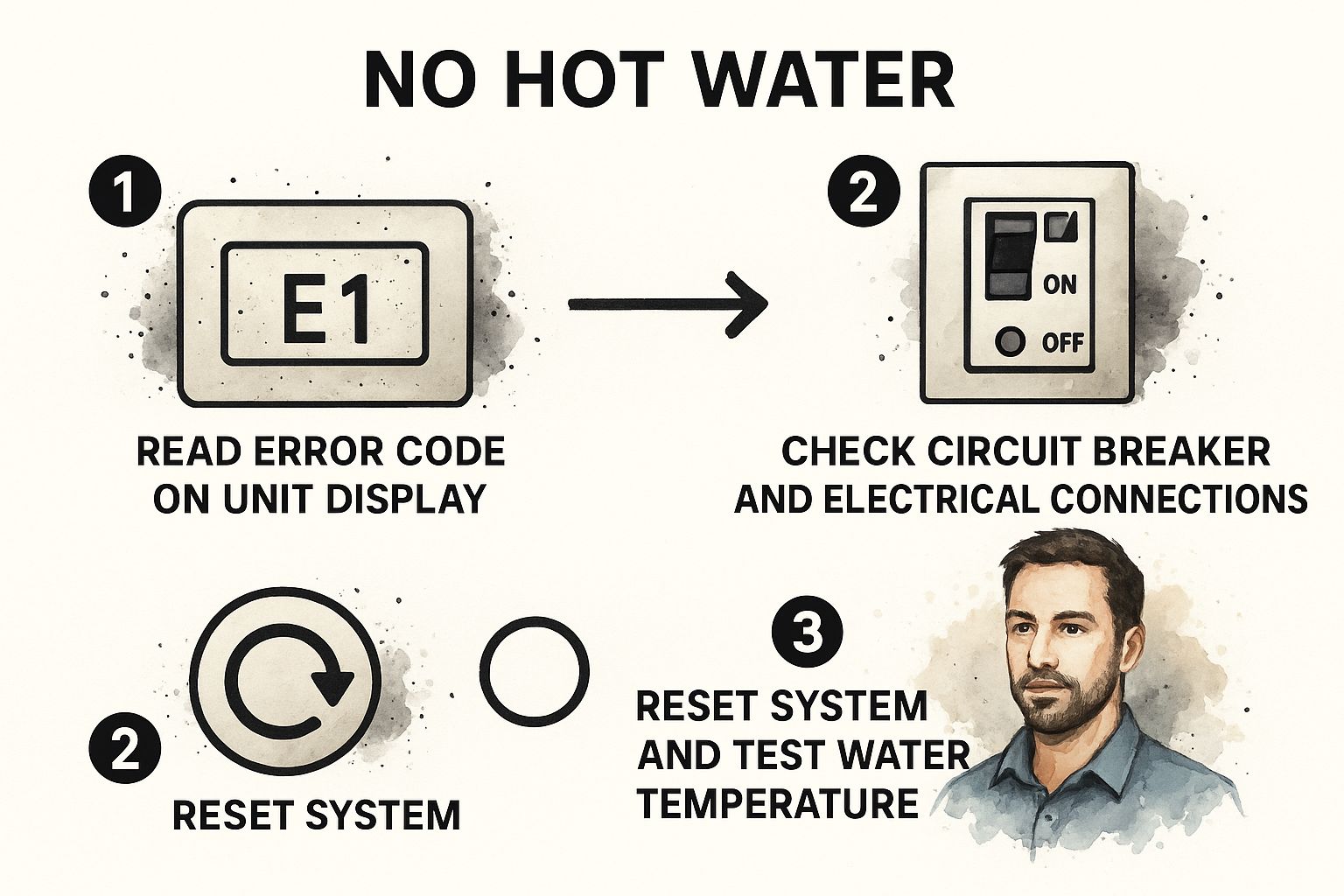
It’s all about a step-by-step process, starting with what the unit is telling you before you jump to resetting breakers.
If you’ve checked the vents and drains and the error code just won't clear, the problem is almost certainly internal. It could be that dirty flame sensor we talked about, a worn-out ignitor, or a gas pressure problem. These are not DIY territory. For more insight into what could be going wrong, check out our guide on common tankless water heater issues. Working with gas and sensitive electronics requires specific tools and, more importantly, the training to do it safely.
Wrestling With Mineral Buildup and Internal Clogs
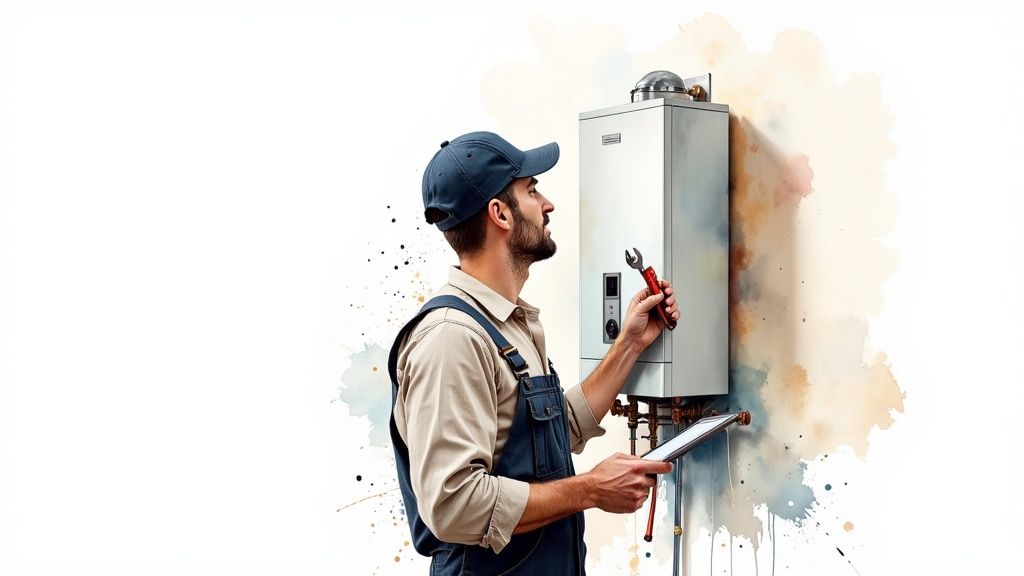
So, you've confirmed the unit has power, the gas is flowing, and the vents are clear, but you're still stuck with cold water. When this happens, the culprit is almost always hiding inside the heater itself.
Here in Denver, our water is famously hard. It’s packed with minerals like calcium and magnesium that, over time, build up inside your tankless unit's tiny passageways. This rock-hard crust, known as scale, is the arch-nemesis of your water heater.
This buildup essentially insulates the heat exchanger, forcing the system to work overtime just to get the water hot. Eventually, it can clog the unit completely, leading to the frustrating reality of no hot water from your tankless water heater.
Spotting the Telltale Signs of Scale
The good news is that mineral buildup rarely causes a sudden failure. Your heater will usually throw up a few red flags first, giving you a chance to act before you're forced into a surprise cold shower.
Keep an eye out for these classic symptoms:
- Weakening Hot Water Pressure: If you notice the stream from your hot water taps getting weaker over time, that’s a dead giveaway. Scale is slowly strangling the flow inside the unit.
- Wild Temperature Swings: Does your shower temperature bounce between hot and lukewarm for no reason? This is a common sign that scale is preventing the heater from accurately sensing and regulating the water temperature.
- Weird Noises: A rumbling, popping, or "kettling" sound when the heater kicks on is a direct result of water getting trapped and superheated in pockets created by the mineral deposits.
Ignoring these clues is just asking for a complete system shutdown. In fact, issues like inconsistent temperatures and poor flow are often the first signs a unit is struggling. You can get more insight into how scaling impacts a unit's lifespan and the long-term performance of tankless water heaters on Angi.com.
The Fix: Descaling Your Water Heater
Thankfully, you can get ahead of this problem with a process called descaling or flushing. This is basically a deep clean for your heater's internal components, where you circulate a descaling solution (food-grade white vinegar works great) through the unit to dissolve all that gunk.
In my experience, an annual descale is the single most important maintenance task a Denver homeowner can perform. It doesn't just restore lost performance; it can easily extend the life of your heater by 5-10 years.
The process itself is straightforward enough for a handy homeowner. It involves using a small pump, a bucket, and a couple of hoses to isolate the heater and create a closed loop to circulate the cleaning solution for about 45-60 minutes.
That said, every model has its quirks, and a misstep could potentially damage the unit. That's why having a solid guide is crucial. We’ve put together a full walkthrough covering safety and specific steps. To see exactly how it’s done, check out our guide on essential tankless water heater maintenance. This simple yearly flush is your best weapon against internal clogs and the key to keeping your system running smoothly.
When You Need to Call a Professional Plumber
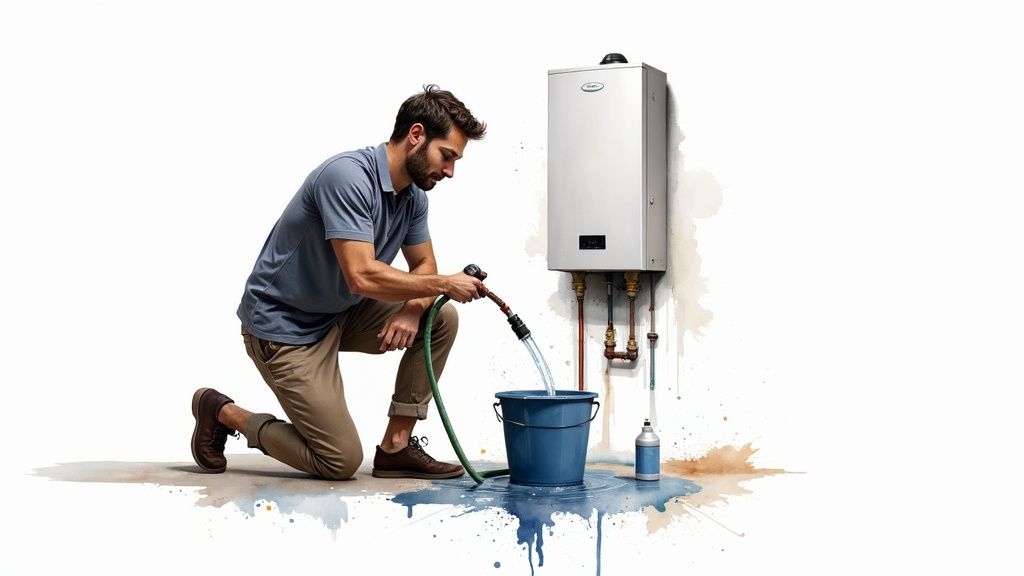
While tackling a clogged aerator or resetting a breaker is a satisfying DIY win, the most important part of troubleshooting is knowing when to stop. Your tankless water heater is a sophisticated piece of equipment, mixing water, high-voltage electricity, and natural gas in a very small space. A mistake here isn't just an inconvenience—it can be downright dangerous.
Knowing the clear red flags that require a professional’s touch is key. Some issues are simply non-negotiable and signal that it's time to put down the tools and pick up the phone. Trying to fix these yourself could void your warranty, cause far more expensive damage, or worse, put your family at risk.
Non-Negotiable Signs to Call a Pro
If you run into any of these situations, your DIY troubleshooting journey is over. These are sure signs of a problem that needs a licensed plumber who knows their way around tankless technology.
- You Smell Gas: This is the most serious red flag. If you catch that distinct rotten egg smell near your heater, don't hesitate. Shut off the gas supply at the main valve immediately, get everyone out of the house, and call your utility company and a plumber from a safe distance.
- Persistent Ignition Failures: You’ve already cleared the vents and checked the easy stuff, but that ignition error code just won't go away. This often points to a deeper issue with the gas valve, ignitor, or flame sensor—all components that are unsafe for an amateur to handle.
- Major Water Leaks: A tiny drip from a pipe connection might be something you can tighten. But if you see water streaming from the main body of the unit itself, that could mean a cracked heat exchanger. That’s a major, and often costly, problem that requires an expert.
- Complex Electrical Faults: Is the circuit breaker for your heater tripping over and over again, even right after you reset it? This is a classic sign of an electrical short or a failing component inside the unit.
Attempting to repair gas or electrical systems without proper training is one of the biggest risks a homeowner can take. A licensed professional not only has the right tools but also understands the intricate safety protocols required to work on these systems.
Finding the Right Technician in Denver
When you realize you need backup, don't just call the first plumber in the search results. You need to find a company that specifically lists tankless water heater repair as one of their specialties. These systems are a world away from old-school tank models and demand a different set of diagnostic skills.
When you call, ask if their technicians have factory training for your specific brand (like Rinnai or Navien). It’s also a great idea to check their reviews for mentions of successful tankless repairs.
A qualified expert can get to the root of why you have no hot water from your tankless water heater quickly and safely, making sure the job is done right the first time.
Common Questions About Tankless Water Heaters
https://www.youtube.com/embed/ostKcxYQuW4
Even after you've run through the basic troubleshooting steps, you might still have a few lingering questions about how your tankless heater works. Honestly, that's completely normal. Understanding the "why" behind your unit's little quirks can help you catch small problems before they leave you taking an ice-cold shower.
Here are a few of the most common questions we get from homeowners all over the Denver area. A lot of the time, what feels like a major malfunction is really just the system doing its job or telling you it's time for a little upkeep.
Why Is My Tankless Water Heater Only Producing Lukewarm Water?
This is a big one, especially when a cold snap hits Denver. If your water just isn't getting hot enough, your heater is probably having a tough time keeping up with the demand you're placing on it.
Sometimes, it's the "cold water sandwich" effect—that burst of cold water you get when you turn a hot faucet off and then quickly back on. More often than not, though, it comes down to capacity. In the winter, the groundwater coming into your home can be 30-40 degrees colder than in the summer. That means your heater has to work way harder to reach the target temperature. If you're running the faucet at full blast, water might be zipping through the heat exchanger too fast for the unit to heat it properly.
Here's a quick test: Try turning the faucet down so the flow is slower. If the water gets noticeably hotter, that’s a dead giveaway. It tells you the unit is either slightly undersized for your peak winter needs or, more likely, it's overdue for a good descaling to get its heating power back.
Could a Tripped Breaker Be the Only Reason I Have No Hot Water?
You bet. It’s actually one of the first things a pro checks because it's so common and so easy to fix. People forget that even gas-fired tankless units need electricity to run their digital controls, sensors, and the ignition system. No power, no hot water—it's that simple.
Before you do anything else, head to your main electrical panel. Find the breaker for your water heater and see if it’s tripped (usually stuck in the middle position). If it is, push it all the way to "off" and then firmly back to "on." If the breaker trips again right away, stop. That signals a deeper electrical problem inside the unit or its wiring, and you'll need a licensed electrician to safely figure that out.
How Often Should I Service My Tankless Heater to Prevent Problems?
Regular maintenance is hands-down the best way to avoid having no hot water from your tankless water heater. Here in Denver, we have notoriously hard water, which makes an annual descaling service essential. This flush removes the chalky mineral buildup that slowly strangles your heater's performance and can cause it to fail years earlier than it should.
Beyond the yearly flush, a little bit of DIY inspection goes a long way.
- Every few months: Take a quick walk outside and check the air intake and exhaust vents. Make sure they're clear of any leaves, snow, or debris.
- Every year or two: It’s a smart move to have a professional come out for a full tune-up. A tech can check internal parts you can't see, like the burners, ignitor, and safety sensors, to ensure everything is in top shape.
Putting a little effort into upkeep is the secret to getting a long life—sometimes up to 20 years—out of your unit and keeping those surprise cold showers at bay.
If you've gone through these steps and you're still stuck with cold water, it’s probably time to bring in a professional. Professional Plumbers Denver has the tools and deep experience to diagnose and fix any tankless water heater problem, getting your system back to running safely and efficiently. Don't let the problem linger—schedule your service today.

Recent Comments