
A sewer camera inspection is a completely non-invasive way for a plumber to see exactly what’s happening inside your drain and sewer lines. Using a specialized waterproof camera, they can get a firsthand look at the pipe's interior, making it the single most effective method for diagnosing the precise cause and location of a plumbing issue. It takes all the guesswork out of the equation.
This technique is essential for dealing with those stubborn, recurring clogs, perpetually slow drains, or as a crucial due diligence step before you buy a new home.
What Is a Sewer Camera Inspection?
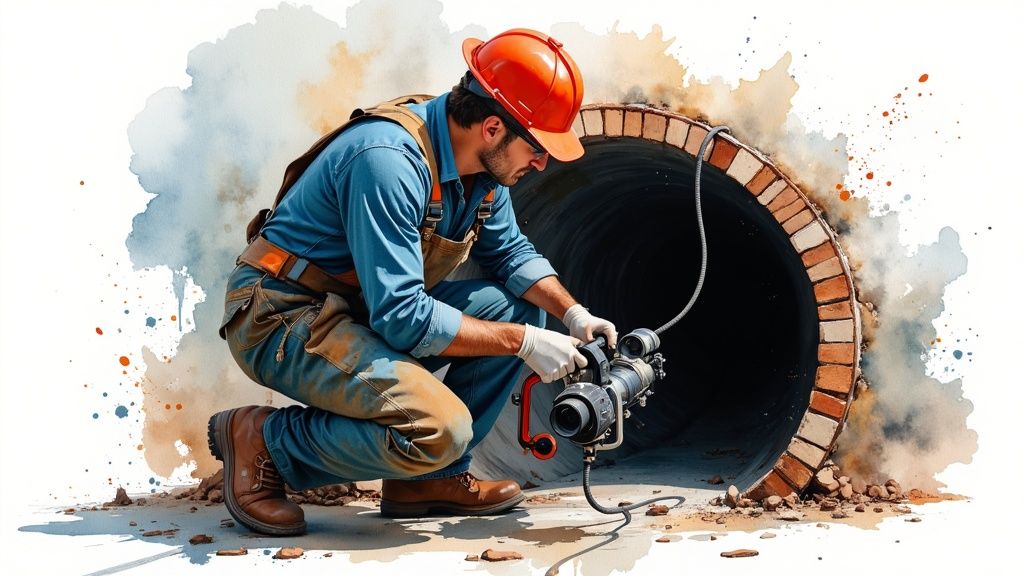
Think of it like a colonoscopy for your home’s plumbing. Instead of blindly trying to figure out what’s causing a backup, this technology gives us a live video feed from deep inside the pipes. It turns a mysterious, hidden problem into something we can see and diagnose with 100% accuracy.
This process single-handedly moves plumbing from a world of educated guesses to one of absolute certainty. Without that visual confirmation, a plumber might snake a drain over and over, never realizing the real issue is a gnarly tree root that has cracked the pipe or a section of the line that has collapsed. The camera provides undeniable proof.
When You Might Need an Inspection
Often, your house will give you little hints that something is wrong deep down in the plumbing system. Ignoring these subtle—and sometimes not-so-subtle—clues can lead to much bigger, messier, and more expensive problems later on.
Learning to recognize these warning signs is the first step toward getting things fixed right the first time.
Here are some of the most common situations that scream for a sewer camera inspection:
- Recurring Clogs: If you're constantly fighting with the same drain backing up, no matter what you do, it points to a stubborn obstruction that a simple snaking just can't clear for good.
- Multiple Slow Drains: When the kitchen sink, the shower, and the toilet all start draining like molasses at the same time, the culprit is almost certainly in your main sewer line, not the individual pipes.
- Unpleasant Odors: A persistent smell of sewer gas wafting through your home is a major red flag for a crack or break somewhere in your sewer line.
- Buying a New Home: Getting an inspection before you close the deal is one of the smartest moves a homebuyer can make. It can uncover potentially catastrophic sewer line issues that a standard home inspection would never catch.
By seeing the problem firsthand, you are empowered to make informed, confident decisions about repairs. It’s the difference between guessing and knowing.
Sometimes, the signs are obvious, but other times they're more subtle. The following table breaks down common symptoms and explains what they might mean for your sewer line.
When to Schedule a Sewer Camera Inspection
| Symptom | What It Could Mean | How an Inspection Provides Answers |
|---|---|---|
| Gurgling Toilets/Drains | Air is trapped in the line due to a partial blockage, preventing proper flow. | The camera can pinpoint the exact location and nature of the clog—be it grease, roots, or a foreign object. |
| Lush, Green Patches in Yard | A leaking sewer line is "fertilizing" a specific area of your lawn. | The inspection can identify the precise location of cracks or breaks in the underground pipe. |
| Frequent Backups | There's a significant obstruction or structural damage, like a belly (sagging pipe) or offset joint. | The video feed will clearly show if the pipe is damaged, misaligned, or holding standing water. |
| Foundation Cracks/Sinkholes | A long-term, unaddressed leak is eroding the soil supporting your home's foundation. | An inspection can confirm a severe leak and help assess the extent of the necessary pipe repair or replacement. |
Paying attention to these signals can save you a world of trouble. If you want to dig a bit deeper, you can explore the top signs you need a sewer line inspection in Denver and see if your home is trying to tell you something important.
How Sewer Inspection Technology Works

To really get why a sewer camera inspection is such a game-changer, you have to appreciate the smart tech that makes it all happen. It’s not just a camera on a stick. Think of it more like a purpose-built exploration rig designed specifically for the hidden world running beneath your feet.
The whole setup is an elegant solution to a messy problem. It’s a complete system where a few key parts work in perfect harmony to turn a plumbing mystery into a clear, solvable issue.
The Core Components of the System
The star of the show is a high-resolution, waterproof camera fixed to the end of a long, semi-rigid push rod. This rod is the real workhorse—it's flexible enough to navigate the natural curves and sweeps of your pipes, yet sturdy enough for a technician to guide it hundreds of feet down the line. All the while, it’s sending a live video feed to a high-definition monitor.
This isn't your average camera, either. The ones professionals use are packed with features that make the whole process incredibly accurate and efficient:
- Self-Leveling Camera Head: This is a brilliant feature. It automatically keeps the video feed oriented upright, no matter how much the camera twists and turns inside the pipe. This simple function prevents confusion and makes it easy to tell the top of the pipe from the bottom—which is crucial for diagnosing issues like a sagging "belly" in the line.
- High-Intensity LED Lights: The sewer line is a pitch-black environment, so the camera head is ringed with powerful LEDs. They light up the pipe like daylight, revealing everything from tiny hairline cracks to major blockages in crisp detail.
- Durable, Protective Casing: As you can imagine, a sewer pipe is a rough place. The camera is shielded by a tough, waterproof housing, usually made of stainless steel with a scratch-proof sapphire lens, to withstand the harsh conditions.
Pinpointing the Problem with Precision
Now for the cleverest part. A tiny transmitter, often called a sonde, is built right into the camera head. This little device emits a specific radio frequency as it travels through the pipe.
The sonde is what turns a visual find into a real-world repair plan. It bridges the gap between seeing a problem underground and knowing exactly where to dig on the surface.
While the camera moves through the pipe, the technician walks above ground with a handheld locator, tracking that signal. When the camera stops on a problem—say, a massive tree root intrusion or a collapsed section of pipe—the locator pinpoints its exact location and depth with stunning accuracy. This completely eliminates the guesswork and the need for expensive, destructive trenching just to find the issue.
It's no surprise that the demand for these non-invasive tools is on the rise. The global market for sewer cameras was valued at around USD 389 million and is projected to hit approximately USD 607 million by 2032. This growth really speaks to how vital these tools are for maintaining our aging infrastructure and supporting new construction without tearing everything up. You can learn more about the growth of sewer camera technology in the full market research report.
Your Step-by-Step Inspection Process
Knowing what to expect can take the mystery out of any home service, and a sewer camera inspection is a perfect example. It's a surprisingly simple and transparent process that puts you in the loop from start to finish. Let's walk through what happens when the technician shows up, so you feel completely in the know.
Think of it as a collaborative diagnostic. From the moment the equipment is set up to the final report, every step is designed to give you a crystal-clear picture of your sewer line's health. You'll see exactly what the pros see, in real-time.
Step 1: Finding an Entry Point and Setting Up the Camera
First things first, the technician needs to find the best way into your sewer line. This is usually through a cleanout—a capped pipe designed specifically for access. You'll typically find it in the basement, a crawlspace, or somewhere in your yard.
Once they've opened the access point, they'll prep the camera. It’s a specialized, high-resolution camera head attached to a long, flexible rod. The technician carefully feeds it into the pipe, and the journey begins. The setup is quick, getting the inspection underway without any fuss.
Step 2: The Journey Through Your Pipes (Live!)
Now for the interesting part. The technician skillfully pushes the camera through your pipes, and you get to watch the whole thing live on a high-definition monitor. It's like a real-time documentary of your home's plumbing.
As the camera snakes its way through the line, the technician will act as your guide, explaining what they're seeing. They'll point out pipe joints, connections, and any potential trouble spots. This turns an abstract problem into something you can see with your own eyes, making it much easier to understand what's going on.
Step 3: Pinpointing the Exact Location of Problems
If the camera spots an issue—say, a nasty tree root intrusion, a cracked pipe, or a collapsed section—the technology gets even smarter. The technician will stop the camera right at the problem area.
Using a special locator device, they can track a signal from a transmitter (called a sonde) in the camera head. This lets them pinpoint the exact physical location and depth of the issue from above ground. They'll often mark the spot on your lawn or floor with a small flag or some spray paint, so you know precisely where the work needs to be done. No guesswork involved.
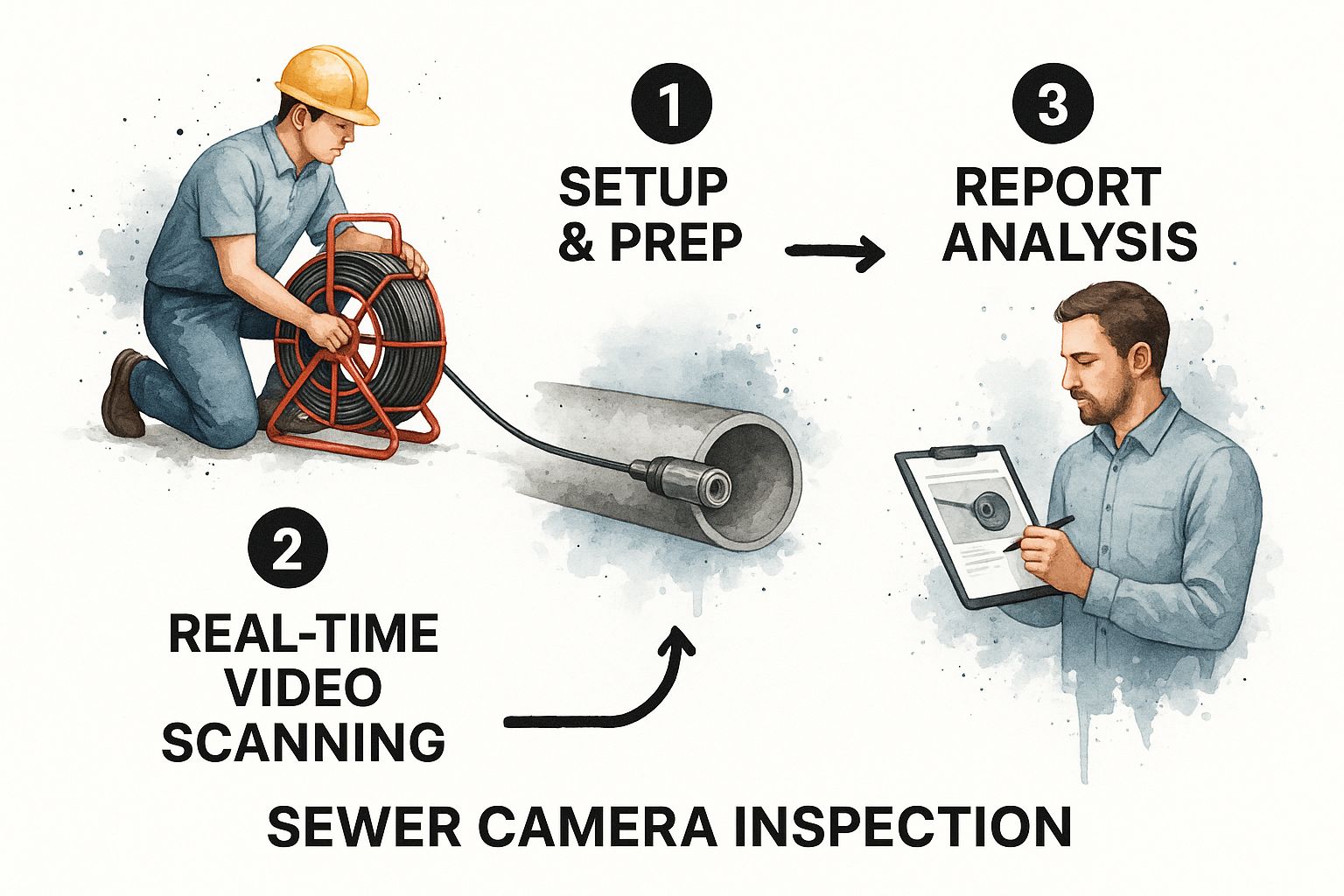
As you can see, the whole process is a logical flow: start with a non-invasive setup, move to a detailed scan, and finish with a solid plan.
Step 4: Getting the Full Report and Planning Next Steps
Once the camera has explored the entire length of the pipe, the inspection is over. The technician will then give you a complete rundown of what they found.
You should receive a detailed report that outlines the condition of your sewer line. Most companies will also provide a digital copy of the video recording. This documentation is gold—keep it for your records, especially if you're dealing with insurance or selling your home.
Finally, you’ll discuss the findings and get a professional recommendation on what to do next. Whether it's a straightforward cleaning or a more significant repair, you'll have all the visual proof you need to make a confident, informed decision.
Common Problems a Sewer Camera Uncovers
https://www.youtube.com/embed/yygWkTuXJrI
Think of a sewer camera inspection as sending a scout into the hidden, underground world of your home's plumbing. It’s the only way to get a clear, firsthand look at what’s really causing those frustrating slow drains, stubborn clogs, and unpleasant odors. The live video feed from the camera turns a frustrating mystery into a solvable problem you can see with your own eyes.
From mother nature forcing her way in to simple wear-and-tear over decades, there are a handful of usual suspects that pop up on the technician’s screen time and time again.
Intrusions and Blockages
One of the most common—and dramatic—things we find is tree root intrusion. Tree roots are relentlessly drawn to the moisture and nutrients inside a sewer line. They can wiggle their way through the tiniest crack or joint, then grow into a dense, fibrous mass that catches everything trying to pass by, eventually choking off the pipe completely.
We also run into blockages caused by years of buildup from everyday use. The main culprits are:
- Grease Buildup: When you pour grease down the drain, it cools and sticks to the inside of your pipes. Over the years, this layer thickens, narrowing the pipe’s diameter and acting like flypaper for other debris.
- Foreign Objects: Things that have no business being flushed—like "flushable" wipes, paper towels, and feminine hygiene products—don't break down and can create a nasty, instant clog.
- Scale Buildup: If you have hard water, mineral deposits can form a rock-hard scale inside the pipes. This scale not only obstructs flow but can also corrode the pipe material itself.
Getting a handle on what causes these issues is the first step in avoiding them. You can dive deeper into this topic in our guide on the primary causes of sewer backups.
Structural Pipe Damage
Beyond just clogs, a sewer camera is absolutely essential for spotting physical damage to the pipe itself. These are problems you'd never be able to diagnose from the surface, and they can lead to huge headaches if ignored.
The camera gives us a clear view of several types of structural failure:
- Cracked or Broken Pipes: Shifting soil, foundation settling, or even the immense pressure from tree roots can cause pipes to crack or completely break apart.
- Collapsed Lines: This is a worst-case scenario where a section of the sewer line has completely caved in, creating a total blockage that requires serious repair work.
- Corrosion: Older cast iron pipes are especially vulnerable to corrosion. The camera will show us the pipe walls flaking, rusting, and deteriorating, which weakens the entire line.
- Bellied Pipes: A "belly" is a sag in the line where a section of pipe has sunk. This low spot creates a permanent pool of standing water and waste, leading to constant backups.
Catching these structural flaws early is the best way to turn a potential catastrophe into a manageable repair. A camera inspection gives you the proof you need to fix the right spot without guesswork.
This kind of diagnostic tool is more important than ever. With over 770,000 miles of aging sewer pipes across the United States, we need precise, non-invasive ways to keep them in working order. The growing demand for these cameras highlights just how critical they are for maintaining our infrastructure.
The Real Payoff: Why a Professional Inspection Matters
Getting a professional sewer camera inspection isn't just another service call—it's one of the smartest investments you can make for your home's long-term health. Think about it: your sewer line is completely buried and out of sight. An inspection brings certainty to this hidden world, letting you make informed decisions instead of just reacting to a messy, expensive emergency.
Before this technology was common, finding a sewer line problem was a destructive guessing game. Plumbers often had to start digging up your yard, hoping they were in the right spot. A camera completely changes the game, giving us a precise, surgical view of the exact issue without a single shovel breaking ground.
Catch Problems Early, Save Money Later
The biggest win here is catching small issues before they spiral into catastrophic failures. Seeing a few minor tree roots starting to creep in or a tiny hairline crack means we can plan for a targeted, less invasive repair.
This proactive approach helps you sidestep a full-blown sewer backup or a collapsed pipe—disasters that can easily cost thousands in excavation, pipe replacement, and restoring your property.
Knowing for sure what's going on inside your pipes delivers incredible peace of mind. This is especially true when you're buying a house. An inspection can save you from inheriting a nightmare of a hidden problem.
This powerful diagnostic tool is why the pipe and sewer inspection camera market is booming. It's projected to hit roughly USD 850 million by 2033, all thanks to a growing understanding of proactive maintenance. As cities and infrastructure age, the need for these precise tools becomes more critical than ever. You can dig into the numbers and trends in this Data Insights Market research report.
Data-Driven Repairs, Not Guesswork
The video footage from an inspection is essentially a roadmap for the right repair. Instead of jumping to the most expensive, one-size-fits-all solution, your plumber can recommend a fix that's perfectly suited to the actual problem.
For instance, if the camera shows the pipe is in good shape but just clogged with grease, hydro-jetting is the obvious answer. If we spot a crack but the pipe's structure is still sound, that opens the door to modern, less disruptive options. You can learn more about how technicians can repair pipes without major digging in our guide on trenchless sewer repair.
Ultimately, having that visual proof ensures you only pay for the work you truly need. No more, no less. That saves you time, money, and a ton of future headaches.
What Does a Sewer Camera Inspection Cost?
When you're looking into a sewer camera inspection, the first question that probably pops into your head is, "How much is this going to set me back?" It's a fair question, but it helps to think of this service less as a cost and more as a smart investment in your property's health.
The price for a standard inspection isn't a simple, flat rate. It can vary quite a bit, and a few key things will determine the final number on your quote. Once you understand what goes into the pricing, you'll see exactly where the value is.
Key Factors That Influence the Price
The total cost really boils down to the specifics of your property. A simple, straightforward look-see is naturally going to be more affordable than a job with a few hurdles.
Here are the main things that move the needle on the price:
- Length of the Sewer Line: The further our camera has to travel from your home to the city's main sewer line, the more time and work it takes. A longer pipe usually means a higher cost.
- Ease of Access: If you have a cleanout that's easy to get to, the job is a breeze. But if our technician has to pull a toilet or get to the line through a roof vent, that extra labor adds to the final bill.
- Geographic Location: Just like with many other home services, plumbing rates can differ depending on where you live. Local market rates and the cost of living in your area play a big part.
An Investment Versus an Expense
It's tempting to get stuck on the upfront price, but the real story is about the money you'll save in the long run. The fee for an inspection is just a tiny fraction of what you'd have to shell out for a full-blown sewer line excavation and repair, which can easily climb into the thousands.
Think of it this way: the cost of the inspection is your insurance policy against the massive headache and expense of digging up your entire yard to fix a collapsed pipe you didn't even know was failing.
Catching problems like tree root intrusion or small cracks early on means you can often choose less disruptive and much more affordable repair options. A sewer camera inspection gives you the upper hand, allowing you to be proactive and turn a potential five-figure emergency into a simple, manageable maintenance job. It's a wise financial move that buys you some serious peace of mind.
Your Sewer Inspection Questions, Answered
Even with all the details, you probably still have a few questions floating around. That's completely normal. Let's tackle some of the most common things homeowners ask, so you can feel confident about the process.
How Long Does a Sewer Inspection Usually Take?
You can expect most residential sewer inspections to wrap up in about one to two hours.
Of course, the exact time can shift a bit. The total length of your sewer line and how easy it is to get to the cleanout pipe are the main factors. An inspection with an easily accessible cleanout in the yard will be quicker than a job where the technician has to access the line from a roof vent, for example.
Should I Be Home for the Inspection?
Yes, if you can. It's highly recommended. Being there lets you see what the technician sees on the live video feed.
This is your best chance to ask questions on the spot and get a firsthand explanation of any problems. It really helps you grasp the true condition of your pipes.
It's important to remember: The camera is a diagnostic tool, not a cleaning tool. Its only job is to find the what and where of a clog or other pipe damage.
Once the camera has pinpointed the issue, your plumber can then suggest the right fix, whether that’s using a plumbing snake or bringing in a hydro-jetter to clear the line completely.
Is a Sewer Camera Inspection Part of a Standard Home Inspection?
That's a great question, and the answer is typically no. A standard home inspection gives you a broad look at the house's main systems, but it rarely goes deep into the sewer line. A sewer camera inspection is a separate, specialized service.
Think of it as an add-on—a smart investment that savvy homebuyers and proactive homeowners make to avoid future surprises. When homeowners look for this kind of expert, it's interesting to see how plumbers find their customers through methods like digital marketing for plumbers.
If you're dealing with stubborn drain issues or just want peace of mind about your sewer line's health, Professional Plumber Denver is ready to assist. Our team uses top-tier camera technology to deliver a clear, accurate diagnosis. You can schedule your inspection today by visiting us at https://professional-plumbers-denver.com.

Recent Comments