
When your tankless water heater starts acting up, the promise of endless hot water can feel pretty hollow. The most common culprits we see are mineral buildup, ignition failure, and system overloads that lead to annoying temperature swings or total shutdowns. Often, these headaches are rooted in a less-than-perfect installation or simply a lack of regular maintenance—a huge factor here in the Denver area.
Diagnosing Common Tankless Water Heater Issues
Instead of just getting frustrated, let’s get to the bottom of what’s really going on. We’ll walk through the most frequent complaints, from that dreaded cold-water sandwich to strange noises and sudden shutdowns, with a special focus on the challenges unique to our local water. The goal is to give you the confidence to understand exactly what your unit is trying to tell you.
Quick Diagnosis for Tankless Heater Symptoms
Figuring out the “what” is the first step to fixing the “how.” A weird noise from the unit is a completely different problem than having no hot water at all. This table is a quick reference guide to connect what you’re experiencing with the most likely cause.
| Symptom | Potential Cause | First Action to Take |
|---|---|---|
| Fluctuating Temperatures | Overloaded system or mineral buildup | Reduce simultaneous hot water usage |
| No Hot Water at All | Ignition failure or tripped circuit breaker | Check gas supply and electrical panel |
| Loud Banging/Knocking | Severe scale buildup in the heat exchanger | Schedule a professional descaling service |
| Low Hot Water Pressure | Clogged faucet aerators or scale buildup | Clean aerators and check for scale |
Think of this as your starting point. It helps narrow down the possibilities so you’re not just guessing in the dark.
Uncovering The Root of The Problem
More often than not, the trail leads back to mineral buildup. Here in Denver, we have notoriously hard water, and that’s the number one enemy of tankless heaters. Over time, minerals like calcium and magnesium cling to the inside of the heat exchanger, creating a layer of scale.
This buildup forces your heater to work harder, leads to those inconsistent temperatures, and can even trigger a safety shutdown. If you’ve noticed your water pressure dropping, that’s a classic sign—the scale is literally narrowing the pipes. You can find more details about how scale affects heater lifespan on angi.com.
Key Takeaway: Don’t underestimate Denver’s hard water. Annual maintenance isn’t just a suggestion; it’s essential for preventing scale-related breakdowns and ensuring your unit operates efficiently for years to come.
This visual guide can also help you quickly move from symptom to solution.
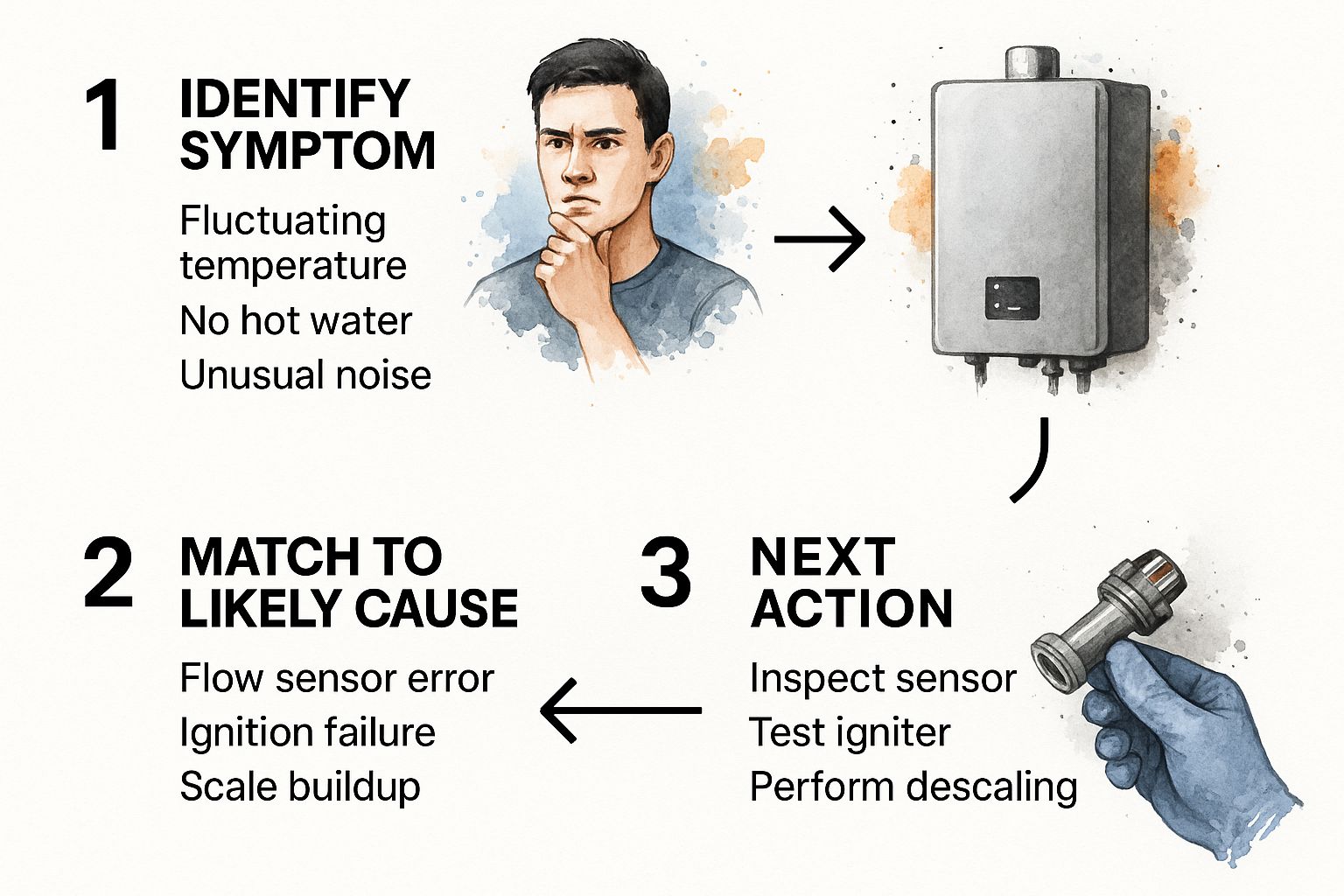
The path is pretty straightforward: see the symptom, find the likely cause, and figure out the right next step. Once you’ve done these initial checks and have a good idea of the problem, you’ll be ready to tackle the specific fixes.
Dealing With Mineral Buildup From Hard Water
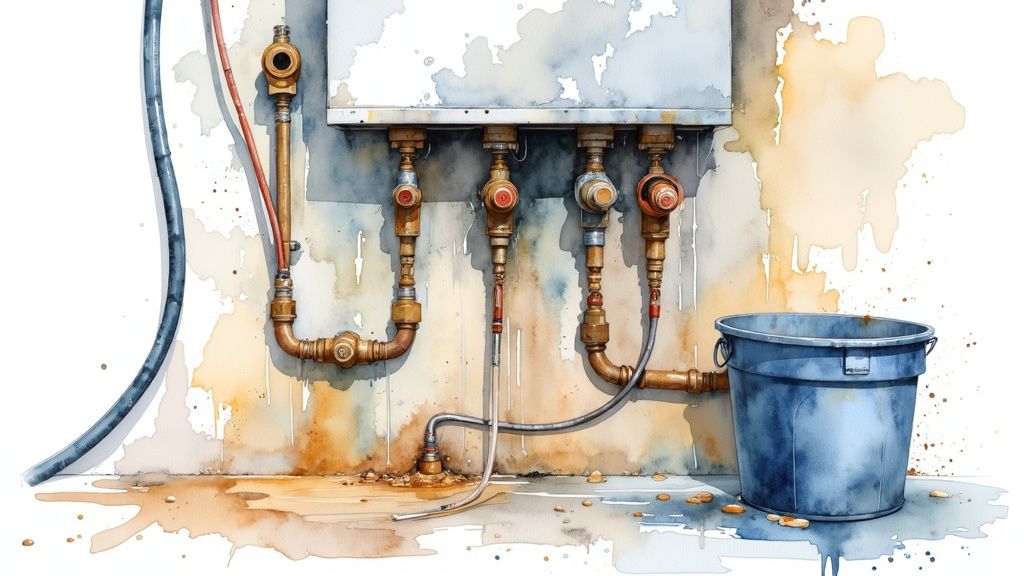
Hear a strange rumbling or knocking sound coming from your unit? That’s not your house settling—it’s your heater practically begging for a cleaning. We call this noise kettling, and it happens when water gets trapped behind thick layers of mineral scale, boils, and flashes into steam. It’s a dead giveaway that Denver’s hard water is taking a toll and a descaling flush is way overdue.
Think of this mineral buildup like cholesterol in an artery. It slowly clogs the delicate pathways inside your heater, forcing it to work much harder just to heat your water. This extra strain kills efficiency, sends your energy bills climbing, and is hands-down one of the most common causes of a complete system breakdown. The good news? You can stop the damage with some routine maintenance.
The single most important thing you can do for your tankless unit is a descaling flush, sometimes called a vinegar flush. This process circulates a solution through the heater to dissolve all that gunk. Here in the Denver area, doing this once a year isn’t just a suggestion; it’s essential.
The Descaling Process: What to Expect
Before you start, you’ll need to gather a few things: a small submersible pump, a standard 5-gallon bucket, a couple of hoses (the kind you use for a washing machine work great), and your descaling solution. Plan for about 60-90 minutes from start to finish. While it’s a pretty straightforward job, you have to be careful to avoid damaging your system.
Your Flushing Toolkit:
- Submersible Pump: A small utility pump is all you need to get the solution moving.
- Hoses: Two short hoses to connect the bucket to the heater’s service valves.
- 5-Gallon Bucket: To mix and hold your descaling solution.
- Descaling Solution: Plain white vinegar or a commercial-grade product.
Plenty of homeowners are comfortable tackling this themselves. But honestly, a botched flush can create bigger, more expensive problems. If you feel even slightly out of your depth, calling in a pro is always the smarter, safer move.
Choosing the Right Descaling Solution
When it’s time to flush, you’ve got two main choices: good old-fashioned distilled white vinegar or a dedicated commercial descaling solution. Both get the job done, but each has its place.
White Vinegar:
- The Good: It’s cheap, easy to find, and non-toxic. For regular yearly maintenance where the buildup isn’t out of control, it’s perfect.
- The Bad: It’s not as powerful as the commercial stuff. If you’ve skipped a few years of maintenance, vinegar might not have enough muscle to cut through heavy scale.
Commercial Descalers:
- The Good: These are specially formulated to obliterate tough mineral deposits quickly. They’re the best option for a unit that’s already showing signs of serious buildup.
- The Bad: They cost more and can be corrosive if you don’t follow the directions to the letter.
For most Denver homeowners who are good about their yearly flush, four gallons of undiluted white vinegar is more than enough. But if your unit is already making loud noises, a commercial solution is probably a wise investment.
It’s worth remembering that the quality of the initial installation plays a huge role here. Some industry studies have shown that early failures in tankless units are often traced back to improper installation, which can make problems like flow restriction and mineral buildup even worse.
The Best Fix: Preventing Scale in the First Place
While descaling is a great way to treat the problem, prevention is the real long-term strategy. The only way to permanently stop the assault of hard water is to keep those minerals from getting into your heater to begin with. Installing one of the various water softeners is the most effective way to do this.
A whole-home water softener treats every drop of water that enters your house, pulling out the hard minerals like calcium and magnesium before they can cause trouble. This not only protects your tankless water heater but also extends the life of every other water-using appliance you own, from the dishwasher to the coffee maker.
We’ve put together a comprehensive resource if you want to learn more. Check out our water softener installation guide to see what a difference it can make for your home.
What to Do About That “Cold Water Sandwich” and Fluctuating Temps
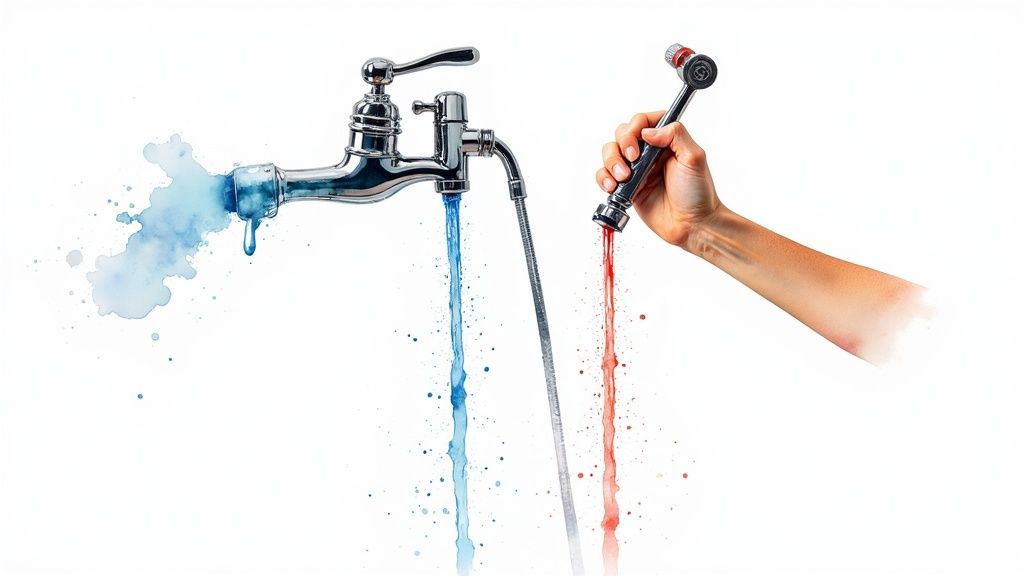
You’re in the shower, enjoying a perfectly hot stream of water, and then—BAM—an ice-cold blast hits you out of nowhere. A few seconds later, it’s hot again. That frustrating shock is the notorious “cold water sandwich,” and it’s one of the top complaints we hear from homeowners with new tankless heaters.
It usually happens when you briefly turn the hot water off and then right back on. That short pause lets your tankless unit’s burner shut down. When you turn the tap back on, the cold water sitting in the pipes comes out first, followed by the freshly heated water. This creates that unpleasant “sandwich” of hot, then cold, then hot again.
Understanding the Quirks: Flow Rate and Ignition Delays
This whole cold water sandwich thing is a perfect example of how different tankless heaters are from their old-school tank-based cousins. These on-demand units need a certain minimum flow of water to kick on the heating element. If the flow drops below that threshold, the burner simply shuts off.
For instance, quickly flicking a faucet on and off or using an older low-flow showerhead might not create enough demand to trigger the unit, which leads to those frustratingly inconsistent temperatures. It’s not just a weird quirk; early testing on some gas tankless models showed they wouldn’t even ignite at very low flow rates, just sending cold water down the line.
The good news is you can often solve this with a few adjustments.
- Change Your Habits: Instead of turning the water on and off repeatedly while doing dishes, try leaving it running in a low, steady stream. This keeps the heater engaged and the temperature consistent.
- Clean Your Faucet Aerators: Mineral buildup in your faucet aerators can choke the water flow, dropping it below the minimum level your heater needs. Unscrew them and give them a good cleaning.
- Consider a Mini-Tank: For instant hot water without any delay, a small point-of-use tank heater installed under a sink can be a game-changer. It holds just enough hot water to eliminate that gap.
A Quick Tip from the Field: In our experience, old low-flow showerheads are often the number one culprit behind temperature swings. While modern low-flow fixtures are designed better, older models can cause the flow rate to dip just enough to confuse a tankless heater into shutting off.
When It’s More Than Just a Minor Annoyance
While you can often fix the cold water sandwich by changing your habits, persistent temperature swings during continuous use can signal a bigger problem. If your water goes from hot to lukewarm and back again without you touching the faucet, it’s time to look deeper. A clogged mixing valve, for example, can fail to blend hot and cold water correctly, causing unpredictable temperatures at the tap.
Another issue we see, especially with gas units, is improper gas pressure. If the pressure is too low, the heater simply can’t generate enough energy to get the water up to your set temperature. This is definitely not a DIY job—it requires a licensed plumber to safely adjust the gas line.
Is Your Heater Too Small for Your Home?
Does the shower turn lukewarm the moment someone starts the dishwasher? That’s a tell-tale sign that your unit is undersized. A tankless water heater’s capacity is measured in Gallons Per Minute (GPM), based on how much it has to raise the water’s temperature.
Here in Denver, our incoming groundwater gets incredibly cold, especially in the winter. This means your heater has to work much harder to deliver that 120-degree water you want.
- An average shower uses about 2.0 GPM.
- A dishwasher uses around 1.5 GPM.
- A washing machine can pull 2.0 GPM.
If you’re running a shower and the dishwasher at the same time, you’re asking for 3.5 GPM. If your unit is only rated for 3.0 GPM at Denver’s chilly water temperatures, it just can’t keep up. The result? A noticeable drop in heat.
If you suspect your unit is getting overwhelmed and you frequently have no hot water from your tankless water heater, it might be time to have our team at Professional Plumbers Denver take a look. We can assess your home’s actual hot water demand and see if an upgrade is in order.
Resolving Unexpected Shutdowns and Overload Issues
When your tankless water heater abruptly decides to take a break and shuts down, it’s rarely a random glitch. More often than not, it’s a safety feature kicking in, doing exactly what it was designed to do—prevent a much bigger, potentially dangerous problem. The trick is figuring out what triggered that safety response in the first place.
The most common reason for a sudden shutdown is simply system overload. This happens when your household demands more hot water than the unit can possibly produce at one time. If the heater can’t keep up, it will often shut itself down to protect its delicate internal components from damage. But overload isn’t the only potential cause; blocked vents and failing internal sensors are also common culprits behind these frustrating shutdowns.
Is Your System Overwhelmed?
Try to recall what was happening right before the unit quit. Was the dishwasher running at the same time two people were taking showers? That’s a classic overload scenario. Every tankless unit has a maximum flow rate, measured in Gallons Per Minute (GPM). If you push past that limit, the system can get overwhelmed and shut down.
A quick calculation of your home’s peak demand can tell you if your unit is undersized, which is a common issue here in Denver with our frigid tap water.
- Shower: 2.0 GPM
- Washing Machine: 2.0 GPM
- Dishwasher: 1.5 GPM
- Kitchen Sink: 1.5 GPM
If your family’s daily routine often adds up to more GPM than your unit is rated for, you’ve probably pinpointed the source of the shutdowns. This is one of the most common tankless hot water heaters problems we see, especially in growing families or homes where the heater was never upgraded to match the household’s needs.
Pro Tip: If shutdowns seem to happen mostly in the winter, your unit is likely struggling with the “temperature rise.” The colder the incoming water, the harder the heater has to work. A unit that’s perfectly sized for a mild summer might be undersized for a freezing Denver winter.
Inspecting Your Vents for Blockages
If you’ve ruled out overload, the next critical safety check is your unit’s ventilation. A tankless heater needs a constant, clear supply of air to function safely and efficiently. If the air intake or exhaust vent gets blocked, the system is designed to shut down immediately to prevent a dangerous buildup of carbon monoxide.
This is a check you can’t afford to skip, especially in Denver where our weather can create all sorts of unexpected obstructions.
Common Blockages to Look For:
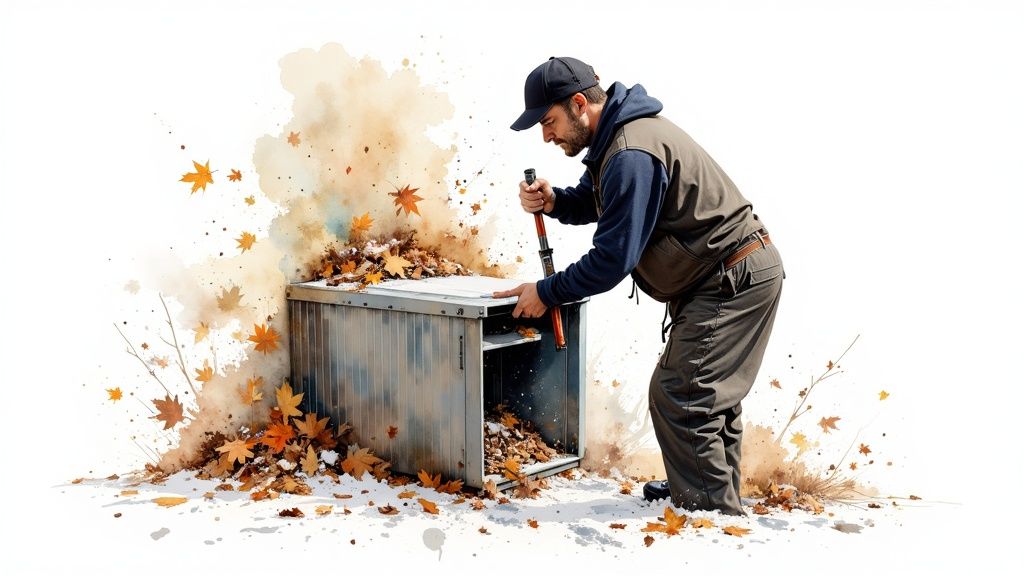
- Snow and Ice: After a heavy storm, snow can easily drift up and cover exterior vents.
- Leaves and Debris: Fall leaves, twigs, and even windblown trash can clog up vent openings.
- Nesting Critters: Small birds and rodents often find vents to be an ideal place to build a home.
Take a careful look at the vent terminations on the outside of your house. If you spot any obstructions, clear them away completely. This simple maintenance task can often solve shutdown issues in an instant and is a vital safety step for any homeowner with a gas-powered unit. You should never, ever operate a heater with a blocked vent.
Decoding Your Heater’s Error Codes
When your heater shuts down, it almost always flashes an error code on its digital display. That code isn’t just a random set of numbers; it’s a direct message from the unit telling you precisely what it thinks is wrong. Don’t just reset it and hope for the best—grab your owner’s manual (or find it online) and look up what that specific code means.
Understanding these codes can be empowering. Some point to easy fixes you can handle yourself, while others are a clear sign that you need to call a professional right away.
| Error Code Category | Example Meaning | What You Should Do |
|---|---|---|
| Flow-Related Codes | Insufficient water flow detected | Clean faucet aerators and check water supply |
| Ignition Failure Codes | Gas supply issue or faulty igniter | Check that your gas is on; otherwise, call a pro |
| Venting/Exhaust Codes | Blockage in the air intake or exhaust | Immediately inspect and clear vents |
| Overheat Codes | High-limit switch tripped | Turn the unit off and call for professional service |
Some of these issues, like cleaning a filter or clearing a vent, are things a confident homeowner can handle. But when you see codes related to gas pressure, internal sensors, or overheating components, it’s time to stop. These are clear signs that you need to call our team at Professional Plumbers Denver. Trying to fix these complex tankless hot water heaters problems on your own can be dangerous and could easily void your warranty.
What to Do When Your Tankless Heater Fails to Ignite or Water Pressure Plummets
https://www.youtube.com/embed/mDKj19Hnhd0
You turn the shower handle, expecting a rush of hot water, but all you get is cold. It’s a frustrating moment, and a classic sign of an ignition failure. This is one of the most common tankless hot water heaters problems we see in the Denver area, and it simply means the unit isn’t kicking on to heat the water. Before you panic, let’s walk through what might be happening.
For Gas Heaters: Is It Getting Fuel?
With gas models, we always start with the most basic question: is gas actually getting to the unit? First, make sure the gas valve connected to your heater is switched to the “on” position. An easy way to confirm gas flow to your house is to check another gas appliance, like your stovetop. If the burners light up, you know gas is flowing.
Next, have someone turn on a hot water tap while you listen closely to the heater. You should hear a distinct click, click, click—that’s the sound of the electronic igniter doing its job.
If there’s no clicking sound at all, the problem is likely electrical. But if you hear the clicks and the burners still don’t fire up, you could be looking at a dirty igniter or a faulty flame sensor. These tiny parts get covered in grime and can’t detect the flame, so the unit shuts down as a safety precaution.
For Electric Heaters: Checking the Power
Electric tankless heaters have their own troubleshooting checklist, and it begins at your main electrical panel. Find the breaker for your water heater; it’s usually a big, double-pole breaker. If it’s tripped, you’ll see it shifted to the middle or “off” position. Flip it all the way off, then back on to reset it.
But be careful. If that breaker trips again right away, don’t just keep resetting it. This is a red flag for a bigger electrical problem, and it’s time to call in a pro. Another possibility is a tripped high-limit switch, which is a safety feature that cuts power if the unit gets too hot. Check your owner’s manual to find it and see how to reset it.
Expert Insight: An electric heater that constantly trips its breaker is often screaming for help. More often than not, it points to a failing heating element that’s shorting out and drawing too much power. That’s a clear signal to put down the tools and pick up the phone.
Low Water Pressure: The Sneaky Culprit
Here’s something that surprises a lot of homeowners: many so-called “ignition failures” have nothing to do with the heater itself. The real problem is low water pressure. Tankless units are designed with a flow sensor; they won’t even try to ignite unless water is moving through at a certain speed—typically around 0.5 Gallons Per Minute (GPM).
If the flow is too weak, the unit stays off. Simple as that.
Luckily, the fix is often just as simple. The number one cause of low flow is a clogged faucet aerator or showerhead. Mineral buildup from our hard Denver water can clog these little screens, choking off the flow. Just unscrew them, soak them in a cup of vinegar for an hour, and rinse them out. You’d be amazed how often this solves the problem instantly.
If cleaning the aerators doesn’t do the trick, you might have a bigger pressure issue on your hands. We cover that in more detail in our guide on troubleshooting low water pressure throughout your home.
DIY Fixes vs Professional Service Calls
So, how do you know when to tackle an issue yourself versus when it’s time to bring in the experts at Professional Plumbers Denver? Sometimes the problem is a bad gas valve, a failed sensor, or a wiring issue that requires a trained eye. This table can help you make the right call.
| Problem Symptom | Potential DIY Action | When to Call a Professional Plumber |
|---|---|---|
| No “click” sound from gas heater | Check your circuit breaker to ensure the unit has power. | If power is confirmed and the unit still won’t spark. |
| Breaker for electric heater trips | Reset the breaker one time. | If it trips again immediately or does so repeatedly. |
| Low hot water pressure at one faucet | Unscrew and thoroughly clean the faucet aerator. | If pressure is weak at all faucets across the house. |
| Heater clicks but won’t ignite | Confirm other gas appliances in your home work. | If the gas supply is on but ignition consistently fails. |
Deciding what you can safely handle is key. Simple cleaning and basic resets are fine for most homeowners, but for anything involving gas lines or persistent electrical faults, your safety is paramount. That’s when a professional diagnosis isn’t just a good idea—it’s essential.
Still Have Questions About Tankless Water Heaters?
Even after troubleshooting a specific problem, you probably still have some general questions floating around. That’s completely normal. Getting good answers is key to making smart choices about maintenance, knowing when to upgrade, and deciding if a tankless system is even right for your home in the first place. Let’s walk through some of the most common questions we get from homeowners here in Denver.
How Often Do I Really Need to Service My Tankless Heater in Denver?
Here in Denver, with our notoriously hard water, you should treat annual servicing as non-negotiable. Seriously. The single most important thing we do during a service call is descale the unit to get rid of all that mineral gunk that strangles efficiency and leads to major breakdowns.
Ignoring this simple task is, without a doubt, the number one reason we see these systems fail prematurely.
Now, if you have a whole-home water softener, you might be able to push that service window out to every 18 or maybe even 24 months. But you should always, always check what the manufacturer recommends for your specific model first.
Beyond the internal flush, get into the habit of giving the intake and exhaust vents a quick look each season. You’d be surprised what can get in there—leaves in the fall, snow drifts in the winter, and even little critters building nests in the spring.
Are Tankless Heaters Worth It If They Can Be So Finicky?
Absolutely, but they come with two huge caveats: they have to be installed correctly from day one, and you have to keep up with the maintenance. The overwhelming majority of serious tankless hot water heaters problems we see are tied directly to a failure in one of those two areas.
When a licensed pro sets it up and you have it serviced annually, a tankless unit absolutely delivers on its promises. You get incredible energy efficiency, truly endless hot water, and a system that can easily last twice as long as an old-school tank heater. The trade-off for those fantastic long-term benefits is the higher upfront cost and the commitment to that yearly maintenance.
Why Isn’t My Brand-New Tankless Heater Getting the Water Hot Enough?
This is a super frustrating one, but it usually comes down to a few common culprits. First, check the obvious: what’s the temperature setting on the unit itself? It’s easy for it to be accidentally set too low. Many come from the factory set to a conservative 120°F for safety.
Next, you have to understand a concept we call “temperature rise.” Your heater is rated to raise the incoming water temperature by a specific number of degrees. In the dead of a Denver winter, the tap water coming into your home can be brutally cold, sometimes down in the 40s. If your unit is undersized for your home, it will physically struggle to raise that frigid water all the way up to your target, leaving you with lukewarm showers.
A less common, but tricky, cause can be crossed plumbing lines. If a hot and cold line are mistakenly connected somewhere in your house, cold water will constantly mix into the hot supply, dropping the temperature you feel at the tap.
A Quick Word on DIY Installation: Look, I get wanting to save a few bucks upfront. But unless you are a professional plumber with electrical experience, please don’t attempt this yourself. Improper installation is the root of countless performance headaches and can create genuine safety hazards, from gas leaks to deadly carbon monoxide venting failures.
So, Can I Install a Tankless Water Heater Myself?
Technically, yes. But should you? It’s a huge risk. Installing a tankless water heater is a complex job that involves high-voltage electrical work, intricate plumbing, and, for most models, natural gas lines. One little mistake with the venting can be incredibly dangerous, and a bad gas connection can be catastrophic.
Putting the serious safety risks aside for a moment, almost every manufacturer will instantly void the warranty if the unit isn’t installed by a licensed professional. Any money you thought you saved on the installation will vanish the second you have to pay out-of-pocket for a major repair that should have been covered. It’s just not worth the gamble.
When you’re facing complex tankless hot water heaters problems or you’re ready to have a new unit installed to the highest professional standards, don’t leave it to chance. The experts at Professional Plumbers Denver have the specialized training and field experience to make sure your system runs safely and efficiently for years. Contact us today for a professional consultation.

Recent Comments