
Picture this: it’s 2 AM, and you’re jolted awake by the sound of rushing water. That’s not a sound you ever want to hear inside your house. In that moment, knowing how to shut off your home’s main water supply is the one thing that stands between a manageable puddle and a full-blown, catastrophic flood. This isn’t just a random plumbing tip; it’s a core skill for protecting your home.
Why Every Homeowner Needs This Skill
Honestly, learning this simple task is one of the best things you can do for your peace of mind. It can literally save you thousands of dollars in water damage repairs. We’re talking about the difference between a quick mop-up and needing to call in the contractors for a major renovation.
It’s not just for burst pipes, either. You’ll need to shut off the water for all sorts of common situations:
- Stopping a Flood in Its Tracks: When a washing machine hose lets go or a supply line under the sink cracks, it can dump an incredible amount of water in minutes. Shutting off the main stops the disaster immediately.
- DIY Plumbing Projects: Thinking about swapping out that old bathroom faucet or installing a new dishwasher? The first, non-negotiable step is always turning off the water to the whole house.
- Heading Out of Town: If you’re leaving for a vacation, shutting off the water is a smart move. It completely removes the risk of coming home to a soggy, heartbreaking surprise.
Being Ready for the Big Stuff
This skill becomes even more crucial during larger emergencies. Think about how often we hear about water-related disasters on the news. It’s a sobering fact, but 90% of all natural disasters involve water in some way, from massive floods to droughts that can mess with our water systems. You can read more on this in the World Economic Forum’s Global Risks Report. Knowing how to control your home’s water is a key part of any solid family emergency plan.
Knowing where your water main is and how to use it changes your entire perspective. You go from hoping a disaster never happens to knowing you’re ready if it does. It’s probably the most empowering ten-minute lesson a homeowner can learn.
When you know how to do this, you’re no longer just a resident—you become the first line of defense for your property. It’s a fundamental skill that safeguards your home, your belongings, and your bank account from the unexpected.
Locating Your Home’s Main Water Shutoff Valve
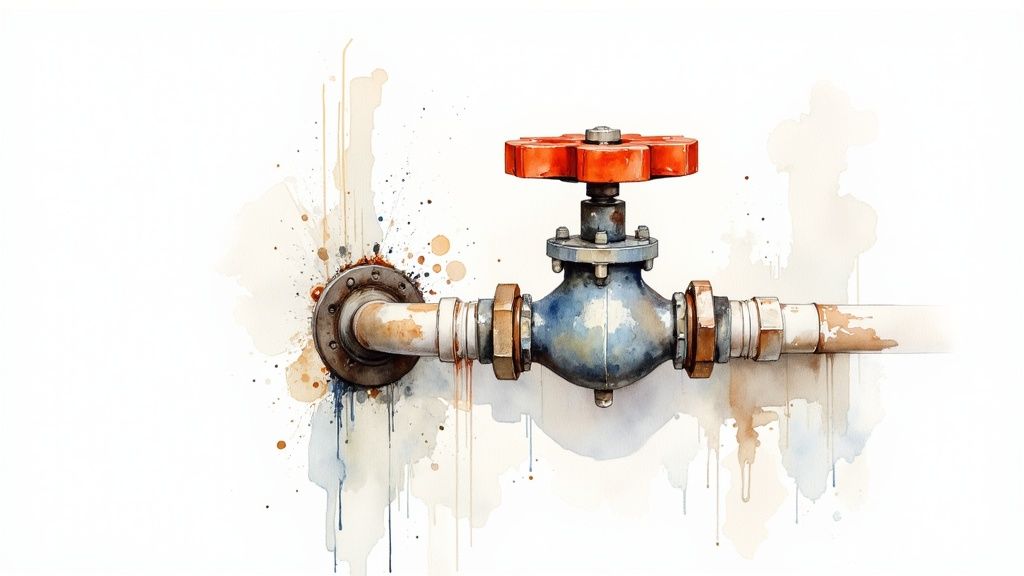
Every homeowner should go on one crucial mission: find your main water shutoff valve before you actually need it. Trust me, when water is spraying everywhere, the last thing you want is to be on a frantic scavenger hunt for a mystery valve. Where you’ll find it really depends on your home’s age, its layout, and most critically, the local climate.
The valve is almost always located where the main water line first enters your house. Picture the water pipe’s journey from the street to your home; the shutoff will typically be on the first interior wall it meets, usually at the front of the house.
For homes with basements or crawl spaces, that’s your starting point. Scan the perimeter walls, especially the one facing the street. Look for a pipe coming through the concrete foundation, often near your water heater. You’re looking for a valve with either a round, wheel-like handle (a gate valve) or a single, straight lever (a ball valve).
Common Interior Hiding Spots
What if you don’t have a basement? If your house is built on a concrete slab, your search moves to other common spots. Check inside your garage or a first-floor utility closet. Again, focus on the wall that faces the street or your water meter. Sometimes, builders hide these things behind small access panels, so keep an eye out for a little square cover on the drywall that doesn’t seem to have a purpose.
Here in Denver and other regions with cold winters, the valve is almost always installed inside. This is a critical design choice to protect the pipe from freezing and bursting during our harsh winters.
Here’s a fantastic pro tip: Go outside and find your water meter, which is usually in a box near the curb. Now, imagine a straight line from that meter to the closest wall of your house. The main shutoff valve will almost always be on the other side of that wall. It’s the most reliable clue you’ve got.
Searching Outside Your Home
In parts of the country with milder winters where freezing isn’t a constant threat, it’s not unusual to find the main shutoff valve outside. You might spot it on an exterior wall, often close to an outdoor faucet.
In some cases, the main shutoff is actually located out by the street in an underground utility box. This is often called a curb stop or curb valve. This box is typically recessed into the lawn or sidewalk and has a heavy metal lid. Opening it and turning the valve often requires a special long-handled tool called a curb key, and it’s usually best to check with your local water utility before you try to operate it yourself.
To help you narrow down your search, I’ve put together a quick reference table. It’s a great starting point for figuring out where your valve is most likely hiding.
Where to Find Your Main Water Shutoff Valve
| Location Type | Specific Place to Check | Climate Considerations |
|---|---|---|
| Basement/Crawl Space | Along the front foundation wall, near other utilities. | This is the standard for colder regions like Denver. |
| Garage or Utility Closet | On an interior wall facing the street, sometimes behind a panel. | Very common for homes built on slab foundations. |
| Exterior of Home | On an outside wall near a hose spigot or in a ground-level box. | Primarily found in warmer climates where freezing isn’t a risk. |
Using these clues should get you right to the valve. Once you find it, make sure everyone in the household knows where it is and how to turn it off.
Getting the Right Tools for the Job
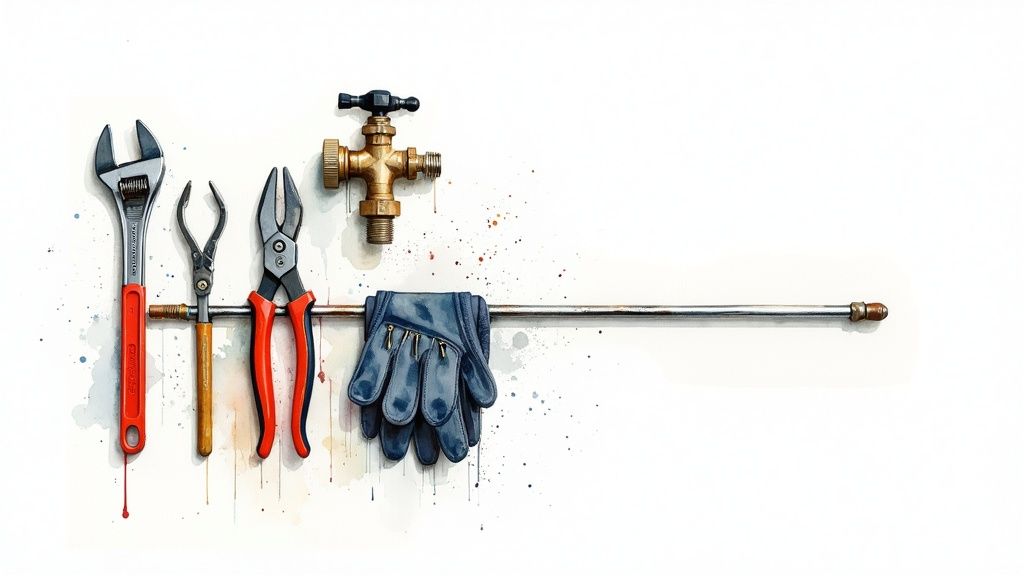
Alright, you’ve located your main water valve. Now what? Your next move depends entirely on which type of valve you’re looking at. Homes typically have one of two kinds, and knowing the difference is key to shutting off your water without causing more problems.
You’ll either have a gate valve or a ball valve. Gate valves have a round, spigot-like handle and are pretty common in older homes. To close one, you’ll turn it clockwise—remember “righty-tighty”—several times until it stops. Go slow and steady.
Newer homes almost always have a ball valve, which is the one with a lever handle. These are much faster. A simple quarter-turn (90 degrees) is all it takes. When the handle is parallel to the pipe, water is flowing. When it’s perpendicular, it’s off. Simple as that.
Your Go-To Shutoff Kit
In a perfect world, the valve would turn easily by hand. But after years of sitting untouched, collecting dust and mineral deposits, they can get incredibly stubborn. Having a few basic tools ready before an emergency will save you a world of panic.
Here’s what I recommend keeping nearby:
- A good pair of gloves: For a better grip and to protect your hands.
- A bright flashlight: You’ll probably be in a dark basement corner or a cramped crawl space.
- An adjustable wrench: This gives you the leverage you need for a stiff gate valve.
Expert Tip: If you apply moderate pressure and the valve won’t budge, stop right there. Don’t force it. You risk shearing off the handle or breaking the valve stem, which turns a simple leak into a full-blown flood. When a valve is seized up like that, it’s time to call in a pro.
For a more complete list of what you should have on hand, we put together a guide on the most essential plumbing tools for any homeowner.
The Curb Key: Your Last Resort
What if the valve inside your house is broken or you need to shut the water off at the source? For that, there’s another shutoff valve out by the street, usually under a small metal lid in your lawn or sidewalk. Accessing it requires a special tool called a curb key—a long, T-shaped wrench designed specifically for this job.
A word of caution, though: in most areas, including Denver, that street-side valve is technically the property of the water utility. They prefer that only their trained personnel operate it. Before you ever try to use a curb key, it’s smart to check with your local water department first. Tampering with it could land you in hot water, no pun intended.
How to Safely Shut Off Your Main Water Supply
When a pipe bursts and water is spraying everywhere, it’s easy to panic. But the absolute best thing you can do is take a breath and act deliberately. Your goal is to get that main water valve shut off without accidentally causing more damage.
The key here is a slow, steady hand, especially if you’re dealing with an older, round-handled gate valve. You’ll want to turn the handle clockwise—just remember “righty-tighty”—until you feel it come to a gentle stop. Whatever you do, don’t try to force it any further.
If your home is newer, you probably have a ball valve with a lever handle. These are much simpler. Just give the lever a quarter-turn (90 degrees). When the handle is parallel to the pipe, water is flowing. When it’s perpendicular to the pipe, it’s closed. Simple as that.
A Quick Word on Water Hammer
So, why the big deal about turning the old gate valves slowly? Because turning it too fast can trigger a water hammer. This is a massive pressure spike that happens when all that moving water in your pipes slams to a sudden stop. It creates a shockwave that can shake your entire plumbing system, possibly damaging joints or even causing a new pipe to burst somewhere else. A little patience here prevents a much bigger headache.
This image sums up the key actions for shutting things down safely.
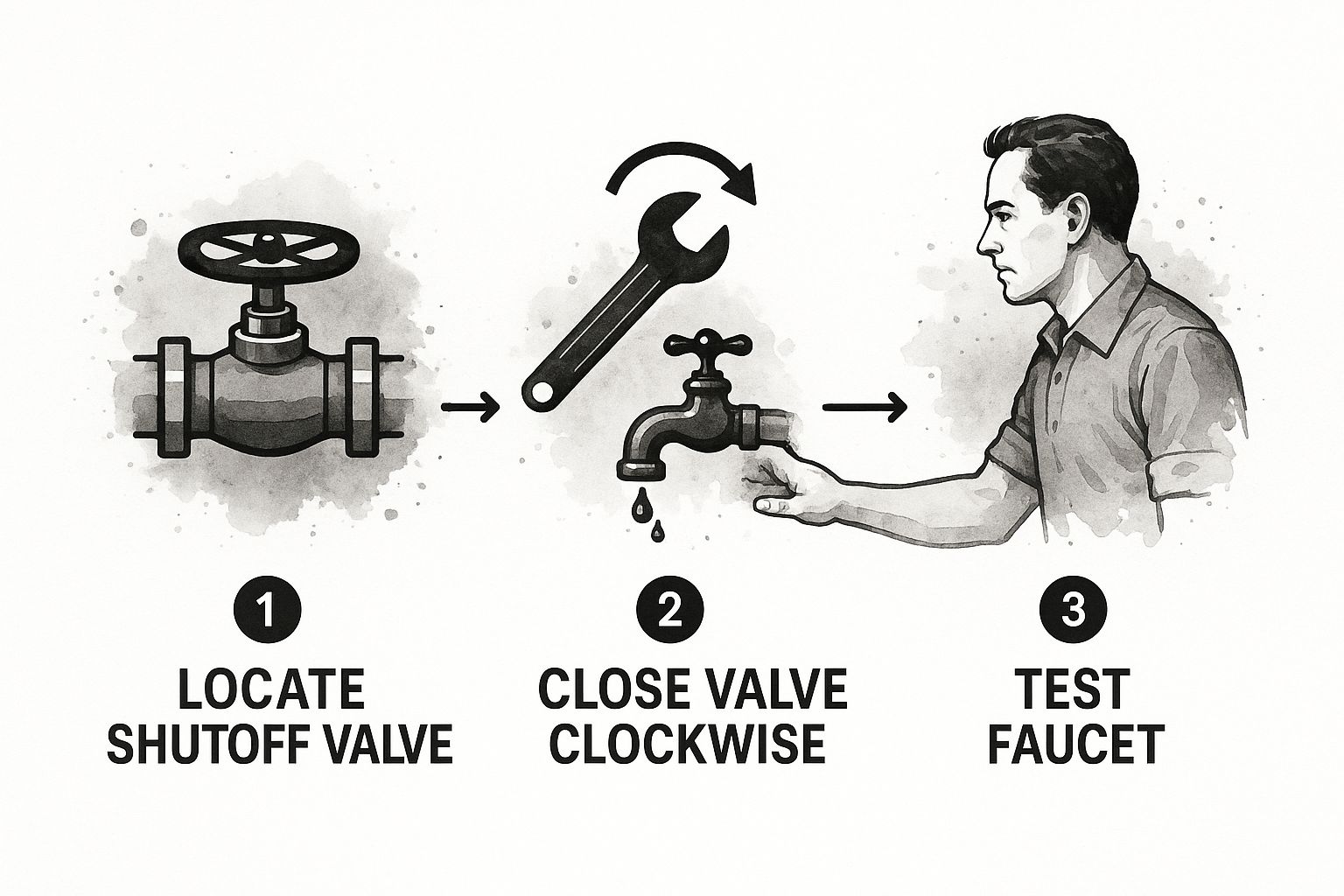
As you can see, it’s all about finding the valve, using the right motion to close it, and then confirming the water is actually off.
Don’t Skip This Final, Crucial Step
Okay, the valve is closed. You’re not done yet, though. This next part is something people forget all the time, but it’s absolutely essential: you need to drain the water that’s still sitting in your pipes.
Here’s the right way to do it:
- First, go to the highest floor in your house and open a faucet completely. A bathroom sink on the top floor is perfect.
- Next, head to the lowest point in your home and open a faucet there. This could be a basement laundry sink or an outdoor hose bib.
Opening that top faucet lets air into the pipes, breaking the vacuum. Gravity then takes over, pulling all the remaining water down and out through the lower faucet. This depressurizes the whole system, which is critical for making any repairs safer and stopping any leftover water from continuing to cause damage. Knowing what to do after a burst pipe is half the battle, and this step is a non-negotiable part of the process.
Knowing When to Call a Professional Plumber
While every homeowner should feel confident enough to shut off their main water supply for a burst pipe or a planned repair, some situations are best left to the pros. Honestly, knowing your limits is one of the most important skills you can have. Your safety and your home’s well-being should always be the top priority.
Trying to force a stubborn valve can quickly turn a manageable problem into a full-blown, expensive catastrophe. If you find your main shut-off valve and it’s heavily corroded, rusted stuck, or already leaking, just stop. Don’t touch it. The same goes if you apply firm, steady pressure and the handle won’t budge at all. These are all clear signs that it’s time to call for backup.
When DIY Becomes a Liability
Some plumbing jobs are just beyond the scope of a typical homeowner’s toolset and experience. Pushing ahead can cause serious damage, sometimes even requiring professional home repair contractors to fix the aftermath.
The decision to call for help isn’t a failure—it’s a strategic choice to protect your investment. A licensed plumber has the specialized tools and experience to replace a seized valve safely, preventing a catastrophic break that could flood your basement.
On a larger scale, poor water management has massive economic consequences. Projections show that by 2050, high water stress could impact 31% of global GDP—that’s a staggering $70 trillion. It really puts into perspective how vital proper plumbing infrastructure is for everyone.
At the end of the day, if you feel unsure or the situation seems out of your control, making that call is always the right move. To help you recognize those moments, we’ve put together a guide on the most common plumbing emergencies in Denver homes and how to approach them.
Common Questions About Your Water Main
https://www.youtube.com/embed/GRPcHwH0Kx8
Even after you’ve got the basics down, it’s natural for a few “what-if” scenarios to run through your mind. Plumbing problems can be stressful, but knowing the answers to a few common questions will help you feel much more in control when you need to turn off water main access. Let’s walk through them.
What if My Main Water Shutoff Valve Is Stuck?
This happens more often than you’d think, especially with older, less-used gate valves. The most important thing to remember is do not force it. Trying to muscle a stuck valve can snap the handle right off, or worse, break the valve stem. That’s how a manageable problem quickly becomes an emergency flood inside your home.
If you’ve given it a firm but reasonable turn with a wrench and it’s not cooperating, stop. The safest move is to call a licensed plumber. They have the right tools and, more importantly, the experience to either free a seized valve or replace it without causing a bigger mess. It’s a small price to pay to avoid thousands in water damage repairs.
Should I Turn Off My Water Heater After the Main Is Off?
Yes, without a doubt. This is a crucial safety step that many homeowners miss.
- For electric water heaters: The heating elements are designed to be surrounded by water. If the tank drains while the power is still on, those elements can overheat and burn out in seconds.
- For gas water heaters: When you turn the water back on, the sudden rush can stir up sediment from the bottom of the tank. This gunk can get sucked into the burner assembly and cause clogs or damage.
Always head to your circuit breaker and flip the switch for an electric heater. For a gas model, turn the control knob to the “Pilot” or “Off” setting.
Key Takeaway: Shutting off the main water supply is only half the job. Always remember to power down or turn off the gas to your water heater to prevent burnout or damage. This simple action protects one of your home’s most expensive appliances.
How Can I Be Sure the Water Is Completely Off?
You’ll want to double-check that the valve did its job. The easiest way is to test it.
Once you’ve turned the main valve as far as it will go, walk over to the lowest faucet in your house—a basement utility sink or a first-floor bathtub is perfect. Bathtubs are a great choice because they don’t have aerators that can get clogged by any stirred-up sediment.
Turn on both the hot and cold taps. You should see the water pressure fall off almost immediately, slow to a trickle, and then stop completely within about a minute as the remaining water drains from the pipes. If you still have a steady flow, your valve isn’t fully closed or it might be broken and needs professional attention.
When you’re dealing with a stubborn valve or a plumbing issue that feels over your head, don’t risk it. The team at Professional Plumber Denver has seen it all and has the right tools for any challenge, from emergency leak repairs to full valve replacements. Protect your home and get peace of mind by getting help from the pros.

Recent Comments