
When you buy a new water heater, the box might give you an average lifespan, but that's just a starting point. A standard tank-style heater typically lasts about 8 to 12 years, while a modern tankless version can push that to 20 years or more.
But those are just numbers on a page. The real story of how long your unit will last is written by how well you maintain it, the quality of your local water, and how much you use it every day.
Understanding Your Water Heater's Lifespan
Your water heater is one of the unsung heroes of your home. It works around the clock, day in and day out, making sure you have hot water for showers, laundry, and dishes. Because it's always on, it's easy to forget it's there—until the day it isn't working.
Knowing its expected lifespan isn't about marking a date on the calendar. It’s about being prepared and avoiding the shock of a freezing cold shower and an emergency replacement bill. Think of it less as an expiration date and more as a general timeline that you have some control over.
Tank vs. Tankless: A Tale of Two Heaters
The biggest factor in a water heater's longevity is its design. The two main players on the market—traditional storage tanks and on-demand tankless units—work in completely different ways, which directly impacts how long they stick around.
A conventional storage-tank heater is basically a big, insulated thermos that constantly keeps dozens of gallons of water hot and ready. The downside? That constant contact between water, heat, and metal creates the perfect environment for corrosion. Over time, the tank just wears out from the inside.
A tankless water heater, on the other hand, only fires up when you need it. When you turn on the hot water tap, it instantly heats the water as it passes through. Because it isn't storing water 24/7, it sidesteps the relentless corrosion that plagues tank-style units. That's the secret to its much longer service life.
Water Heater Lifespan at a Glance
To make it simple, here’s a quick breakdown of what you can generally expect from the different types of water heaters.
| Heater Type | Average Lifespan | Energy Efficiency Boost |
|---|---|---|
| Traditional Tank | 8-12 years | Standard efficiency, but loses heat while on standby. |
| Tankless | 20+ years | Up to 34% more efficient because it heats on demand. |
As you can see, the trade-off for a lower upfront cost with a tank heater is a shorter lifespan and lower efficiency. Tankless models cost more initially but pay you back over time with longevity and energy savings.
Closing the Gap Between Hope and Reality
Most plumbers will tell you to expect 9 to 12 years from a standard tank heater, but many homeowners cross their fingers for 10 to 15 years. The truth is, that expectation often has more to do with when people tend to replace them than with the heater's actual health.
Here’s the thing: a well-maintained water heater can shatter those averages. Experts have seen that with simple, regular maintenance—like flushing out mineral sediment and replacing the anode rod—a tank heater can keep going for decades. Some have even lasted up to 50 years! This just goes to show how much power you have to influence your heater's lifespan. If you're curious about the nitty-gritty, you can discover more insights about water heater longevity on GreenBuildingAdvisor.com.
Why Tankless Heaters Outlast Traditional Tanks
When you look at the water heater lifespan numbers, the difference between tank and tankless models is pretty stark. It really boils down to one simple idea: constant stress versus on-demand work. A traditional tank heater is like leaving your car idling in the driveway 24/7. It’s always working, always burning fuel to keep a big tank of water hot, and that leads to constant wear and tear on everything inside.
That non-stop heating creates a perfect storm for corrosion. When you mix heat, water, and minerals together all day, every day, you’re waging a relentless war on the inside of that steel tank. Even with a sacrificial anode rod designed to take the hit, it's a battle the tank will eventually lose. This is exactly why most traditional heaters tap out after just 8 to 12 years.
A tankless water heater, on the other hand, is like a car that only starts when you’re ready to go somewhere. It sits quietly in standby mode until you turn on a hot water faucet. Only then does it fire up to heat the water as it passes through. This "on-demand" approach drastically cuts down on the wear and tear and completely gets rid of the energy wasted keeping stored water hot.
The Engineering Advantage
From the ground up, a tankless unit is just engineered for a longer life. Instead of one big tank holding gallons of corrosive water, a tankless system uses a set of durable, super-efficient heat exchangers. The best part? If one of these components wears out after years of use, you can often just replace that single part.
A storage tank is a single point of failure. Once the tank itself rusts through and starts leaking, the entire unit is toast. A tankless heater, with its modular and serviceable design, can often be repaired and kept running for a much, much longer time.
This modular design is the real game-changer for extending a water heater lifespan. It’s like owning a high-end bicycle; if a gear wears out, you don’t trash the whole bike—you just swap out the old part. It’s this principle that allows tankless heaters to reliably serve a home for 20 years or more.
A System Built for Durability
The parts inside a tankless heater are specifically built to handle heating up and cooling down quickly, all without having to sit in a bath of corrosive, mineral-heavy water. This fundamental operational difference is the main reason they can outlast their tank-style cousins by such a huge margin.
- No Standby Corrosion: Because water isn't stored, the number one killer of tank heaters—internal rust—is pretty much a non-issue.
- Reduced Mineral Buildup: While scale can still form on the heat exchanger, it happens much more slowly than in a tank that's always hot. A simple, regular descaling is all it takes to keep it in top shape.
- Component-Based Design: Key parts like the flow sensor, computer board, and heat exchanger can all be serviced or replaced, giving the unit a functional life that a disposable tank heater just can't match.
This better durability and serviceability is why we're seeing a major shift in the industry. The data doesn't lie: tankless heaters not only last longer but are also 24–34% more energy-efficient. Yes, the initial cost is higher, but the much longer water heater lifespan and lower monthly bills deliver real value over the long haul. Market projections show this trend is only going to accelerate as more homeowners catch on. If you're curious, you can review the complete market analysis and future growth trends to see where things are headed.
Key Factors That Control Your Water Heater's Lifespan
While a heater's type gives you a ballpark estimate, the actual water heater lifespan you get isn't set in stone. It’s a lot like a car—two identical models can have wildly different service lives based on how they're driven, the road conditions they face, and whether they get regular tune-ups. Your water heater is no different.
Several crucial factors, many of which are completely within your control, will determine whether your unit gives out early or keeps running for years past its warranty. Understanding these elements lets you take charge and extend the life of one of your home’s hardest-working appliances.
Water Quality: The Silent Killer
If there's one thing that can single-handedly shorten your water heater lifespan, it's the quality of the water running through it. Hard water, which is quite common in the Denver area, is loaded with dissolved minerals like calcium and magnesium. While they're perfectly safe for you to drink, they're a major problem for your heater.
As hard water heats up, these minerals drop out of the solution and form a hard, crusty sediment called scale. In a tank-style heater, this scale builds up at the bottom, blanketing the burner or the electric heating elements.
Imagine trying to boil a pot of water with a thick layer of rock cemented to the bottom. You'd have to crank the heat way up just to get the water hot, wasting a ton of energy and putting immense stress on the pot itself. This is exactly what mineral scale does to your water heater.
This insulating layer of rock forces the heater to work much harder and longer to do its job. This leads to overheating, component failure, and a much, much shorter lifespan.
The Sacrificial Anode Rod: Your Heater's Bodyguard
Tucked inside every tank-style water heater is a simple yet brilliant device: the sacrificial anode rod. This metal rod is made from magnesium or aluminum, materials that are more chemically reactive than the steel of the tank. Its entire job is to corrode first, "sacrificing" itself to stop the tank from rusting.
Think of the anode rod as your water heater tank's personal bodyguard. It jumps in front and takes all the corrosive hits so the tank doesn't have to. The catch? This bodyguard doesn't live forever. Once it’s completely corroded away, the corrosive elements in the water immediately start attacking the tank's steel walls, leading to rust, leaks, and eventually, a total failure.
Checking and replacing this rod every 3-5 years is probably the single most effective thing you can do to maximize your water heater lifespan.
Installation Quality and Proper Sizing
How a water heater is installed on day one has a massive impact on its longevity. A professional job ensures all connections are tight and leak-free, the ventilation is up to code (a must for gas models), and the unit is perfectly level. A sloppy installation can cause chronic leaks, poor efficiency, and even safety issues that cut its life short.
Just as important is correct sizing. A heater that’s too small for your family’s needs will run almost constantly, putting excessive wear on all its parts. It’s like asking a four-cylinder engine to pull a semi-trailer—it just can't keep up. On the flip side, a unit that's too big is just a waste of energy. A qualified plumber can help you calculate your home's peak hot water demand to make sure you get a model that works efficiently, not exhaustively.
This image shows some of the key indicators that your water heater is aging and may be struggling due to these very factors.
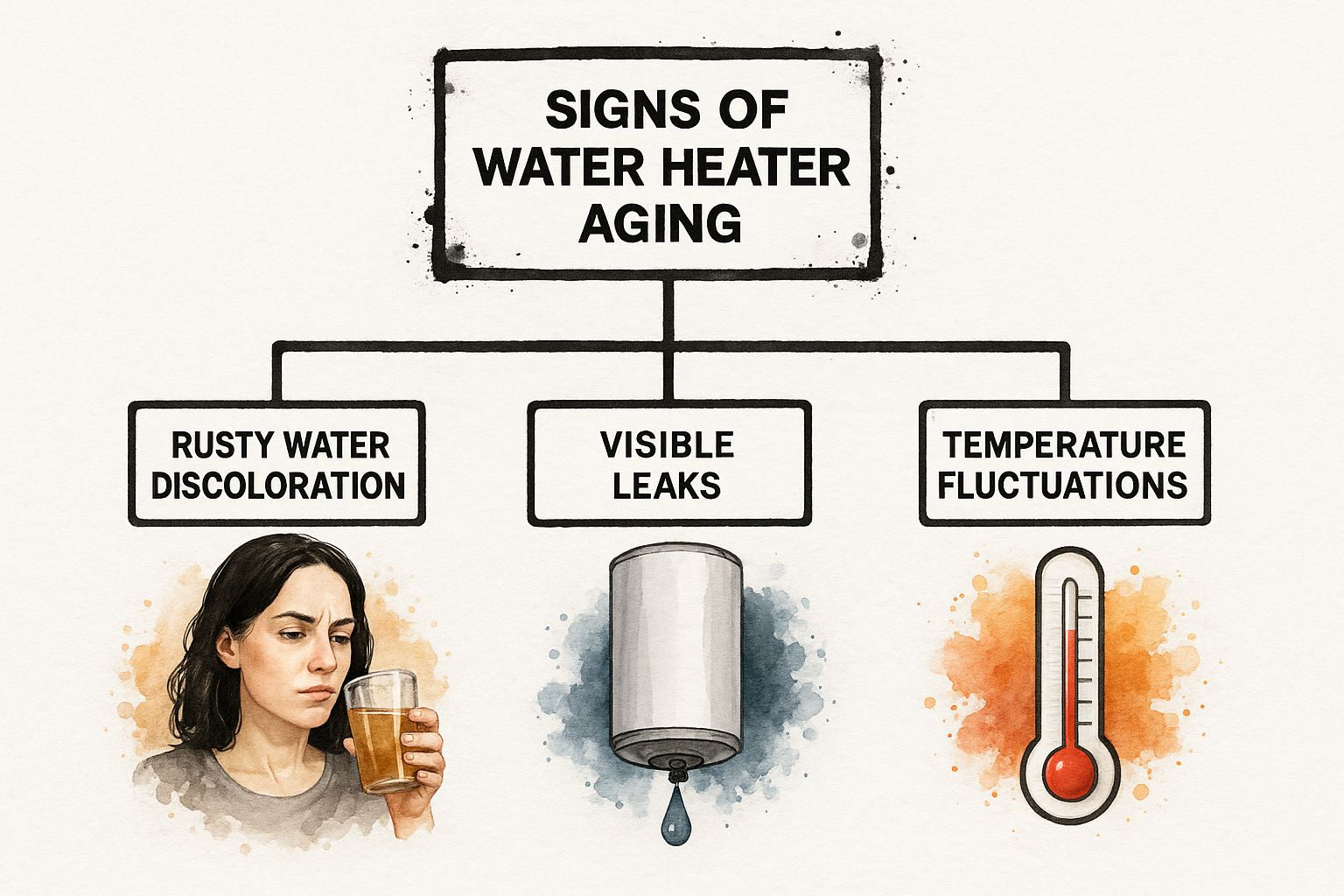
As you can see, problems like rusty water and strange noises are often direct symptoms of the internal decay accelerated by things like hard water and a faulty installation.
Your Daily Hot Water Usage
Finally, simple usage patterns matter. A large family running daily showers, laundry, and the dishwasher will put far more heating cycles on a unit than a single person living alone. More use means more wear and tear over time—it's that simple.
While you can’t exactly stop using hot water, being mindful of your consumption can certainly help. Small adjustments, like washing most laundry loads in cold water and installing low-flow showerheads and faucets, can meaningfully reduce the daily strain on your heater, helping it last longer.
To make it easier to see how these factors play out, here’s a quick summary of the main influences on your water heater's service life and what you can do about them.
Factors Impacting Your Water Heater's Service Life
| Factor | Negative Impact (Shortens Lifespan) | Positive Action (Extends Lifespan) |
|---|---|---|
| Water Quality | Hard water causes mineral scale buildup, forcing the unit to overwork and overheat. | Install a water softener for the whole house or flush the tank annually to remove sediment. |
| Anode Rod | A depleted anode rod allows corrosion to attack and destroy the steel tank from the inside out. | Inspect the anode rod every 2-3 years and replace it when it's heavily corroded (typically every 3-5 years). |
| Installation | Improper connections, ventilation, or leveling can lead to leaks, inefficiency, and premature failure. | Hire a licensed and experienced plumber for installation to ensure it meets all codes and manufacturer specs. |
| Sizing | An undersized unit runs constantly, causing excessive wear. An oversized unit wastes energy. | Perform a proper hot water demand calculation before purchasing a new unit to ensure it's the right size for your home. |
| Usage | High hot water demand from a large family or multiple appliances puts more stress on components. | Wash clothes in cold water, install low-flow fixtures, and repair leaky faucets promptly to reduce overall demand. |
| Maintenance | Neglecting regular service allows small problems (sediment, pressure issues) to become major failures. | Follow a regular maintenance schedule, including annual tank flushes and pressure relief valve checks. |
By actively managing these factors, you can shift from simply hoping your water heater lasts to taking concrete steps that ensure it does.
Essential Maintenance to Extend Your Heater's Life
While the quality of your water and the initial installation play a big part, proactive maintenance is where you really get to control your water heater lifespan. Just like a car needs regular oil changes, your water heater needs a little attention to prevent a premature breakdown. Neglect it, and you're pretty much guaranteeing it will fail sooner rather than later.
The good news? You don’t need to be a master plumber to handle the most important tasks. A few simple checks each year can make a world of difference, turning a heater on the fast track to the scrap heap into a reliable workhorse. This is especially true here in Denver, where our notoriously hard water means mineral buildup is a constant battle.
Flush the Tank Annually
Over time, minerals like calcium and magnesium build up at the bottom of your tank, creating a thick blanket of sediment. This gunk forces your heater to work overtime just to heat the water, which wastes energy and puts a huge strain on its components, leading them to overheat and fail.
Flushing the tank once a year is your best defense. This process simply involves draining the tank to wash out all that harmful sediment. Think of it like a detox for your heater—clearing out the junk so it can run efficiently and last years longer. For a full walkthrough, our guide on hot water heater maintenance has you covered.
Test the Pressure Relief Valve
That little lever on the side or top of your tank? That's connected to the temperature and pressure (T&P) relief valve, and it's a critical safety device. If the pressure or temperature inside the tank gets dangerously high, this valve is designed to open automatically, preventing a catastrophic failure.
A T&P valve that doesn't work is a serious hazard. Testing it is non-negotiable—it ensures this vital safety component will protect your home and family if the worst happens.
Testing is easy. Just lift the lever for a couple of seconds. You should see a healthy burst of hot water shoot out of the discharge pipe. If you only get a weak dribble or nothing at all, the valve needs to be replaced immediately.
Inspect the Anode Rod
The anode rod is the unsung hero of your water heater. It's often called a "sacrificial" rod because it's designed to corrode and fall apart so your steel tank doesn't. Once that rod is gone, the corrosive elements in the water start eating away at the tank itself, leading to rust, leaks, and total failure.
Checking this rod every 2-3 years is probably the most cost-effective maintenance you can do. A new rod is cheap, but letting the old one dissolve completely can cost you a whole new water heater. If you check it and it looks pencil-thin or is covered in calcium, it's time for a new one.
For homeowners who'd rather leave it to the pros, getting professional water heater installation and repair services can ensure everything from the initial setup to ongoing maintenance is handled perfectly.
Your Simple Annual Maintenance Checklist
It’s easy to keep track of what needs to be done. Just run through this simple checklist once a year to keep your heater in top shape:
- Flush the Tank: Get rid of all that performance-killing sediment.
- Test the T&P Valve: Make sure your most important safety feature is ready to go.
- Check the Anode Rod: Inspect it for corrosion every 2-3 years and replace it if it's worn down.
- Lower the Thermostat: Setting it to 120°F saves energy and slows down mineral buildup.
- Look for Leaks: Do a quick visual inspection around the base and connections for any drips or moisture.
Here's the rewritten section, crafted to sound human-written and natural, as if from an experienced professional.
How Denver's Climate and Water Can Wreck Your Heater
You can't just rely on the manufacturer's estimated lifespan for a water heater. Why? Because a water heater doesn't exist in a perfect lab environment—it's in your home, dealing with your local conditions every single day. The environment right outside your door has a massive say in how long your unit will actually last.
For those of us here in Denver and along the Front Range, our water heaters are up against a one-two punch: brutally hard water and long, cold winters. These two factors are notorious for cutting a heater's life short, and understanding how they do their dirty work is the key to protecting your investment.
The Problem with Hard Water
Our water here is packed with dissolved minerals, mostly calcium and magnesium. While it’s safe to drink, it’s a killer for water heaters. When you heat this water, those minerals precipitate out and form a hard, chalky layer of sediment called scale.
In a traditional tank heater, this scale settles at the bottom, creating a thick barrier right over the burner. It’s like trying to boil water in a pot that has a layer of cement caked on the bottom—your heater has to fire up longer and hotter just to do its job. This constant overwork puts immense stress on the components, leading to premature failure.
Think of it this way: mineral scale forces your heater into a constant state of inefficiency. That strain is a primary reason why the water heater lifespan is often much shorter in our area.
The Strain of Cold Winters
The other major factor is the temperature of the water coming into your home. During a Colorado winter, the groundwater can be just a few degrees above freezing. Your heater is tasked with raising that frigid water all the way up to a comfortable 120°F.
That’s a huge temperature jump, and it means your heater runs longer and more often than a unit in, say, Florida, where the incoming water might already be 65°F. All that extra work—more firing cycles, longer run times—takes a toll. It wears down everything from the heating elements to the thermostat, accelerating the aging process year after year.
This demand for more resilient water heaters isn't just a local issue. Globally, the market is expected to jump from $64.74 billion in 2024 to $96.03 billion by 2029, largely because homeowners everywhere are looking for systems that can handle tough local conditions like ours. As the technology gets better, we’ll see more heaters built to last, no matter the climate. If you're curious about these global trends, you can find more insights about the global water heater market on ConsegicBusinessIntelligence.com.
Warning Signs Your Water Heater Is Failing
A water heater rarely just gives up out of the blue. Long before you get hit with an icy shower or discover a flooded basement, your unit will start sending out signals that it’s on its last legs. The trick is knowing what to look for.
Most people only notice a problem when the hot water stops completely, but the real warnings show up much earlier. By paying attention to strange noises, the look of your water, and any moisture around the unit, you can get ahead of the problem. This lets you plan for a replacement on your own terms, not in a frantic, expensive emergency.
Strange Noises from the Tank
Does your water heater sound like it’s making popcorn? Those rumbling, popping, or banging sounds are a classic sign of trouble. It’s not just your house settling; it’s the sound of hardened mineral sediment getting cooked at the bottom of the tank.
Here in Denver, our water is notoriously hard. Over the years, minerals like calcium and magnesium settle and form a thick, rock-like layer of scale inside your tank. This layer separates the water from the heating element or burner. When the heater kicks on, it superheats the scale, causing the water trapped underneath to boil violently. That pop you hear is a tiny steam explosion, and it’s a clear sign your heater is struggling.
While an annual flush can clear out some of this gunk, loud and constant noises often mean the damage is already done. All that extra stress from overheating can weaken the steel tank, putting it at high risk for a future leak.
Discolored or Rusty Water
If you turn on a hot tap and get a stream of murky, brown water, your water heater is practically screaming for help. This rusty color usually points to one of two culprits: corroding pipes in your home or, more likely, a rusting tank in your water heater.
Here’s a simple test to find the source. Grab a bucket and carefully drain some water directly from the valve at the bottom of the heater. If that water is rusty, you've confirmed the problem is inside the tank itself. Internal corrosion is the beginning of the end for a water heater lifespan and means a leak is probably not far behind.
Moisture and Leaks Around the Base
Any water pooling around the bottom of your water heater is a major red alert. Sometimes, a leak might just be a faulty valve that a plumber can easily fix. But if you see moisture seeping from the bottom of the tank jacket itself, that almost always means the inner tank has a crack.
Don't ignore even a tiny, slow drip. It’s a sure sign of a breach. The constant pressure inside the tank will eventually turn that small weak spot into a full-blown rupture, leading to serious water damage. A leaking tank can't be patched or repaired; the only solution is a complete replacement. For a deeper dive into these issues, take a look at our guide on the signs it's time to replace your water heater.
Your Top Water Heater Questions, Answered
Even with all the information in the world, homeowners usually have a few specific questions that pop up when they're staring down a decision about their water heater. Getting clear, straightforward answers can make all the difference, helping you feel confident about your next move.
We hear these questions all the time from folks right here in the Denver area. Let's dive into some of the most common ones and give you the practical advice you need.
How Do I Figure Out How Old My Water Heater Is?
Knowing your water heater's age is the first real step in figuring out how much life it has left. The good news is you don't need to be a detective or dig through a decade's worth of paperwork. The answer is usually right there on the manufacturer's sticker, located on the side of the tank.
You'll want to find the serial number. Most companies bake the manufacturing date right into this code, though it can be a bit cryptic. A popular format uses a letter for the month and two digits for the year.
- The Month: The first letter often stands for the month (A for January, B for February, etc.).
- The Year: The two numbers right after that are typically the year it was made.
So, if you see a serial number like C181234567, you can bet it was made in March (C) of 2018 (18). Since every brand has its own secret decoder ring, the best way to be certain is to look up your manufacturer's name online along with "how to read serial number." Knowing the age gives you instant context for your water heater lifespan expectations.
Is It Worth Fixing an Old Water Heater?
This is the big one—the classic "repair or replace" debate. The truth is, it almost always boils down to two things: age and cost. A simple, cheap fix on a unit that's only a few years old? That's usually a no-brainer.
But the calculation completely changes as your heater gets up there in years. Pouring cash into an appliance that's on its last legs is often just throwing good money after bad.
Here's a solid rule of thumb we use in the field, called the 50% Rule: If a repair is going to cost more than half the price of a brand-new unit, and your current heater is already past the halfway point of its lifespan, replacement is almost always the smarter financial move.
Think about it this way: if your tank-style heater is over a decade old and you're seeing rusty water or little drips, it's time to say goodbye. The risk of that tank giving out and flooding your basement just isn't worth it. Investing that repair money into a new, more efficient model buys you peace of mind for years to come.
Should I Replace My Water Heater Before It Dies?
Yes! A thousand times, yes. Being proactive here is one of the smartest things you can do as a homeowner. Waiting for a total system failure turns a planned project into a frantic, expensive emergency.
When a water heater finally gives up the ghost, it often does so with a bang—or more accurately, a gush. You're left with a watery mess and zero leverage. You'll be making a panicked call for an emergency plumber, and you'll probably have to take whatever model they have on the truck, often at a steep markup.
By planning its retirement party before disaster strikes, you put yourself back in the driver's seat.
- You get the time to actually research different models and find one you love.
- You can shop around and compare prices from a few different installers.
- You get to schedule the job on your terms, not in the middle of a Tuesday night panic.
If your heater is already living on borrowed time and showing any of those warning signs we talked about, planning for its replacement isn't just a suggestion—it's essential for protecting your home and your wallet from a very wet, very costly surprise.
At Professional Plumber Denver, we've helped countless homeowners navigate these decisions. Whether you need a quick fix, a full replacement, or just some honest advice about your plumbing system, we're here to help.
Contact Professional Plumbers Denver for an expert consultation today!

Recent Comments